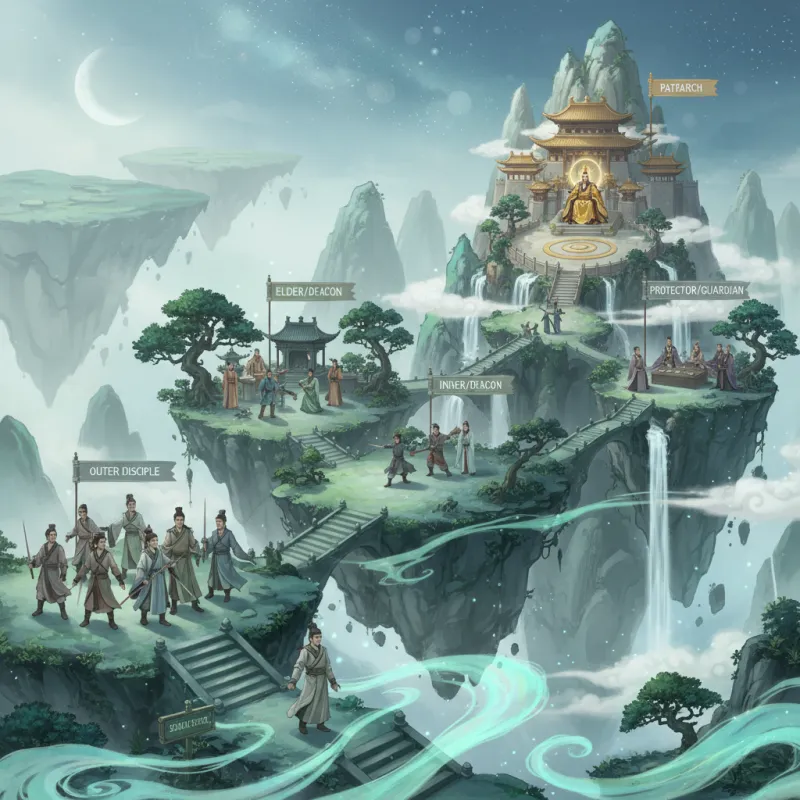
You're sweeping the same stone steps for the third time this week when a senior brother flies overhead on his sword, not even glancing down. He's an inner disciple—you're not. That single rank difference means he gets actual cultivation resources while you're rationed three spirit stones per month. Welcome to sect life, where the hierarchy isn't just about respect—it's about whether you get to cultivate at all or spend your twenties as glorified janitorial staff.
The Pyramid That Determines Your Destiny
Every cultivation sect operates on a rigid hierarchy that makes medieval feudalism look egalitarian. This isn't arbitrary—it's a resource allocation system. Spiritual energy, rare herbs, cultivation manuals, and elder guidance are finite. The sect can't give everyone the good stuff, so they create a ladder where each rung represents not just status, but access to the tools that determine whether you break through to the next realm or die trying.
The standard structure appears in everything from I Shall Seal the Heavens to A Record of a Mortal's Journey to Immortality. The specific titles might vary—some sects call them "disciples," others use "students" or "members"—but the functional roles remain identical. Understanding this hierarchy is like learning the rules of chess: once you know how each piece moves, you can play any game.
Outer Disciples: The Expendable Foundation
Outer disciples (外门弟子 wàimén dìzǐ) are the sect's probationary workforce. They've passed the entrance trials—usually some combination of spiritual root testing, basic aptitude evaluation, and age requirements—but they haven't proven themselves worthy of real investment. Think of them as unpaid interns who might get hired in five to ten years if they're exceptional.
Their daily reality is brutal. They receive the sect's most basic cultivation manual, typically a watered-down version that caps out at Foundation Establishment if they're lucky. They're assigned menial tasks: tending spirit herb gardens, maintaining protective formations, cleaning beast pens, or serving as sparring practice for inner disciples. In Renegade Immortal, Wang Lin spends years as an outer disciple doing exactly this kind of grunt work, which Er Gen uses to establish how disposable these disciples are to the sect's power structure.
The resource allocation is deliberately minimal. Three to five spirit stones per month. Access to the outer sect library, which contains techniques so basic they're practically public domain. One lecture per season from a Foundation Establishment elder who's clearly phoning it in. The sect isn't trying to cultivate these disciples—it's filtering them. Most will never advance beyond Qi Condensation. They'll age out, leave the sect, or die in the low-level missions the sect uses to cull the weak.
But here's the thing: outer disciples aren't completely without opportunity. The sect holds periodic competitions where top performers can earn bonus resources or even promotion to inner disciple status. These tournaments are vicious. You're not just competing against your peers—you're fighting for a chance at a real cultivation future versus a life of mediocrity. The sect encourages this cutthroat environment because it identifies the disciples with the drive and talent worth investing in.
Inner Disciples: Where Cultivation Actually Begins
The jump from outer to inner disciple (内门弟子 nèimén dìzǐ) is the first real threshold in a cultivator's life. This is where the sect starts treating you like an actual investment rather than disposable labor. Inner disciples receive proper cultivation manuals—techniques that can take you to Core Formation or even Nascent Soul if you have the talent. Their monthly resource allocation jumps to fifty or a hundred spirit stones. They get access to the inner sect library, private cultivation chambers, and regular guidance from Core Formation elders.
More importantly, inner disciples are freed from menial labor. They can focus on cultivation, though they're still expected to contribute through missions, sect defense, or teaching outer disciples. The sect has decided these individuals are worth developing, so it removes the obstacles that would slow their progress. In Coiling Dragon, the distinction between outer and inner disciples at the Ernst Institute follows this exact pattern—inner disciples get better teachers, better resources, and actual respect.
The competition doesn't disappear at this level—it intensifies. Inner disciples compete for core disciple positions, for the attention of powerful elders, for the right to enter secret realms or inherit special techniques. But it's a different kind of competition. Outer disciples fight to survive; inner disciples fight to excel. The sect has given them the tools to cultivate seriously, and now it's watching to see who makes the best use of them.
Core Disciples: The Sect's Future Leadership
Core disciples (核心弟子 héxīn dìzǐ) represent the sect's investment in its future. These are the individuals the sect believes can reach Nascent Soul or beyond, who might become elders themselves one day. The resource allocation reflects this: premium spirit stones, access to the sect's true inheritance techniques, personal guidance from Nascent Soul elders, and priority for any opportunities like secret realm expeditions or ancient ruins exploration.
A core disciple typically has a personal master—an elder who takes direct responsibility for their development. This relationship is crucial. The elder provides tailored guidance, protects the disciple from sect politics, and shares insights that can't be written in manuals. In A Will Eternal, Bai Xiaochun's relationship with his master exemplifies this—the elder's guidance and protection are as valuable as any cultivation resource.
Core disciples also gain authority. They can command inner and outer disciples, lead missions, and represent the sect in external affairs. They're being groomed for leadership, so the sect gives them opportunities to develop those skills. But this status comes with expectations. Core disciples are expected to contribute significantly to the sect—whether through alchemy, formation mastery, combat prowess, or other specializations. The sect has invested heavily in them, and it expects returns.
The number of core disciples is always limited. A sect might have thousands of outer disciples, hundreds of inner disciples, but only a dozen or two core disciples. This scarcity makes the position intensely competitive and politically charged. Core disciples often form factions, compete for the patriarch's favor, and maneuver for advantage. The sect tolerates this because it believes competition breeds excellence, though it will intervene if things threaten sect stability.
Elders: The Power Behind the Throne
Elders (长老 zhǎnglǎo) are the sect's true power base. These are cultivators who've reached Nascent Soul or higher—individuals who've transcended mortal limitations and achieved genuine immortality. They're no longer disciples being trained; they're the trainers, the decision-makers, the ones who determine sect policy and direction.
The elder structure typically has its own hierarchy. Junior elders might be early Nascent Soul cultivators who handle day-to-day sect operations—teaching, mission oversight, resource management. Senior elders are mid to late Nascent Soul, often specializing in specific domains like combat, alchemy, or formations. They form the sect's council and make major decisions collectively. Then there are supreme elders (太上长老 tàishàng zhǎnglǎo)—Soul Formation or higher cultivators who've mostly withdrawn from sect affairs but can be called upon in emergencies.
Elders have enormous autonomy. They can take personal disciples, pursue their own cultivation goals, and generally do as they please as long as they fulfill their sect responsibilities. In Martial World, the elder structure of the Sky Fortune Kingdom's sects follows this pattern—elders are semi-independent powers who cooperate because it benefits them, not because they're subordinate employees.
The relationship between elders and the patriarch is interesting. The patriarch has ultimate authority, but they can't simply dictate to elders who are themselves powerful cultivators with their own bases of support. Sect politics at this level is about coalition-building, favor-trading, and managing competing interests. A wise patriarch leads through consensus and respect; a foolish one tries to rule through force and usually ends up deposed or dead.
The Patriarch: Absolute Authority (In Theory)
The patriarch (宗主 zōngzhǔ) or sect master sits at the pyramid's apex. They're typically the sect's strongest cultivator—often Soul Formation or higher—and hold ultimate decision-making authority. They represent the sect in dealings with other powers, make final calls on major decisions, and serve as the sect's ultimate protector and symbol.
But here's what novels often gloss over: being patriarch is a political position as much as a cultivation one. You don't just need to be strong—you need the support of the elder council, the respect of the disciples, and the political acumen to navigate sect factions. In Reverend Insanity, Fang Yuan's observations about sect leadership emphasize this—patriarchs who rely solely on cultivation strength without political skill don't last long.
The patriarch's actual power varies by sect culture. In orthodox sects with strong institutional traditions, the patriarch is constrained by precedent and elder consensus. In demonic sects or those founded by a single powerful cultivator, the patriarch might have near-absolute authority. But even the strongest patriarch has to consider sect stability. Alienate too many elders, and you might find yourself facing a "cultivation deviation" that's actually a coordinated assassination.
Succession is always fraught. Some sects have clear rules—the strongest core disciple, the eldest elder, a vote by the elder council. Others leave it deliberately ambiguous, believing competition for the position will ensure only the worthy attain it. This often leads to bloody succession crises when a patriarch dies or ascends to a higher realm, which is why many novels use patriarch succession as a major plot point.
Special Positions: The Hierarchy's Complications
The basic hierarchy gets complicated by special positions that don't fit neatly into the ladder. Direct disciples (亲传弟子 qīnchuán dìzǐ) are personal students of the patriarch or supreme elders—they might technically be inner or core disciples, but their actual status and resources often exceed normal core disciples. They're being groomed for patriarch succession or elder positions.
Legacy disciples (传承弟子 chuánchéng dìzǐ) are chosen to inherit a specific elder's complete techniques and knowledge. This is a huge honor and responsibility—the disciple is expected to master and preserve their master's legacy, potentially passing it to their own disciples eventually. In Understanding Cultivation Realms, we discuss how these inheritance relationships affect cultivation progression.
Then there are enforcement disciples, alchemy disciples, formation disciples, and other specialists. These individuals might be inner disciples by rank but have authority in their domain that exceeds normal core disciples. An alchemy disciple who can produce Foundation Establishment pills is more valuable to the sect than a core disciple who's just good at fighting.
Some sects also have guest elders (客卿长老 kèqīng zhǎnglǎo)—powerful cultivators who affiliate with the sect without fully joining. They provide services in exchange for resources or protection but maintain independence. This arrangement benefits both sides: the sect gains access to expertise without full commitment, and the cultivator gets sect backing without sect obligations.
Why This System Persists
The sect hierarchy isn't just a narrative convention—it reflects the fundamental economics of cultivation. Spiritual energy, rare materials, and expert guidance are scarce. The sect can't give everyone everything, so it creates a filtering system that identifies the most talented and dedicated individuals and concentrates resources on them.
This is brutally unfair to those at the bottom, which is why so many xianxia protagonists start as outer disciples or rogue cultivators. The system is designed to be unfair—it's designed to produce a few exceptional cultivators rather than many mediocre ones. From the sect's perspective, this makes sense. One Nascent Soul elder is worth more than a thousand Qi Condensation disciples in terms of sect power and prestige.
But the system also creates opportunities for the ambitious. Every sect needs to recruit new talent to replace elders who die, ascend, or leave. The hierarchy provides a clear path: prove yourself at each level, and you'll advance. It's meritocratic in the sense that talent and effort are rewarded, even if the starting conditions are unequal. This is why protagonists can rise from outer disciple to patriarch—the system, for all its flaws, does allow exceptional individuals to climb.
Understanding sect hierarchy helps you appreciate the stakes in cultivation novels. When a protagonist is stuck as an outer disciple, you understand they're not just low-status—they're being denied the resources needed to cultivate effectively. When they become a core disciple, you recognize this as a fundamental shift in their trajectory. And when they clash with elders or the patriarch, you understand they're challenging the entire power structure that determines who gets to cultivate and who doesn't.
The sect hierarchy is the framework that makes cultivation society function. It's unfair, it's brutal, and it's absolutely essential to understanding how Sect Politics and Power Dynamics shape every xianxia story you'll read.
Related Reading
- Ancient Sects and Spiritual Realms in Chinese Cultivation and Xianxia Fiction
- The Rise of Sects in Chinese Cultivation Fiction: Paths to Immortality
- Cultivation Sects: The Corporations of the Immortal World
- Secret Realms: Hidden Dimensions of Power
- Secret Realms and Pocket Dimensions: Treasure Hunting in Cultivation Fiction
- Merchant Guilds and Trade Routes in Cultivation Worlds
- The Art of Immortal Cultivation: A Dive into Chinese Xianxia Fiction
- Mortal vs. Immortal Realm: The Two Worlds of Cultivation Fiction