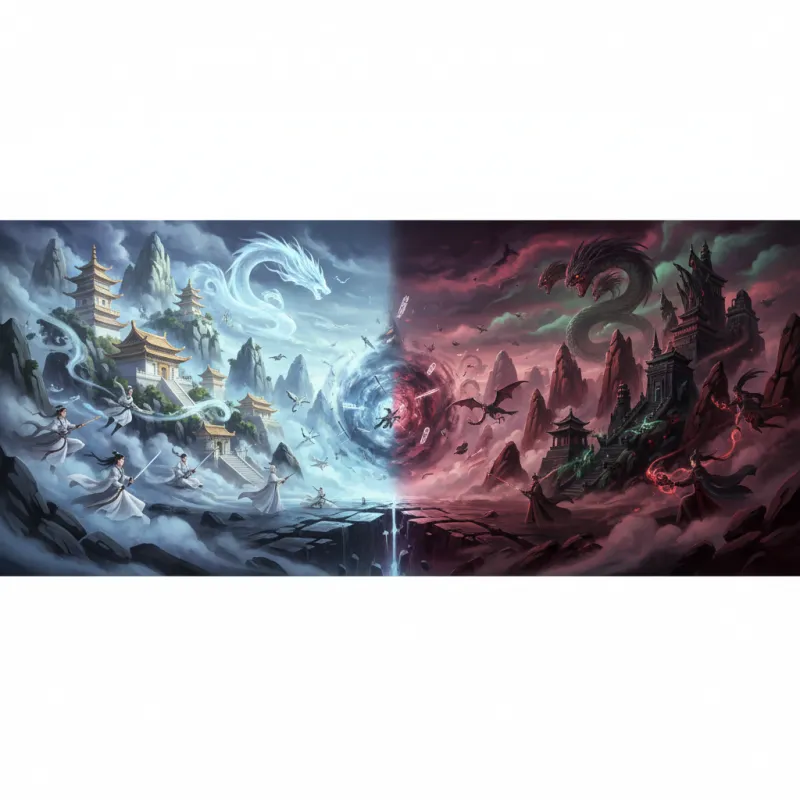
Every cultivation novel has that moment: the righteous sect elder, draped in pristine white robes, condemns a demonic cultivator for "slaughtering innocents" — right before ordering his disciples to massacre an entire village suspected of harboring a single demon spy. The hypocrisy is so thick you could cut it with a spiritual sword, yet this moral divide between righteous sects (正道 zhèngdào) and demonic sects (魔道 módào) remains the backbone of nearly every xianxia story worth reading. The question isn't whether this divide exists — it's whether it means anything at all.
The Righteous Playbook: Rules for Thee, Not for Me
Righteous sects love their rules. The Kunlun Sect, Emei Sect, Shushan Sword Sect — these pillars of the cultivation world built their reputations on strict moral codes that sound impressive until you examine them closely. They claim to follow the heavenly dao (天道 tiāndào), protect mortals, punish evildoers, and maintain cosmic balance. Noble stuff.
The reality? Their definition of "evildoer" shifts based on political convenience. In Renegade Immortal (仙逆 Xiān Nì), Wang Lin discovers that righteous sects will happily slaughter entire families to obtain rare cultivation resources, then justify it as "preventing future calamities." The Heavenly Dao Alliance in I Shall Seal the Heavens orchestrates genocides against smaller sects, calling it "maintaining order." When you control the narrative, every atrocity becomes a necessary sacrifice.
Righteous sects typically prohibit certain cultivation methods: no blood refinement, no soul devouring, no corpse puppetry, no dual cultivation with unwilling partners. These restrictions sound ethical until you realize they're often about monopolizing power rather than morality. Techniques that allow rapid advancement without requiring centuries of resource accumulation? Banned. Methods that don't depend on sect-controlled spirit veins and treasure vaults? Heretical. The orthodox cultivation methods conveniently require exactly the resources that righteous sects hoard.
The Demonic Path: Honest About Being Terrible
Demonic cultivators, at least, don't pretend. They practice blood refinement (炼血 liànxuè), harvest souls, create corpse armies, and generally do whatever accelerates their cultivation. The Blood River Sect doesn't hold press conferences explaining why draining a city of its life force was actually a humanitarian intervention. They did it for power. End of story.
This brutal honesty makes demonic sects paradoxically more trustworthy in many novels. When a demonic cultivator says they'll kill you for your golden core, they mean it. When a righteous sect elder offers "protection," you'd better read the fine print — you might end up as a human cauldron for their disciples' breakthrough attempts, all perfectly legal according to sect law.
The demonic path (魔道 módào) encompasses various schools: the ghost path (鬼道 guǐdào) that commands spirits, the blood path (血道 xuèdào) that refines life essence, the corpse path (尸道 shīdào) that animates the dead. In Reverend Insanity, Fang Yuan points out that these methods aren't inherently more evil than righteous techniques — they're just more efficient and don't require being born into the right family or sect. A peasant can become powerful through demonic cultivation. Try doing that in a righteous sect without spending three hundred years as an outer disciple.
The Gray Area Where Everyone Actually Lives
The best cultivation novels recognize that most cultivators exist in the murky middle. Rogue cultivators (散修 sǎnxiū) can't afford the luxury of moral absolutism when they're scrambling for resources. Smaller sects practice whatever techniques keep them alive, righteous or demonic labels be damned.
Grandmaster of Demonic Cultivation (魔道祖师 Mó Dào Zǔ Shī) built its entire plot around this ambiguity. Wei Wuxian creates demonic cultivation methods out of necessity, gets condemned by righteous sects, and later discovers those same sects secretly practicing his techniques while maintaining their moral superiority. The Wen Sect's destruction — presented as righteous justice — was really about eliminating competition and seizing their territory.
Even protagonists who start in righteous sects often end up using "demonic" methods. Han Li in A Record of a Mortal's Journey to Immortality cultivates both righteous and demonic techniques, choosing based on effectiveness rather than ideology. He's not evil — he's pragmatic. In a world where hesitation means death, moral purity is a luxury for the powerful.
The Political Economy of Good and Evil
Here's what cultivation novels rarely state explicitly but always demonstrate: the righteous-demonic divide is fundamentally about resource control. Righteous sects dominate the best spirit veins, control access to ancient inheritances, and maintain monopolies on high-grade materials. They can afford to cultivate "slowly and righteously" because they're not competing — they're already at the top.
Demonic cultivation methods threaten this hierarchy. Blood refinement lets you advance without spirit stones. Soul techniques don't require sect-approved manuals. Corpse puppets provide combat power without decades of training disciples. These methods democratize power, which is exactly why righteous sects label them forbidden (禁术 jìnshù).
The great sect wars in cultivation fiction are rarely about good versus evil — they're about established powers crushing threats to their dominance. When the righteous sects unite to destroy a demonic sect, check what resources that sect controlled. Spirit stone mines? Ancient ruins? Rare herb gardens? The moral justification comes after the strategic calculation.
When Righteous Sects Do Demonic Things
The most interesting moments in cultivation fiction happen when righteous sects reveal their true nature. In Martial World, the righteous Divine Phoenix Island practices human cauldron cultivation — using living people as resources for their disciples' breakthroughs. They just call it "voluntary sacrifice for the greater good." The Profound Sky Continent's righteous factions maintain slave markets, but since they call them "servant contracts" rather than slavery, it's apparently fine.
Coiling Dragon shows righteous churches conducting inquisitions that make demonic sects look merciful. The Radiant Church burns "heretics" by the thousands, all while claiming divine mandate. Their cultivation methods require faith energy harvested from believers — is that really different from a demonic cultivator harvesting soul energy? The source is different, but the exploitation is identical.
The sect hierarchy systems in righteous organizations often perpetuate brutal inequality. Outer disciples are disposable. Inner disciples are tools. Only core disciples and elders matter. A righteous sect might not practice blood refinement, but they'll happily send ten thousand outer disciples to die in a resource war. The body count is the same; only the paperwork differs.
The Protagonist Problem: Beyond the Binary
Smart cultivation novels use protagonists to expose the righteous-demonic false dichotomy. These characters typically start believing in the divide, then experience enough betrayal and hypocrisy to question everything. They develop their own moral codes based on personal principles rather than sect affiliation.
Meng Hao in I Shall Seal the Heavens gets betrayed by righteous sects so many times he stops caring about labels. He'll ally with demons if they're honest and oppose righteous cultivators if they're treacherous. His morality is relational and contextual — exactly what the rigid sect system can't accommodate.
The most compelling protagonists practice both righteous and demonic techniques, judging methods by results rather than origin. They protect people they care about and destroy enemies without worrying whether their techniques are "approved." This pragmatic approach reveals the sect divide as the political construct it always was.
Why This Divide Persists (And Why It Matters)
Despite the obvious hypocrisy, the righteous-demonic divide serves crucial narrative functions. It creates instant conflict, provides clear factional identities, and lets authors explore moral philosophy through action rather than exposition. The best novels don't try to eliminate this divide — they complicate it until readers question their own assumptions about good and evil.
The divide also reflects real philosophical traditions. Confucian emphasis on social harmony and proper conduct versus Daoist acceptance of nature's amorality. Buddhist compassion versus Legalist pragmatism. These aren't just cultivation novel inventions — they're ancient Chinese philosophical debates repackaged for a genre about immortality-seeking martial artists.
Modern xianxia increasingly subverts the traditional divide. Protagonists reject both righteous hypocrisy and demonic cruelty, forging independent paths. Novels like Reverend Insanity present demonic protagonists as more principled than righteous heroes. Lord of the Mysteries shows that moral categories depend entirely on perspective and power.
The great divide in cultivation fiction isn't between righteous and demonic sects — it's between those who question the system and those who benefit from maintaining it. Every cultivator eventually faces this choice: accept the comfortable lies of factional morality or forge their own path through the ambiguous reality of power. The strongest cultivators, in fiction and philosophy, are those who recognize that the real dao (道 dào) transcends simplistic binaries.
In the end, the righteous-demonic divide reveals more about who holds power than who deserves it. The sects in white robes and the sects in black robes both want the same thing: immortality, power, and control. They just have different marketing strategies.
Related Reading
- Sect Hierarchy Explained: From Outer Disciple to Patriarch
- Secret Realms and Pocket Dimensions: Treasure Hunting in Cultivation Fiction
- Sect Politics: Why Cultivation Sects Are Basically Corporations
- The Rise of Sects in Chinese Cultivation Fiction: Paths to Immortality
- Ancient Sects and Spiritual Realms in Chinese Cultivation and Xianxia Fiction
- The Art of Immortal Cultivation: A Dive into Chinese Xianxia Fiction
- Weapon Refining in Cultivation Fiction: Why Your Sword Has a Soul
- Body Cultivation vs. Soul Cultivation: Two Paths to Power