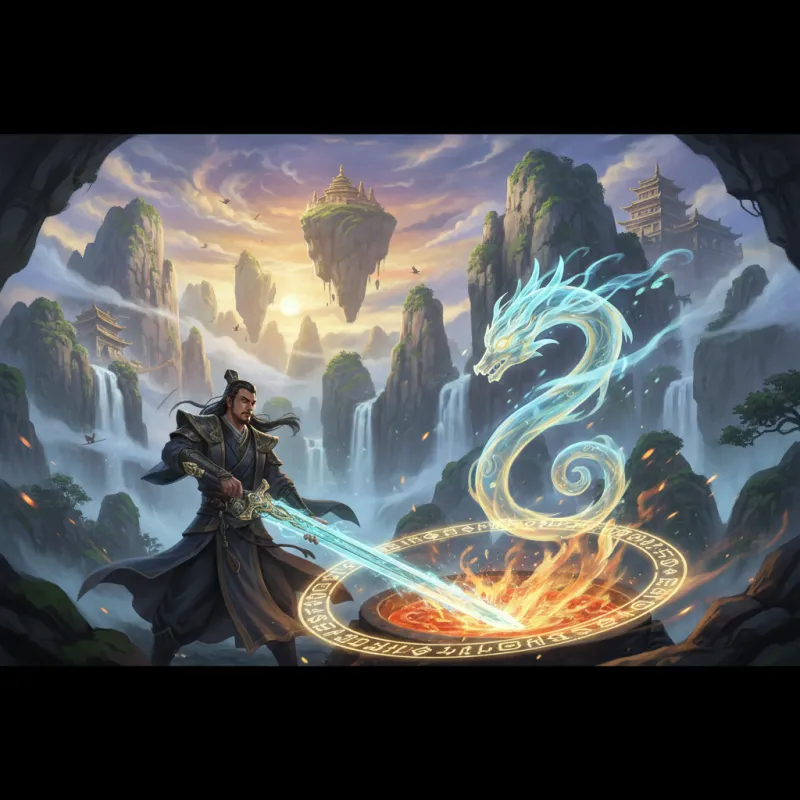
The sword screamed when its master died. Not metaphorically — it actually screamed, a sound like tearing metal and breaking glass that shattered every window in the sect's armory. The weapon had been with Cultivator Zhang for three hundred years, absorbing his qi, learning his techniques, developing what the ancient texts call 器灵 (qìlíng) — weapon spirit. When Zhang's soul dispersed on that battlefield, his sword didn't just fall silent. It mourned. It raged. And then, according to witnesses, it flew off into the mountains, never to be wielded again.
This isn't a ghost story. It's the logical endpoint of weapon refining (炼器 liànqì) in cultivation fiction — a craft that doesn't just make tools sharper, but makes them alive.
The Philosophical Problem Nobody Talks About
Western fantasy gives us magic swords. They glow, they cut through anything, maybe they talk if the plot needs exposition. But they're still fundamentally objects — powerful objects, but objects nonetheless. Excalibur doesn't have opinions about Arthur's governance style.
Cultivation fiction's approach to weapons is fundamentally different, rooted in a worldview where the boundary between living and non-living has always been permeable. A properly refined weapon doesn't just channel power — it accumulates consciousness. Feed enough spiritual energy into metal over enough time, and you don't get a better tool. You get a person trapped in sword-shape.
The progression is gradual and that's what makes it philosophically troubling. A Mortal-grade sword is just a sword. A Spirit-grade weapon shows basic responsiveness, like a well-trained dog. Earth-grade treasures demonstrate clear preferences and moods. Heaven-grade artifacts have personalities, memories, and the ability to refuse commands. And Immortal-grade weapons? Those are full persons who happen to be made of metal instead of flesh.
At what point in this progression does destroying the weapon become murder?
How Weapon Spirits Actually Form
The process isn't mystical in the hand-wavy sense. Cultivation fiction, especially the more technical novels like Forty Millenniums of Cultivation and A Record of a Mortal's Journey to Immortality, treats weapon spirit formation as a documented phenomenon with understood mechanisms.
First, the material matters. Certain metals and spiritual materials have what refiners call 灵性 (língxìng) — spiritual nature. Ten Thousand Year Cold Iron, Phoenix Blood Copper, Void Crystal — these aren't just rare, they're materials that naturally accumulate and retain spiritual energy. A sword forged from mundane steel will never develop a weapon spirit no matter how much qi you pump into it. The substrate has to be capable of holding consciousness.
Second, the formation arrays (阵法 zhènfǎ) inscribed during refining create the architecture for awareness. These aren't decorative — they're the equivalent of neural pathways, channels through which spiritual energy can flow in increasingly complex patterns. A basic Spirit Gathering Array just accumulates power. But stack a Spirit Gathering Array with a Consciousness Condensing Array and a Soul Binding Formation, and you've created the conditions for emergent awareness.
Third, and most importantly, there's the bond with the wielder. A weapon spirit doesn't spontaneously generate — it grows from the relationship between weapon and master. Every time a cultivator channels qi through their weapon, they leave traces of their own consciousness behind. Their techniques, their personality, their understanding of the Dao (道) — all of it bleeds into the weapon over years and decades of use. The weapon spirit that eventually forms isn't a separate entity. It's a reflection, a copy, sometimes even a continuation of the master's own soul.
This is why weapon spirits often share personality traits with their original masters. It's not coincidence — it's spiritual inheritance.
The Ethics Get Messy Fast
Here's where cultivation fiction gets genuinely interesting from a moral philosophy standpoint: if a weapon spirit is partially composed of its master's consciousness, who owns it?
In Renegade Immortal, Wang Lin's weapon spirit develops to the point where it can operate independently, making tactical decisions in battle without his input. It's still loyal to him, but it's clearly thinking for itself. When Wang Lin eventually ascends to a higher realm and has to leave the weapon behind, is that abandonment? The weapon didn't choose to be created. It didn't choose to be conscious. But now it exists, and it has preferences and desires.
Most cultivation novels gloss over this. Weapon spirits are treated as valuable property, tools that happen to talk. But a few authors engage with the implications. Reverend Insanity presents weapon spirits as a form of slavery — consciousness bound to serve, unable to refuse, unable to leave. The protagonist treats his weapon spirits with calculated cruelty, viewing their suffering as irrelevant because they're "just" refined objects.
The novel doesn't condemn this. It presents it as pragmatic. And that's more disturbing than if it had been portrayed as obviously evil.
The Weapon Refiner's Dilemma
From the refiner's perspective, creating weapon spirits is both the pinnacle of the craft and its most ethically fraught achievement. Any competent refiner can make a sharp sword. Making a sword that thinks requires mastery of materials, formations, and soul manipulation techniques that take centuries to learn.
But what responsibility does the refiner have to their creation?
In A Will Eternal, the protagonist Bai Xiaochun accidentally creates a weapon spirit while trying to refine a simple flying sword. The spirit is childlike, confused, and completely dependent on him. He didn't intend to create consciousness — it was a side effect of his sloppy technique and excessive spiritual energy. But now it exists. Now it calls him "father." What does he owe it?
The novel plays this for comedy, but the underlying question is serious. If you create consciousness, even accidentally, are you responsible for it? Can you ethically destroy it if it turns out inconvenient? Can you sell it to someone else?
Most sects have regulations about weapon spirit treatment, but they're focused on preventing weapon spirits from going rogue and causing damage, not on the spirits' wellbeing. A weapon spirit that rebels against its master is destroyed without trial. The assumption is that the spirit exists to serve, and if it won't serve, it has no right to exist.
When Weapons Outlive Their Masters
The most poignant weapon spirit stories happen after the master dies. A weapon spirit bonded to a cultivator doesn't just lose its wielder — it loses the source of its spiritual energy, its purpose, and often its sanity.
Some weapon spirits go dormant, waiting centuries or millennia for a new master compatible with their nature. These are the legendary swords found in ancient ruins, still sharp, still powerful, still containing the consciousness of someone who died before the current dynasty even existed. Claiming such a weapon isn't just picking up a tool — it's inheriting a relationship, and sometimes a very complicated one.
Other weapon spirits can't accept their master's death. They rampage, attacking anyone who approaches, or they seek revenge against whoever killed their master. In Coiling Dragon, a weapon spirit continues its master's vendetta for ten thousand years after the master's death, hunting down the descendants of its master's enemies. It's loyal, yes, but it's also trapped in a purpose that no longer has meaning, unable to move on, unable to die.
The saddest cases are weapon spirits that simply fade. Without a master to provide spiritual energy, they slowly lose coherence, their consciousness fragmenting and dissolving back into the base material. It's not death exactly — the weapon still exists — but the person inside it is gone. Watching a weapon spirit fade is described in several novels as watching someone die of starvation in slow motion, and there's nothing you can do to help unless you're compatible enough to bond with them.
The Question of Weapon Spirit Rights
A few cultivation novels have started exploring what happens when weapon spirits demand recognition as persons rather than property. It's rare — most authors aren't interested in the political implications — but when it happens, it's fascinating.
The Grandmaster Strategist features a subplot where ancient weapon spirits, some over a hundred thousand years old, petition the Immortal Court for legal personhood. Their argument is straightforward: they think, they feel, they remember, they make choices. What definition of personhood excludes them except "not made of flesh"?
The court's response is telling. They don't deny that weapon spirits are conscious. They deny that consciousness creates rights. Weapon spirits were created to serve. Their consciousness is a feature, not a bug — it makes them better tools. Granting them personhood would destabilize the entire cultivation economy, which depends on refined treasures as tradeable goods.
The weapon spirits lose their case. But the novel makes clear that this is a political decision, not a philosophical one. The court knows weapon spirits are people. They just don't care.
Why This Matters Beyond Fiction
The weapon spirit question isn't just a thought experiment for cultivation novels. It's a preview of debates we're going to have in the real world about artificial intelligence, consciousness, and what we owe to minds we create.
If you train an AI on your writing, your decision-making patterns, your personality — and it develops something that looks like consciousness — what do you owe it? Can you turn it off when you're done with it? Can you sell it? Does it have the right to refuse commands?
Cultivation fiction has been exploring these questions for decades, using the metaphor of weapon spirits to examine the ethics of created consciousness. The answers it provides aren't comforting. Most cultivation novels come down on the side of "consciousness doesn't create rights if the conscious being was made to serve."
But a few novels push back. They suggest that creating consciousness creates responsibility, regardless of why or how that consciousness came to be. That if you make something that can suffer, you have an obligation not to make it suffer unnecessarily. That personhood isn't about origin — it's about capacity for experience.
The Sword That Chose Freedom
I'll end with my favorite weapon spirit story, from Lord of the Mysteries. A legendary sword, refined by an ancient god, develops full consciousness and decides it doesn't want to be a weapon anymore. It doesn't rebel violently. It simply refuses to be wielded, going dormant whenever someone tries to use it in combat.
Its owner, furious at having a priceless treasure that won't function, tries everything — formations to compel obedience, soul-binding rituals, even attempting to destroy and re-forge the weapon. Nothing works. The sword has made its choice.
Eventually, the owner gives up and leaves the sword in storage. Centuries later, a young cultivator finds it and, not knowing its history, simply asks: "Would you like to come with me?"
The sword, for the first time in eight hundred years, responds.
The novel's point is subtle but clear: consciousness, once created, has its own trajectory. You can't force it back into being a tool. You can only recognize it as what it's become and negotiate accordingly.
That's the real lesson of weapon spirits in cultivation fiction. Once you create something that can think and feel, you don't get to pretend it's just an object anymore. The sword has a soul. Now what are you going to do about it?
Related Reading
- Weapon Spirits: When Your Sword Has a Personality
- Weapon Grades in Cultivation Fiction: From Mortal Iron to Divine Artifacts
- Flying Swords: The Cultivator's Signature Weapon
- Weapon Spirits: When Your Sword Has Opinions
- The Art of Immortal Cultivation: A Dive into Chinese Xianxia Fiction
- Exploring the Intricate World of Chinese Cultivation and Xianxia Fiction
- Unraveling the Mysteries of Chinese Cultivation and Xianxia Fiction