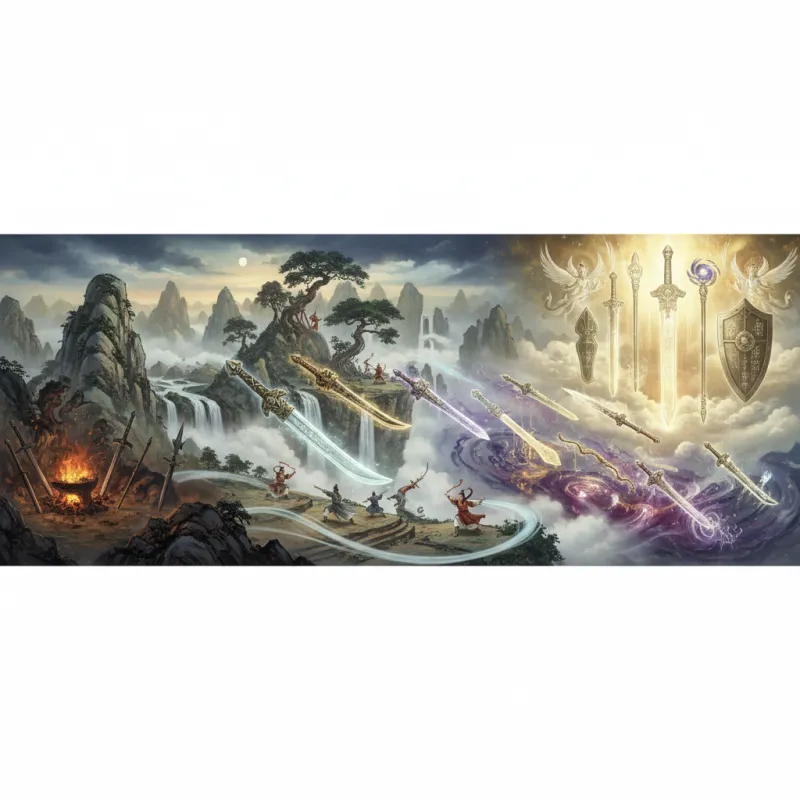
Every cultivator remembers their first spiritual weapon. Not because it was powerful—most weren't—but because it was the moment they realized the rusty sword they'd been carrying was about as useful as a butter knife in a dragon fight. The weapon grading system in xianxia fiction isn't just world-building flavor; it's the measuring stick that tells you exactly how screwed (or how overpowered) the protagonist is at any given moment.
The Foundation: Understanding Weapon Grades
The weapon hierarchy in cultivation novels follows a logic that mirrors the cultivation realms themselves. Just as cultivators progress from Qi Condensation to Nascent Soul and beyond, weapons evolve from mundane metal to artifacts that can split mountains. The standard system most authors use—with regional variations that would make any taxonomy enthusiast weep—breaks down into roughly seven to nine tiers, though some ambitious authors have pushed it to twelve or more.
Mortal Grade (凡品 fánpǐn) weapons are what normal blacksmiths produce. No spiritual energy, no special properties, just well-crafted steel. These appear in the first few chapters before the protagonist stumbles into their first fortuitous encounter. In Coiling Dragon, Linley's original sword falls into this category—functional, but utterly outclassed the moment spiritual beasts enter the picture.
Spirit Grade (灵品 língpǐn) marks the entry point into true cultivation weaponry. These weapons can channel qi and typically have one or two special properties—maybe they're unusually sharp, or they can store a cultivator's attack for later release. The jump from Mortal to Spirit Grade is like going from a bicycle to a motorcycle. In Martial World, Lin Ming's first real weapon, the Heavy Profound Soft Spear, sits at the lower end of this tier.
Treasure Grade (宝品 bǎopǐn) is where things get interesting. These weapons have weapon spirits—nascent consciousness that can communicate with their wielder. They're rare enough that possessing one marks you as someone important, but common enough that every major sect has a few in their treasury. The quality gap within this tier is massive; a low-grade treasure might be worth a small city, while a peak treasure could buy a kingdom.
The Divine Threshold
Earth Grade (地品 dìpǐn) and Heaven Grade (天品 tiānpǐn) weapons represent a fundamental shift. These aren't just better versions of lower-tier weapons—they operate on different principles entirely. Earth Grade weapons can affect the laws of reality in limited ways, while Heaven Grade weapons can temporarily rewrite them. When Meng Hao in I Shall Seal the Heavens acquires the Blood Immortal Legacy, he's dealing with Heaven Grade artifacts that have survived multiple apocalypses.
The naming convention here reveals something about Chinese cosmology: Earth (地 dì) and Heaven (天 tiān) aren't just locations but fundamental forces. Earth Grade weapons are bound to the physical realm and its laws. Heaven Grade weapons touch the celestial, the domain of immortals. This isn't arbitrary—it reflects the Daoist concept of the Three Realms (三界 sānjiè): Heaven, Earth, and the Underworld.
Immortal Grade (仙品 xiānpǐn) weapons are where most novels draw a hard line. These are artifacts that survived the tribulation to become immortal themselves, or were forged by true immortals using materials that don't exist in the mortal realm. They're plot devices as much as weapons—when one appears, you know the story is about to escalate dramatically. The Immortal Slaying Sword Formation (诛仙剑阵 Zhūxiān Jiànzhèn) from Investiture of the Gods is the classical example that modern xianxia authors reference constantly.
Beyond Immortal: The Absurd Tiers
Some authors don't stop at Immortal Grade. Stellar Transformations introduces Divine Grade (神品 shénpǐn) and Primordial Grade (鸿蒙品 hóngméngpǐn) weapons that can destroy universes. Desolate Era has Chaos-level treasures that predate the current cosmos. At this point, the grading system becomes less about practical power scaling and more about establishing cosmic hierarchy—these weapons are MacGuffins that drive plot rather than tools the protagonist uses regularly.
The proliferation of tiers above Immortal Grade reveals something about the genre's evolution. Early xianxia novels like Shushan Swordsman (1932) had simpler systems because they focused on personal cultivation rather than cosmic-scale conflicts. Modern web novels, competing for reader attention in a saturated market, keep inflating the power scale. It's the literary equivalent of Dragon Ball Z's power level problem—once you've destroyed a planet, where do you go next?
The Sub-Tier Problem
Most grading systems subdivide each major tier into Low, Middle, High, and Peak grades. This creates a weapon hierarchy with 28+ distinct levels, which sounds excessive until you realize it's necessary for the genre's economics. Auction scenes need graduated pricing. Treasure pavilions need inventory variety. Antagonists need to be threatening but not impossible to defeat, which means their weapons need to be exactly one sub-tier above the protagonist's current gear.
The sub-tier system also enables one of xianxia's favorite tropes: the protagonist using a lower-grade weapon to defeat someone with a higher-grade one. When the underdog wins, it's never just because they're skilled—it's because their Low Heaven Grade sword, when wielded with perfect technique and supplemented by a secret art, can temporarily match a Middle Heaven Grade blade. The math has to work out, and sub-tiers make that possible.
Material Matters: What Makes a Weapon Powerful
The grade of a weapon depends on three factors: the materials used, the refiner's skill, and the weapon's accumulated spiritual essence over time. A master refiner using Immortal-grade materials might produce a Peak Heaven Grade weapon, while a mediocre refiner with the same materials might only achieve Low Heaven Grade. This creates interesting plot possibilities—the protagonist finds amazing materials but needs to locate a skilled refiner, or they discover an ancient weapon that's degraded over millennia and needs restoration.
Spiritual metals and materials form their own complex hierarchy. Star Iron (星铁 xīngtiě) is a common Spirit Grade material. Profound Ice Jade (玄冰玉 xuánbīngyù) typically produces Treasure Grade weapons. Divine Crystals (神晶 shénjīng) are necessary for anything above Heaven Grade. The material system parallels the weapon grades, creating a nested hierarchy that gives authors tremendous flexibility in crafting treasure-hunting arcs.
Weapon Spirits and Sentience
Starting at Treasure Grade, weapons develop spirits—consciousness that ranges from vague awareness to full personality. This is where Chinese cultivation fiction diverges sharply from Western fantasy. In Western traditions, sentient weapons are rare and often sinister (think Stormbringer or the One Ring). In xianxia, weapon spirits are expected, even necessary for high-grade artifacts.
The weapon spirit concept draws from Chinese animism and the Daoist idea that all things contain spirit (灵 líng). A weapon used in countless battles, soaked in spiritual energy and blood, naturally develops consciousness. The relationship between cultivator and weapon spirit becomes a subplot in itself—some spirits are loyal, others treacherous, and the best ones have distinct personalities that complement or clash with their wielder.
In Martial God Asura, Chu Feng's relationship with his weapon spirit Eggy is central to the story. She's not just a power-up; she's a character with her own goals and personality. This transforms the weapon from equipment into a companion, which is why readers get emotionally invested in weapon upgrades. You're not just getting a better sword; you're potentially saying goodbye to a friend.
The Economics of Weapon Grades
The value gap between grades is exponential, not linear. A Peak Spirit Grade weapon might cost 10,000 spirit stones. A Low Treasure Grade weapon could cost 100,000. A Peak Treasure Grade weapon might go for 10 million. This creates the economic structure that drives much of xianxia plotting—protagonists are perpetually broke because the next weapon upgrade costs more than they've earned in their entire life.
This also explains why weapon refining is such a lucrative profession in cultivation worlds. A skilled refiner who can consistently produce Treasure Grade weapons becomes wealthy beyond measure. The protagonist who learns refining isn't just picking up a hobby; they're solving their chronic poverty problem while also ensuring they'll never lack for proper equipment.
Breaking the System: Unique and Growth-Type Weapons
Not all weapons fit neatly into the grading system. Growth-type weapons (成长型法宝 chéngzhǎngxíng fǎbǎo) start at low grades but evolve alongside their wielder, potentially reaching Immortal Grade or beyond. These are author solutions to the "constantly replacing weapons" problem—instead of the protagonist discarding their signature weapon every hundred chapters, it grows with them.
Coiling Dragon's Bloodviolet sword is a classic growth-type weapon. It starts as a decent but unremarkable blade and eventually becomes a Sovereign artifact. This creates emotional continuity—readers don't have to adjust to new weapons constantly—while still allowing for power progression.
Unique-grade weapons (无品 wúpǐn, literally "gradeless") exist outside the standard hierarchy. These are one-of-a-kind artifacts with properties that don't fit conventional categories. They might be weaker than Immortal Grade in raw power but possess abilities that make them invaluable. The Celestial Sealing Array (封天阵 Fēngtiānzhèn) in Renegade Immortal is technically gradeless because it's not a weapon but a formation that can trap beings far more powerful than its user.
Why the System Works
The weapon grading system succeeds because it provides clear, quantifiable progression in a genre obsessed with advancement. Readers know exactly what it means when the protagonist upgrades from a Peak Treasure Grade sword to a Low Heaven Grade one. The numbers go up, the power increases, and everyone understands the stakes.
But it's more than just numbers. The grading system reflects Chinese philosophical concepts about hierarchy, cultivation, and the relationship between the mundane and divine. The progression from Mortal to Immortal Grade mirrors the cultivator's journey from ordinary human to transcendent being. The weapon becomes a physical manifestation of the protagonist's advancement, a tangible marker of how far they've come.
This is why weapon upgrade scenes carry emotional weight despite being fundamentally about getting better equipment. When the protagonist finally obtains that Heaven Grade sword they've been working toward for two hundred chapters, it's not just a power-up—it's validation of their journey, proof that they've ascended to a new level of existence. The weapon grading system transforms equipment upgrades into milestones of personal transformation, which is why it remains central to xianxia fiction despite being, on the surface, just a fancy way to rank swords.
Related Reading
- Weapon Spirits: When Your Sword Has Opinions
- Weapon Refining in Cultivation Fiction: Why Your Sword Has a Soul
- Flying Swords: The Cultivator's Signature Weapon
- Weapon Refining in Cultivation Fiction: Forging Swords That Think
- Weapon Spirits: When Your Sword Has a Personality
- Cultivation Sects Explained: Schools, Clans, and Holy Lands
- Unraveling the Essence of Tribulations in Chinese Cultivation Fiction
- The Alchemist's Arsenal: Cauldrons, Furnaces, and Essential Equipment