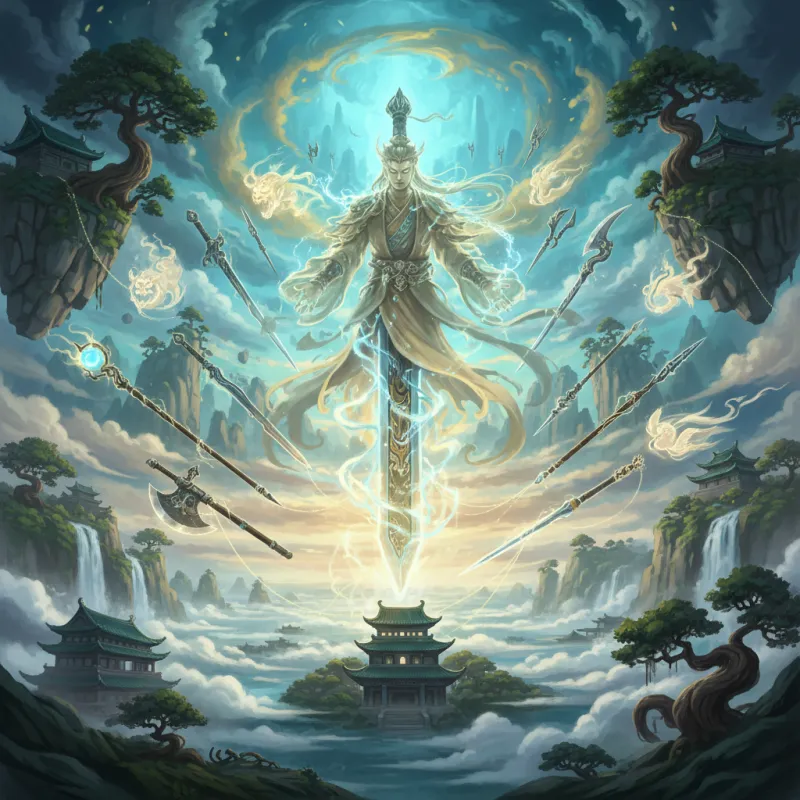
Your sword just called you an idiot. Not out loud — weapon spirits (器灵 qìlíng) rarely bother with actual speech when telepathic disappointment works better — but you felt it. That distinct sensation of your own weapon judging your life choices while you're mid-swing against a demonic beast. Welcome to one of cultivation fiction's most entertaining dynamics: the moment your equipment gains sentience and decides you're not quite living up to its standards.
The Three Paths to Sentient Steel
Weapon spirits don't spawn from thin air the moment a blacksmith finishes hammering. Consciousness in metal follows specific rules, and cultivation novels are surprisingly consistent about how these personalities emerge.
Time and spiritual saturation. The slow path. A weapon absorbs ambient spiritual energy (灵气 língqì) over centuries, gradually developing awareness like sediment forming rock. Ancient swords passed through generations of cultivators accumulate not just power but memory, personality fragments from every wielder. This is why tomb raiding is so profitable in Renegade Immortal — those ancient artifacts aren't just powerful, they're experienced. The weapon spirit of a ten-thousand-year-old blade has seen empires rise and fall. It remembers techniques your sect forgot three dynasties ago.
Deliberate spirit binding during refinement. The intentional method. A weapon refiner (炼器师 liànqìshī) captures a willing spirit — sometimes a beast soul, occasionally a cultivator who chose this form of immortality — and binds it into the weapon during forging. This creates weapon spirits with fully formed personalities from day one. Martial World's Lin Ming encounters several weapons crafted this way, and the results vary wildly. Some spirits are grateful for their new existence. Others are furious about being trapped in metal and make their wielder's life miserable until they prove worthy. The quality of the binding determines whether you get a helpful companion or an angry prisoner who sabotages you at critical moments.
Spontaneous awakening through extreme events. The dramatic path. A weapon witnesses something so spiritually intense — a tribulation, a battle between immortals, the death of its master — that consciousness sparks into existence like lightning striking sand into glass. These spirits tend toward extreme personalities because they're born from trauma or transcendence. The sword that awakened while its master died protecting a city? That weapon spirit has opinions about cowardice. The spear present when someone ascended to immortality? It expects nothing less than perfection from whoever touches it next.
Personality Types: From Helpful to Homicidal
Weapon spirits aren't a monolith. They develop distinct personalities based on their origin, experiences, and the type of weapon they inhabit. Swords tend toward pride and martial philosophy. Spears are often more straightforward and aggressive. Defensive treasures like shields or armor develop protective, sometimes maternal instincts. Bells and cauldrons used in alchemy frequently manifest scholarly or patient personalities.
The helpful mentor spirit is cultivation fiction's equivalent of the wise old master, except this one lives in your sword and can't walk away when you're being stupid. These spirits guide young cultivators, explain techniques, warn about dangers. They're particularly common in weapons that previously belonged to powerful experts. The spirit remembers its former master's skills and wants to see them passed on. Coiling Dragon's Bloodviolet sword contains a spirit that actively helps Linley understand profound mysteries. It's not just a weapon — it's a teacher who happens to be sharp and pointy.
Then there's the tsundere weapon spirit, and yes, that's the actual dynamic in dozens of novels. The spirit clearly cares about its wielder but expresses this through constant criticism and reluctant assistance. "I suppose I'll help you this once, but only because watching you die would be boring." These spirits are protecting their pride while secretly invested in your success. They're especially common in weapons that initially rejected their current wielder but gradually warmed up.
The ancient and aloof spirit treats its wielder like a temporary inconvenience. It's seen countless masters come and go. You're not special. You're not even particularly interesting. This spirit will help if properly motivated — usually through proving your worth or offering something it actually wants — but don't expect warmth. The weapon spirit in A Will Eternal's Eternal Parasol has this energy. It's older than most sects, more knowledgeable than most ancestors, and thoroughly unimpressed by mortal concerns.
Some weapon spirits are genuinely hostile. Maybe they're bound against their will. Maybe their previous master was killed by someone from your sect. Maybe they're demonic in nature and view you as a future meal rather than a partner. These spirits actively work against their wielder, waiting for the perfect moment to strike. Smart cultivators either suppress these spirits completely or avoid such weapons entirely. The risk-reward calculation rarely favors keeping a weapon that wants you dead.
The Compatibility Problem
Not every cultivator can wield every spirit weapon, even if they're strong enough to lift it. Weapon spirits choose their masters based on compatibility — a nebulous concept that combines personality match, cultivation path alignment, karmic connection, and sometimes pure whim.
This is why inheritance trials exist. An ancient expert dies and leaves behind their weapon, but the spirit inside won't accept just anyone. Candidates must prove themselves worthy through tests designed by the spirit itself. These trials reveal character more than strength. A weapon spirit that served a righteous master will reject cruel cultivators regardless of their power level. A blade forged in demonic techniques won't bond with someone walking an orthodox path.
The recognition process varies. Some spirits test potential wielders through combat — fight me, prove your skill. Others prefer philosophical debates or demonstrations of character. A few just know instantly, recognizing something in the cultivator's soul that resonates with their own nature. When the match is right, both weapon and wielder benefit. The spirit gains a partner who can help it grow stronger. The cultivator gains a weapon that actively assists them, sometimes even fighting independently.
Rejection is messy. A weapon spirit that doesn't accept you will resist being wielded. The sword feels heavy, techniques don't flow properly, and in extreme cases, the weapon actively harms its would-be master. Trying to force a spirit weapon to submit usually ends badly. The spirit either breaks free and escapes, or it submits superficially while plotting revenge. Weapon refiners know this, which is why they emphasize compatibility during the forging process.
Communication Methods: Telepathy and Tantrums
Weapon spirits communicate in ways that range from subtle to impossible-to-ignore. Telepathy is standard for spirits that have reached a certain level of development. Direct mind-to-mind communication lets the spirit share information, offer advice, or complain about your technique without anyone else hearing. This privacy is valuable during sect politics or when the spirit knows something you shouldn't publicly acknowledge.
Emotional projection is cruder but effective. The weapon radiates feelings — approval, warning, disgust — that its wielder interprets instinctively. A sudden chill from your sword means danger. Warmth indicates you're on the right path. Bone-deep revulsion suggests you're about to do something the spirit finds morally reprehensible. These emotional signals work even when the spirit isn't developed enough for speech.
Physical manifestation is the flashy option. Powerful weapon spirits can project an avatar — usually a humanoid form that appears near the weapon or in the wielder's consciousness. These manifestations range from translucent ghosts to fully solid bodies depending on the spirit's strength. Some spirits prefer animal forms related to their nature. A dragon-slaying spear might manifest as a dragon. A phoenix feather fan's spirit appears as a phoenix. The symbolism isn't subtle, but it works.
Behavioral rebellion is how weapon spirits communicate when they're angry. The sword suddenly weighs three times normal. The spear's aim drifts at critical moments. The shield's defensive formations activate sluggishly. This is the weapon spirit equivalent of giving you the silent treatment while also sabotaging your performance. It's petty, it's effective, and it usually means you've violated some principle the spirit holds dear.
Growth and Evolution
Weapon spirits aren't static. They grow alongside their wielders, developing new abilities and deeper consciousness as they absorb spiritual energy and experience. A newly awakened spirit might only manage vague emotional signals. Give it a few decades and several major battles, and suddenly it's offering tactical advice and manifesting independently.
The growth process mirrors cultivation realms. Spirits advance through stages of awareness, each bringing new capabilities. Early-stage spirits are barely conscious — more like sophisticated instincts than true personalities. Mid-stage spirits develop clear preferences and can communicate effectively. High-stage spirits achieve wisdom that rivals ancient cultivators, sometimes surpassing their wielders in knowledge if not power.
Feeding a weapon spirit accelerates growth. Not literal food — spirits consume spiritual energy, treasures, or materials aligned with their nature. A fire-attribute sword spirit grows stronger by absorbing flame crystals or being bathed in tribulation fire. Some cultivators specifically hunt resources to nurture their weapon spirits, treating the relationship like raising a spiritual beast. The investment pays off when the spirit unlocks new abilities or evolves into a higher form.
Evolution can change a weapon's fundamental nature. A sword spirit that reaches a certain threshold might transform the blade itself, adding new properties or even changing its shape. The spirit of a common iron sword could, through centuries of growth, transform its vessel into a legendary artifact. This is why ancient weapons are so valuable — they've had time to evolve far beyond their original specifications.
The Dark Side: When Spirits Go Wrong
Not all weapon spirit relationships are healthy. Some cultivators treat their spirits as slaves, using suppression formations to force obedience. This works short-term but creates resentment that eventually explodes. A suppressed spirit that breaks free is dangerous — it knows its wielder's techniques, weaknesses, and secrets. Betrayal by your own weapon is a special kind of disaster.
Possession is the nightmare scenario. A weapon spirit strong enough and malicious enough can attempt to take over its wielder's body. This usually happens when the cultivator is weakened or the spirit has been planning for years. The spirit inverts the relationship, using the cultivator as a vessel while wielding its own weapon body through them. Demonic cultivation texts describe methods to achieve this, treating weapon spirits as tools for body-snatching rather than partners.
Spirit degradation occurs when a weapon is damaged or its wielder dies traumatically. The spirit can fracture, losing coherence and becoming a dangerous, insane presence. These broken spirits lash out randomly, attacking anyone who touches the weapon. Repairing such damage requires specialized techniques and often isn't worth the effort unless the weapon was exceptionally powerful to begin with.
Dependency is subtler but equally problematic. Some cultivators rely too heavily on their weapon spirit's guidance, never developing their own judgment. When the spirit is unavailable — suppressed by an enemy formation or exhausted from battle — the cultivator is helpless. A healthy relationship requires balance. The spirit advises, but the wielder decides.
Famous Partnerships in Cultivation Fiction
Desolate Era's Ji Ning and his Darknorth swords showcase the ideal partnership. The swords' spirits grow alongside Ning, their relationship evolving from simple tools to trusted companions who understand his dao. When Ning faces impossible odds, his swords fight beside him as equals, not subordinates.
I Shall Seal the Heavens features the meat jelly, which isn't technically a weapon spirit but fills the same narrative role. It's ancient, powerful, occasionally helpful, and mostly interested in its own agenda. The dynamic between Meng Hao and the meat jelly demonstrates how weapon spirit relationships can be transactional rather than loyal — both parties benefit, but neither fully trusts the other.
The Blood Demon Grand Magic from the same novel contains multiple spirits from the cultivators who previously wielded it. Each spirit offers different knowledge and abilities, but they also compete for influence. Managing multiple weapon spirits with conflicting personalities adds complexity that single-spirit weapons don't face.
Practical Considerations for Aspiring Wielders
If you're a cultivator seeking a spirit weapon, understand what you're signing up for. This isn't just acquiring equipment — it's entering a relationship that might last centuries. Choose carefully. A weapon spirit's personality matters as much as its power. A slightly weaker weapon with a compatible spirit will serve you better than a legendary artifact that hates your guts.
Respect goes both ways. Treat your weapon spirit as a partner, not a possession. Listen to its advice even when you disagree. Invest in its growth. The cultivators with the strongest spirit weapons are those who view the relationship as mutual benefit rather than master-servant.
Be prepared for judgment. Your weapon spirit will witness everything you do. Every moral compromise, every moment of cowardice, every act of cruelty. Some spirits won't care. Others will. If you plan to walk a dark path, choose a spirit that won't object. If you want to maintain your principles, a spirit with strong moral opinions can serve as your conscience when temptation strikes.
The best weapon spirit relationships in cultivation fiction are partnerships between equals who chose each other. The weapon provides power and wisdom. The wielder provides purpose and growth. Together, they achieve what neither could alone. That's the ideal. Reality is messier, but when it works, there's nothing quite like having a sword that's got your back — even when it's criticizing your footwork.
Related Reading
- Weapon Refining in Cultivation Fiction: Why Your Sword Has a Soul
- Weapon Refining in Cultivation Fiction: Forging Swords That Think
- Weapon Grades in Cultivation Fiction: From Mortal Iron to Divine Artifacts
- Flying Swords: The Cultivator's Signature Weapon
- Weapon Spirits: When Your Sword Has Opinions
- The Philosophical Underpinnings of Chinese Cultivation Fiction and Immortal Realms
- The Allure of Chinese Cultivation Fiction: A Journey Through Immortal Realms
- Exploring the Intricate World of Chinese Cultivation and Xianxia Fiction