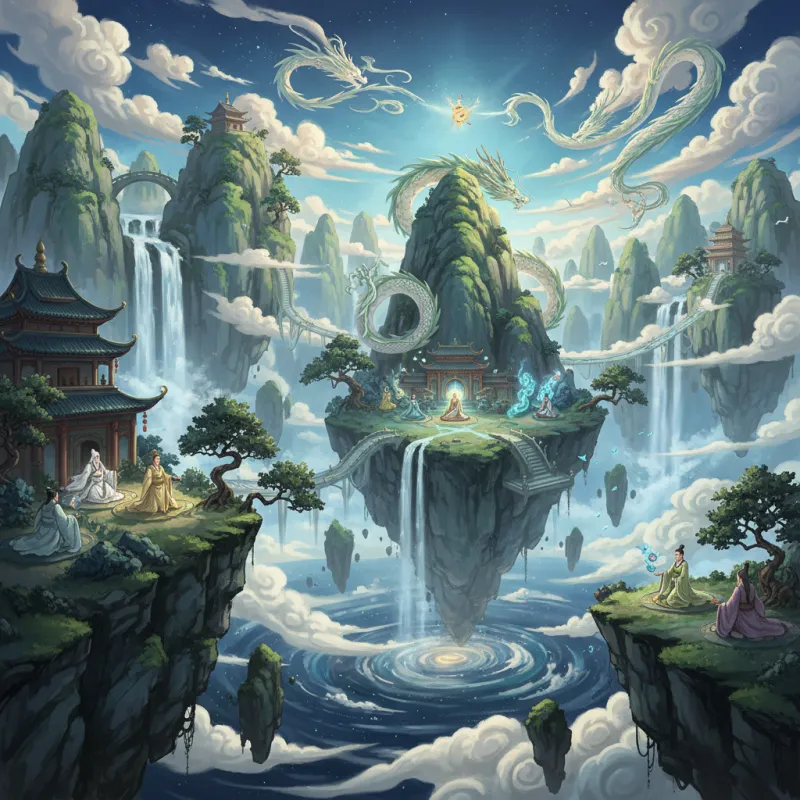
A young cultivator sits cross-legged beneath a waterfall, enduring bone-crushing pressure for three days straight. His master watches from a distance, unmoved. When asked why he doesn't intervene, the old immortal replies: "The Dao cannot be given, only realized." This scene, repeated across thousands of cultivation novels, isn't just dramatic flair—it's a direct echo of philosophical debates that consumed Chinese thinkers for millennia. The xianxia genre didn't invent its worldview from nothing; it inherited a complex philosophical framework that blends Daoist mysticism, Buddhist cosmology, and Confucian ethics into something uniquely suited for serialized fiction.
The Daoist Foundation: Why Immortality Matters
When Ge Hong (葛洪, Gě Hóng) compiled the Baopuzi (抱朴子) in 317 CE, he wasn't writing fantasy—he was documenting what he believed were actual techniques for achieving physical immortality. His text describes alchemical formulas, breathing exercises, and dietary restrictions that would let practitioners transcend mortality. Sound familiar? Every cultivation novel from Coiling Dragon to A Record of a Mortal's Journey to Immortality follows this same blueprint: systematic practice leads to systematic advancement leads to transcendence.
The key Daoist concept here is neidan (內丹, nèidān)—internal alchemy. Unlike waidan (外丹, wàidān), which involved literally consuming mercury and lead (with predictably fatal results), internal alchemy treated the human body as a crucible. The dantian (丹田, dāntián) or "elixir field" becomes the furnace where qi (氣, qì) is refined into jing (精, jīng), then into shen (神, shén), and finally into the void. Modern cultivation novels map this directly onto their realm systems—Qi Condensation, Foundation Establishment, Golden Core, Nascent Soul. The terminology changes, but the underlying logic remains pure Daoist alchemy.
Buddhist Cosmology: The Multiverse Before Marvel
Here's what most readers miss: the reason cultivation novels feature multiple realms, higher planes, and ascension isn't borrowed from Western fantasy. It comes straight from Buddhist cosmology, which described a vast multiverse thousands of years before modern physics entertained the idea. The Avatamsaka Sutra describes countless world-systems, each containing countless worlds, stacked in hierarchies of spiritual refinement. The Lotus Sutra speaks of beings who've cultivated for "incalculable kalpas" (a kalpa being roughly 16 million years).
When Wang Lin in Renegade Immortal ascends from the mortal realm to the cultivation realm to the celestial realm, he's following a path laid out in texts like the Abhidharmakośa, which categorizes existence into the Desire Realm, Form Realm, and Formless Realm. Each level requires progressively more refined consciousness and less attachment to physical existence. The Buddhist concept of bhūmi (地, dì)—literally "ground" or "stage"—directly parallels cultivation stages. A bodhisattva progresses through ten grounds before achieving buddhahood, just as a cultivator progresses through realms before achieving immortality.
The Buddhist influence goes deeper than cosmology. The entire concept of karma (業, yè) and karmic retribution drives countless cultivation plots. Heavenly tribulations aren't arbitrary—they're karmic tests. The protagonist who slaughters innocents will face harsher tribulations than one who shows mercy. This isn't just plot convenience; it's karma-vipāka (業果, yèguǒ), the fruition of karmic seeds, made literal and immediate.
Confucian Ethics: The Uncomfortable Truth
Here's where cultivation fiction gets philosophically messy, and honestly, more interesting. Confucianism emphasizes social harmony, filial piety, and moral cultivation through education and ritual. The ideal Confucian is the junzi (君子, jūnzǐ)—the gentleman-scholar who perfects himself to serve society. This should clash violently with the individualistic, power-seeking ethos of most cultivation protagonists.
And yet, look closer. The best cultivation novels navigate this tension deliberately. In Grandmaster of Demonic Cultivation, Wei Wuxian's tragedy stems from violating Confucian social norms—he refuses to stay in his place, rejects orthodox methods, and protects outcasts. The cultivation world destroys him not because he's weak, but because he threatens the social order. The novel doesn't resolve this tension; it examines it.
Even power-fantasy novels pay lip service to Confucian values through the shifu-tudi (師父-徒弟, shīfù-túdì) relationship—master and disciple. This mirrors the Confucian emphasis on proper hierarchical relationships and transmission of knowledge through lineage. When a protagonist shows filial piety to their master or seeks revenge for a slain teacher, that's Confucian ethics operating within a Daoist-Buddhist framework.
Legalism's Shadow: Might Makes Right
Let's acknowledge the elephant in the room: many cultivation novels embrace a philosophy closer to Legalism than anything else. Han Fei (韓非, Hán Fēi), the great Legalist philosopher, argued that human nature is fundamentally selfish and only responds to rewards and punishments. Morality is whatever serves the state's power. Sound familiar?
"The strong prey on the weak" (弱肉強食, ruòròu-qiángshí) appears in virtually every cultivation novel as an accepted universal law. This isn't Buddhism or Daoism—it's pure Legalist realpolitik dressed in mystical robes. The cultivation world operates on power (實力, shílì), not virtue. Sects form alliances based on strength calculations, not moral alignment. Treasures go to whoever can seize them, not whoever deserves them.
The fascinating part? Many novels are self-aware about this. Reverend Insanity explicitly rejects conventional morality in favor of ruthless self-interest, and the protagonist Fang Yuan quotes Legalist and Daoist texts to justify his actions. The novel becomes a philosophical thought experiment: what if someone actually lived by the amoral principles that cultivation worlds claim to operate on?
The Synthesis: Why It Works
The genius of cultivation fiction lies in how it synthesizes contradictory philosophies into a functional narrative framework. From Daoism, it takes the methodology—systematic practice, harmony with natural laws, and the goal of transcendence. From Buddhism, it borrows the cosmology—multiple realms, karmic justice, and the long view of existence across countless lifetimes. From Confucianism, it maintains social structures—sects, hierarchies, and the importance of lineage. From Legalism, it derives the brutal logic of power.
This shouldn't work. These philosophies often directly contradict each other. But cultivation fiction resolves the contradictions through progression. A young cultivator might start with Confucian values, learn Daoist techniques, face Buddhist karmic tests, and eventually transcend to a realm where Legalist power-logic no longer applies. The philosophical journey mirrors the cultivation journey.
Consider A Will Eternal—Bai Xiaochun begins as a coward obsessed with immortality (Daoist goal), maintains loyalty to friends and masters (Confucian virtue), faces karmic consequences for his actions (Buddhist law), yet survives through cunning and strength (Legalist pragmatism). The novel works because it lets these philosophies coexist in tension rather than forcing false harmony.
Modern Adaptations and Divergences
Contemporary cultivation novels increasingly interrogate their philosophical foundations. Lord of the Mysteries incorporates Western occultism and creates a cultivation system based on acting and digesting potions—a radical departure from traditional qi cultivation that nonetheless maintains the core progression structure. Forty Millenniums of Cultivation transplants cultivation into a sci-fi setting where spiritual energy is scientifically quantified, asking whether cultivation philosophy survives when stripped of mysticism.
Some authors push back against the genre's moral framework entirely. The Legendary Mechanic features a protagonist who views the cultivation-like progression system as a game mechanic to exploit, not a spiritual path. This meta-awareness reflects a generation of readers who've consumed enough cultivation fiction to question its assumptions.
The Enduring Appeal
Why does this philosophical framework resonate so strongly, even with readers who've never studied Chinese philosophy? Because it addresses fundamental human desires: the wish for self-improvement to have visible results, the hope that effort guarantees advancement, the fantasy that power can be systematically acquired through discipline. The philosophical underpinnings provide structure and legitimacy to what might otherwise be simple power fantasy.
When a cultivator breaks through to a new realm after years of effort, it satisfies both narratively and philosophically. The Daoist would see it as achieving harmony with the Dao. The Buddhist would recognize it as progress toward enlightenment. The Confucian would approve of the disciplined self-cultivation. The Legalist would admire the acquisition of power. The reader just knows it feels earned.
That's the real philosophical achievement of cultivation fiction—it created a framework where progression feels meaningful because it's grounded in millennia of thought about what it means to transcend human limitations. Whether the authors consciously engage with Ge Hong's alchemical texts or Buddhist cosmology doesn't matter. The philosophical DNA is there, shaping every breakthrough, every tribulation, every ascension. The genre inherited a worldview, and that worldview makes the impossible feel inevitable.
Related Reading
- The Black Market: Forbidden Goods in the Cultivation World
- The Enigmatic Beasts of Chinese Cultivation Fiction: A Journey Through the Spiritual Realms
- Top 10 Cultivation Web Novels That Changed the Genre