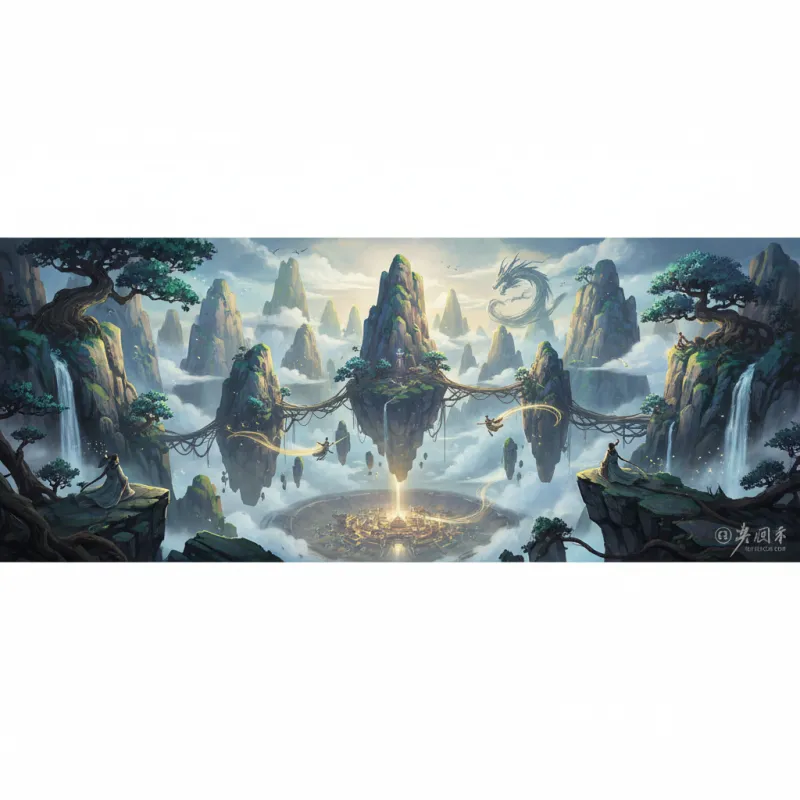
The cultivation web novel genre didn't evolve gradually — it exploded. Between 2003 and 2015, a dozen authors writing serialized fiction on Chinese platforms fundamentally rewrote the rules of what xianxia could be. They weren't working with publishers or editors. They were posting chapters daily, reading comments in real-time, and iterating on tropes that would become the backbone of an entire literary movement. Some of these novels are masterpieces. Others are messy, bloated, and occasionally incoherent. But every single one changed how cultivation stories are told.
The Foundation: Zhu Xian (诛仙) and the Birth of Modern Xianxia
Xiao Ding's (萧鼎) Zhu Xian hit Qidian in 2003 and did something no one expected: it made cultivation tragic. Before Zhu Xian, most xianxia followed the wuxia template — righteous heroes, clear moral lines, happy endings. Xiao Ding's protagonist Zhang Xiaofan starts as a naive village boy and ends as a morally ambiguous figure who's lost almost everything that mattered. The novel's central question — can you remain good while pursuing power? — became the thematic backbone for countless novels that followed.
Zhu Xian also established the "sect structure" that's now ubiquitous. Qingyun Sect (青云门), Tianyin Temple (天音寺), Ghost King Sect (鬼王宗) — these weren't just organizations, they were complete social systems with hierarchies, politics, and conflicting philosophies. Later novels like Stellar Transformations would expand on this, but Zhu Xian proved that cultivation worlds could support genuine political intrigue.
The novel's biggest flaw? The middle section drags terribly, with entire arcs that feel like filler. But its influence is undeniable. When you see a protagonist torn between two love interests who represent different paths, or a "demonic cultivation" technique that offers power at a moral cost, you're seeing Zhu Xian's DNA.
The Power System Revolution: Panlong (盘龙) by I Eat Tomatoes
I Eat Tomatoes (我吃西红柿, Wǒ Chī Xīhóngshì) published Coiling Dragon in 2008 and solved cultivation's biggest structural problem: how do you keep power progression interesting for 800+ chapters? His answer was elegant — create multiple parallel power systems that intersect in unexpected ways.
Panlong introduced the concept of "Laws" (法则, fǎzé) — fundamental forces like fire, earth, wind that cultivators could comprehend at increasingly deep levels. But Linley, the protagonist, doesn't just master one Law. He combines them, discovers hidden connections, and eventually transcends the system entirely. This multi-layered approach to power meant that even after Linley became "strong," there were always new dimensions to explore.
The novel also pioneered the "multiple realms" structure. Linley starts on the Yulan Continent, ascends to higher planes, and eventually reaches the Infernal Realm and beyond. Each realm has its own power ceiling, politics, and rules. This solved the "power creep" problem — instead of making everyone stronger, you just move to a place where the baseline is higher.
I Eat Tomatoes' prose is workmanlike at best, and his female characters are paper-thin. But his architectural innovations in power systems influenced virtually every cultivation novel that came after. The idea that cultivation could be systematic rather than mystical changed everything.
The Ruthless Protagonist: Xian Ni (仙逆) by Er Gen
Er Gen's (耳根) Renegade Immortal, which began serialization in 2009, asked a question that seemed almost heretical: what if the protagonist isn't a good person? Wang Lin isn't evil, exactly, but he's cold, calculating, and willing to sacrifice almost anyone to achieve his goals. He doesn't make friends easily. He doesn't crack jokes. He spends entire arcs in isolation, grinding through cultivation bottlenecks with grim determination.
This was radical. Chinese web novel protagonists were typically either righteous heroes or lovable rogues. Wang Lin was neither. He was a survivor in a universe that didn't care about fairness or justice. The novel's opening — Wang Lin as a talentless outer sect disciple, bullied and overlooked — established a tone of cosmic indifference that persisted for over 2,000 chapters.
Xian Ni also introduced the concept of "karmic cultivation" (因果修炼, yīnguǒ xiūliàn), where a cultivator's actions create spiritual debts that must be resolved. This wasn't just a power system mechanic; it was a philosophical framework that made cultivation feel like a genuine spiritual practice rather than just accumulating strength.
The novel's pacing is glacial, and Er Gen's tendency to repeat emotional beats gets exhausting. But Xian Ni proved that cultivation protagonists could be complex, flawed, and morally ambiguous. It opened the door for darker, more psychological xianxia.
The Comedy Revolution: Zhu Xian (修真聊天群) by Legend of the Paladin
Cultivation Chat Group (2014) by Legend of the Paladin (圣骑士的传说, Shèng Qíshì de Chuánshuō) did something unprecedented: it made cultivation funny. Song Shuhang, the protagonist, accidentally joins a WeChat group full of immortal cultivators and gets dragged into a world he's completely unprepared for. The novel is structured around misunderstandings, comedic timing, and the absurdity of applying modern technology to ancient cultivation practices.
What makes Cultivation Chat Group historically important isn't just the humor — it's how it deconstructed cultivation tropes while still being a genuine cultivation novel. Song Shuhang's "Thirty-Three Divine Beasts' Sect" (三十三兽神宗, Sānshísān Shòushén Zōng) is a parody of traditional sects, but it still functions as a real power structure. The novel mocks face-slapping scenes while delivering genuinely satisfying face-slapping moments.
The chat group format also solved a narrative problem: how do you deliver exposition without boring info-dumps? By having characters explain things to Song Shuhang in real-time, with jokes and tangents, Legend of the Paladin made world-building entertaining. This influenced countless later novels that used similar "modern person in cultivation world" frameworks.
The Alchemy Specialist: Tales of Demons and Gods by Mad Snail
Mad Snail's (发飙的蜗牛, Fābiāo de Wōniú) Tales of Demons and Gods (2015) took the "regression" trope — protagonist returns to the past with future knowledge — and combined it with an obsessive focus on alchemy and artifact refinement. Nie Li doesn't just know future events; he knows which herbs to gather, which techniques to cultivate, and which demon spirits to contract.
The novel's real innovation was making auxiliary skills central to the plot. In most cultivation novels, alchemy and formation arrays are side activities. In Tales of Demons and Gods, they're the main event. Nie Li's power comes not from raw cultivation talent but from his encyclopedic knowledge of how the cultivation world works. He's essentially a min-maxer who's read the strategy guide.
This shifted how cultivation novels approached power progression. Instead of "train harder, break through realm," it became "optimize your build, exploit hidden mechanics, stack multipliers." The novel reads like a cultivation RPG, and that's intentional. Mad Snail was writing for a generation that grew up on video games, and he structured his power systems accordingly.
The downside? The novel's pacing is atrocious, with arcs that drag on for hundreds of chapters. And the manhua adaptation, while popular, diverged so heavily from the source material that it created confusion about what the "real" story even is.
The Western Crossover: Desolate Era by I Eat Tomatoes
I Eat Tomatoes returned in 2012 with Desolate Era (莽荒纪, Mǎnghuāng Jì), a novel that deliberately incorporated Western fantasy elements into cultivation. Ji Ning's journey includes Norse-inspired realms, Greek-style pantheons, and a cosmology that feels more like D&D than traditional Daoist cultivation.
This was a calculated move. By 2012, Chinese web novel readers were increasingly familiar with translated Western fantasy, and I Eat Tomatoes wanted to create something that could work in both directions. Desolate Era was designed to be translation-friendly, with clear power levels, straightforward conflicts, and minimal cultural context required.
The result is a novel that feels oddly universal. The "Three Realms" (三界, Sānjiè) structure — Mortal Realm, Immortal Realm, Divine Realm — maps cleanly onto Western fantasy's tendency to separate mortal and divine spheres. The "Dao" (道) is explained in terms accessible to readers with no background in Chinese philosophy.
Some purists hated this. They felt Desolate Era diluted what made cultivation novels distinctly Chinese. But the novel's international success proved there was an audience for xianxia that didn't require extensive cultural knowledge. It paved the way for cultivation novels to become a global genre.
The Villain Protagonist: Reverend Insanity by Gu Zhen Ren
Gu Zhen Ren's (蛊真人) Reverend Insanity (2011) went further than Xian Ni in exploring protagonist amorality. Fang Yuan isn't just ruthless — he's genuinely villainous. He manipulates, betrays, and kills without hesitation. The novel's "Gu" (蛊) system, where cultivators refine and use magical insects, becomes a metaphor for exploitation and parasitism.
What makes Reverend Insanity fascinating is how it commits to its premise. Fang Yuan doesn't have a redemption arc. He doesn't discover the power of friendship. He remains cold, calculating, and utterly self-interested for over 2,000 chapters. The novel asks: can you write a compelling story about someone with no redeeming qualities? Gu Zhen Ren's answer is yes, if you make the world interesting enough and the protagonist smart enough.
The Gu system itself is brilliantly designed. Each Gu has specific abilities, limitations, and refinement requirements. Fang Yuan's power comes from his ability to combine Gu in unexpected ways, creating synergies that others miss. It's a power system that rewards creativity and strategic thinking over raw strength.
The novel was banned in China in 2020 for "promoting wrong values," which tells you everything about how transgressive it was. Love it or hate it, Reverend Insanity proved that cultivation novels could explore genuinely dark themes without flinching.
The Sect-Building Focus: A Will Eternal by Er Gen
Er Gen's A Will Eternal (一念永恒, Yī Niàn Yǒnghéng, 2016) took the sect structure from Zhu Xian and made it the entire point. Bai Xiaochun's journey through the Spirit Stream Sect, Blood Stream Sect, and beyond is less about personal power and more about navigating institutional politics, making allies, and occasionally burning everything down through sheer incompetence.
The novel is also genuinely hilarious. Bai Xiaochun is a coward, a schemer, and completely shameless — but he's also loyal, surprisingly competent, and weirdly endearing. His fear of death drives him to create increasingly elaborate schemes that somehow work despite being obviously terrible ideas.
A Will Eternal influenced a wave of "sect-building" novels where the protagonist's goal isn't just personal power but creating or reforming an organization. This shifted cultivation novels toward more complex social dynamics and away from pure power fantasy.
The System Novel: The Legendary Mechanic by Qi Peijia
The Legendary Mechanic (超神机械师, Chāoshén Jīxiè Shī, 2016) by Qi Peijia (齐佩甲) isn't technically a cultivation novel — it's sci-fi — but it introduced the "system" mechanic that would dominate cultivation novels for years. Han Xiao has a game-like interface that tracks stats, quests, and rewards. This made power progression transparent and gamified in a way that appealed to readers raised on RPGs and mobile games.
The system mechanic spread like wildfire through cultivation novels. Suddenly protagonists had status screens, skill trees, and achievement notifications. Some authors used this well, creating interesting mechanical depth. Others used it as a crutch, replacing actual plot with stat increases and level-ups.
Love it or hate it, the system novel changed cultivation fiction's DNA. It made power progression more legible but also more formulaic. It's the most controversial innovation on this list, and its long-term impact is still being debated.
The Modern Synthesis: Lord of the Mysteries by Cuttlefish That Loves Diving
Cuttlefish That Loves Diving's (爱潜水的乌贼, Ài Qiánshuǐ de Wūzéi) Lord of the Mysteries (2018) isn't a cultivation novel in the traditional sense — it's a Western-style fantasy with cultivation elements. But it represents where the genre is heading: a synthesis of Eastern and Western fantasy traditions, with complex power systems, intricate plotting, and genuine literary ambition.
Klein Moretti's journey through the "Beyonder" system combines cultivation's focus on power progression with Western fantasy's emphasis on mystery and atmosphere. The novel's Victorian-era setting, Lovecraftian horror elements, and tarot-based power system create something that feels both familiar and completely new.
Lord of the Mysteries proved that cultivation-style power progression could work in any setting, with any cultural framework. It's not about Daoism or Chinese philosophy — it's about the fundamental appeal of watching a character systematically grow stronger while navigating an increasingly complex world.
What These Novels Share
Every novel on this list did something that hadn't been done before. They took risks, broke conventions, and occasionally failed spectacularly. But they all understood something fundamental: cultivation novels aren't about reaching the peak of power. They're about the journey, the systems, the choices made along the way.
The genre has evolved far beyond these ten novels. Modern cultivation fiction incorporates elements from LitRPG, progression fantasy, and even slice-of-life. But the foundation these novels built — the tropes, the power systems, the narrative structures — remains. When you read a cultivation novel today, you're reading something shaped by these works, whether you know it or not.
Related Reading
- How to Write Cultivation Fiction: A Beginner's Guide for Western Authors
- Best Cultivation Web Novels in 2024-2025: Updated Reading List
- 50 Cultivation Novel Tropes Every Reader Will Recognize
- Cultivation Web Novels: The Genre That Conquered the Internet
- The Philosophical Underpinnings of Chinese Cultivation Fiction and Immortal Realms
- Merchant Guilds and Trade Routes in Cultivation Worlds
- Unraveling the Essence of Tribulations in Chinese Cultivation Fiction