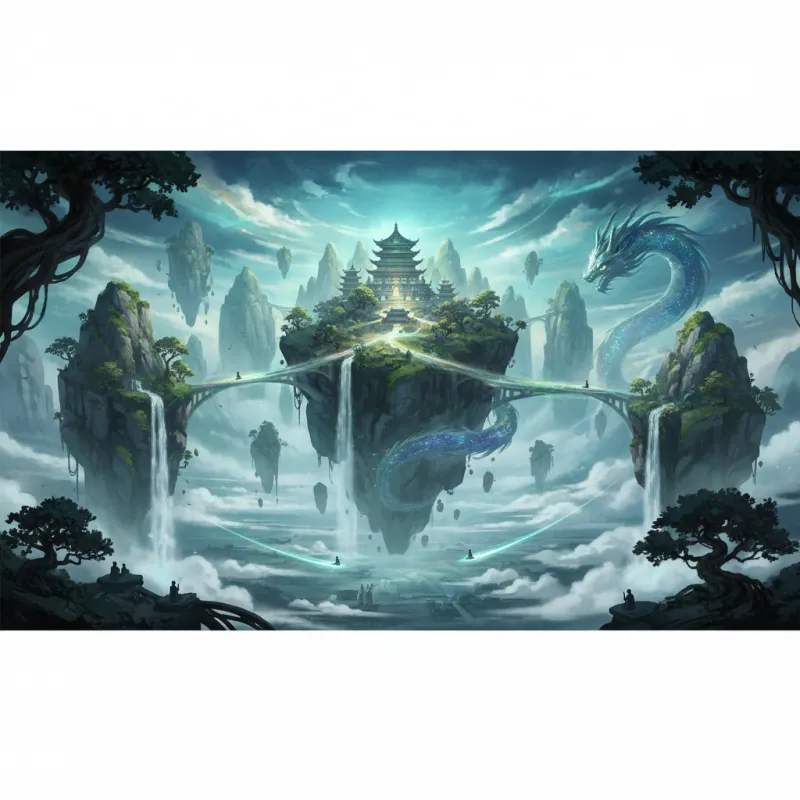
You're staring at a blank page, fingers hovering over the keyboard, and you've just decided to write a cultivation novel. Maybe you binged Cradle and thought, "I can do this." Maybe you fell down the donghua rabbit hole and emerged three weeks later with a head full of golden cores and heavenly tribulations. Either way, you're about to make the same mistakes ninety percent of Western cultivation authors make — and I'm going to help you avoid them.
Stop Treating Cultivation Like D&D With Chinese Characteristics
The single biggest error Western authors make is treating cultivation as a reskinned RPG progression system. They slap Chinese terms onto what is essentially a LitRPG framework: kill monsters, gain experience, level up your "cultivation base" like it's a stat sheet. This fundamentally misunderstands what cultivation fiction is actually about.
Cultivation (修炼 xiūliàn) isn't just magical power-leveling. It's a process of self-refinement that draws from Daoist internal alchemy (内丹 nèidān), Buddhist enlightenment concepts, and Confucian self-cultivation philosophy. When a character breaks through to Foundation Establishment (筑基 zhùjī), they're not just hitting level 20 — they're fundamentally restructuring their body and consciousness. The breakthrough should feel like a spiritual transformation, not a video game achievement notification.
Look at how Er Gen handles this in I Shall Seal the Heavens. When Meng Hao forms his Perfect Foundation, it's not just "congratulations, you're stronger now." The narrative dwells on the philosophical implications, the way his perception of reality shifts, the price he paid in understanding and sacrifice. Compare that to the average Royal Road cultivation novel where Foundation Establishment is just the gate to unlock better techniques.
The Power System Needs Internal Logic, Not Just Cool Names
Western authors love collecting cultivation realm names like Pokémon cards. Qi Condensation, Foundation Establishment, Core Formation, Nascent Soul, Spirit Severing — they copy the terminology without understanding why these stages exist in this order. Each realm in classical cultivation fiction represents a specific stage of Daoist internal alchemy, and the progression follows a coherent metaphysical logic.
Qi Condensation (凝气 níngqì) is about gathering and refining the body's vital energy. Foundation Establishment creates a stable base for that energy to circulate. Core Formation (结丹 jiédān) literally forms a golden core (金丹 jīndān) in the dantian — this is a direct reference to Daoist alchemical practices where practitioners attempted to create an immortal embryo within themselves. Nascent Soul (元婴 yuányīng) is when that embryo "hatches" into a spiritual infant that can exist independently of the physical body.
See the logic? Each stage builds on the previous one in a way that mirrors actual Daoist cultivation theory. When you invent your own realm system, it needs this same internal coherence. Don't just string together cool-sounding words. Ask yourself: what is the cultivator actually doing at each stage? How does it prepare them for the next transformation?
Your Protagonist Needs More Than Determination and Plot Armor
The "plucky underdog with mysterious heritage who out-works everyone" is the most overused protagonist template in Western cultivation fiction. Yes, hard work and determination matter in cultivation stories — but they're not sufficient on their own, and treating them as such reveals a very Western, very Protestant work-ethic mindset that doesn't quite fit the genre.
Classical cultivation protagonists succeed through a combination of factors: comprehension (悟性 wùxìng), karmic fortune (机缘 jīyuán), temperament, and yes, effort. Comprehension is particularly important and often overlooked by Western authors. It's not just "being smart" — it's the ability to grasp the profound truths underlying cultivation techniques, to understand the Dao itself. Some people simply have better comprehension than others, and no amount of hard work can fully compensate for that gap.
This might feel unfair to Western readers raised on "anyone can achieve anything with enough effort" narratives, but it's philosophically consistent with the genre's roots. Buddhism and Daoism both acknowledge that beings have different levels of spiritual capacity based on their karma and nature. The protagonist usually has exceptional comprehension — that's part of what makes them the protagonist. But they still need fortunate encounters, good teachers, and the right temperament to succeed.
Look at Wang Lin from Renegade Immortal. His comprehension is actually mediocre at first, but his temperament — his willingness to endure, his calculating nature, his ability to make hard choices — carries him forward. That's more interesting than "he just worked harder than everyone else."
Techniques Should Reflect Philosophy, Not Just Do Damage
Western cultivation novels treat techniques (功法 gōngfǎ) like spells in a fantasy novel: discrete abilities with cool names that deal damage or provide utility. But in Chinese cultivation fiction, techniques are expressions of philosophical understanding. The way a character fights reveals their comprehension of the Dao.
Take sword cultivation (剑修 jiànxiū) as an example. It's not just "fighting with swords but magical." Sword cultivators in Chinese fiction often follow a path of extreme focus and purity of intent — one sword, one path, cutting through all obstacles. This reflects Daoist ideas about simplicity and directness. When a sword cultivator's technique is described as "returning to simplicity" (返璞归真 fǎnpúguīzhēn), that's not just flavor text — it's indicating they've achieved a higher level of understanding where complex techniques become unnecessary.
Your techniques should work the same way. Don't just create a list of abilities. Think about what philosophical principle each technique embodies. A fire-path cultivator might have techniques that reflect transformation and purification. An earth-path cultivator might emphasize stability and endurance. When characters advance, their techniques should evolve to reflect deeper understanding, not just deal more damage.
The World Needs to Feel Genuinely Dangerous and Amoral
One thing Chinese cultivation fiction does consistently well that Western authors often soften: the world is genuinely amoral and dangerous. Might makes right isn't just a saying — it's the fundamental law of reality. Weak cultivators get killed or enslaved. Resources are scarce and worth killing for. Sects and clans operate like organized crime families with better PR.
Western authors often try to import modern moral frameworks into cultivation settings, creating "good guy" sects and "evil" sects with clear moral distinctions. But in classical cultivation fiction, almost everyone is morally gray. The "righteous" sects (正道 zhèngdào) aren't actually righteous — they're just more concerned with reputation and following certain rules. They'll still kill you for your treasures if they can get away with it.
This doesn't mean your story needs to be grimdark or nihilistic. But it does mean you need to take seriously the implications of a world where personal power is the ultimate arbiter of right and wrong. When your protagonist kills someone and takes their stuff, other cultivators shouldn't be shocked — they should be calculating whether they can do the same to your protagonist. Check out how Reverend Insanity handles this; Fang Yuan operates in a world where everyone understands the rules, and the tension comes from watching him navigate that amoral landscape with perfect clarity.
Face and Reputation Matter More Than You Think
Face (面子 miànzi) is a concept Western authors intellectually understand but rarely implement effectively. It's not just about pride or ego — it's a social currency that has real, material consequences in cultivation worlds. Losing face can mean losing access to resources, allies, and opportunities. Gaining face can open doors that raw power alone cannot.
When a young master challenges your protagonist to a duel, it's not just because he's arrogant (though he probably is). It's because allowing a lower-realm cultivator to disrespect him without consequence would damage his face, which would damage his sect's face, which would have cascading effects on his sect's ability to recruit disciples, form alliances, and compete for resources. The entire social structure of cultivation worlds runs on face.
Your protagonist needs to understand this system and navigate it strategically. Sometimes they need to give face to avoid unnecessary conflicts. Sometimes they need to take face to establish their position. The best cultivation protagonists know when to be humble and when to be domineering — and it's not just about power levels, it's about reading the social situation correctly.
Actually Read Chinese Cultivation Novels
This should be obvious, but I'm going to say it anyway: if you want to write cultivation fiction, you need to read actual Chinese cultivation novels, not just Western interpretations. Read Er Gen. Read I Eat Tomatoes. Read Mao Ni. Yes, the translations can be rough, and yes, some of them are hundreds of chapters long, but that's the genre you're trying to write in.
Pay attention to pacing — Chinese web novels have a very different rhythm than Western fantasy. Notice how face-slapping scenes are structured. Observe how romance is handled (or not handled). See how authors balance philosophical exposition with action. Learn the common tropes and understand why they exist before you subvert them.
And please, for the love of the Heavenly Dao, learn at least basic Chinese cultivation terminology and use it correctly. Don't call it "chi" when you mean "qi" (气 qì). Understand the difference between a cultivation technique (功法 gōngfǎ) and a martial technique (武技 wǔjì). Know that "dantian" (丹田 dāntián) refers to specific energy centers in the body, not just a generic "mana pool." These details matter to readers who know the genre.
The Best Western Cultivation Fiction Knows What to Keep and What to Adapt
Here's the thing: you're not writing for a Chinese audience. You're writing in English, probably for Western readers, and that means some adaptation is not just acceptable but necessary. The key is knowing what's essential to the genre and what's culturally specific packaging.
Essential: the progression through cultivation realms as spiritual transformation, the importance of comprehension and fortunate encounters, the amoral power dynamics, techniques as expressions of philosophy, the role of face in social interactions.
Adaptable: specific realm names (though keep the internal logic), the exact structure of sects and clans, the degree of Chinese cultural elements in the setting, pacing and chapter length, how much face-slapping you include.
Cradle by Will Wight is the gold standard here. It keeps everything essential about cultivation fiction — the realm progression, the importance of understanding your path, the way power reshapes society, the role of mentors and fortunate encounters. But it adapts the setting, creates its own terminology that follows cultivation logic, and paces the story for Western readers. The result feels authentically cultivation while being completely accessible to readers who've never heard of xianxia.
That's your goal. Not to write a Chinese cultivation novel in English, but to write a cultivation novel that understands and respects the genre's philosophical and structural foundations while telling a story that works for your audience.
Now stop reading articles about how to write cultivation fiction and go write your cultivation fiction. The Heavenly Dao waits for no one, and neither does your Royal Road upload schedule.
Related Reading
- Cultivation Web Novels: The Genre That Conquered the Internet
- Best Cultivation Web Novels in 2024-2025: Updated Reading List
- Top 10 Cultivation Web Novels That Changed the Genre
- 50 Cultivation Novel Tropes Every Reader Will Recognize
- Unraveling the Essence of Tribulations in Chinese Cultivation Fiction
- The Essence of Immortality: Understanding Chinese Cultivation and Xianxia Fiction
- The Alchemist's Arsenal: Cauldrons, Furnaces, and Essential Equipment