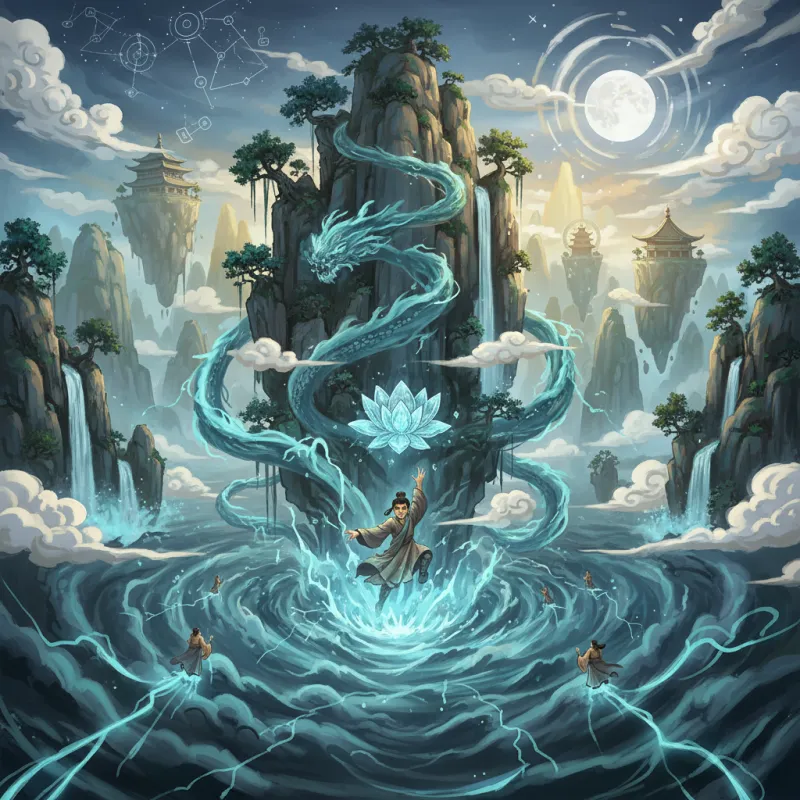
Lightning splits the heavens. A cultivator kneels on a mountain peak, blood streaming from seven orifices, as the ninth and final bolt descends. This is the moment every reader of xianxia fiction waits for—the tribulation that separates mortals from immortals, the living from legends. Yet tribulations (劫难, jiénàn) represent far more than spectacular set pieces in Chinese cultivation novels. They're the philosophical backbone of an entire genre, embodying ancient Daoist principles about transformation through suffering that date back over two millennia.
The Daoist Roots of Heavenly Punishment
The concept of tribulation in cultivation fiction didn't emerge from nowhere. It draws directly from Daoist alchemical texts like the Baopuzi (抱朴子), written by Ge Hong in 317 CE, which described the "three disasters and nine difficulties" (三灾九难, sān zāi jiǔ nàn) that practitioners faced when refining elixirs or their own bodies. The idea was simple yet profound: Heaven itself tests those who dare to transcend their mortal limitations. This wasn't punishment for wrongdoing—it was quality control. The universe maintains balance by eliminating those unworthy of immortality.
Modern xianxia authors have transformed these abstract philosophical concepts into visceral narrative events. When Wang Lin faces his Nascent Soul tribulation in Renegade Immortal (仙逆, Xiān Nì), he's not just fighting lightning—he's proving to the Heavens that his dao heart is unshakeable. The tribulation becomes a dialogue between cultivator and cosmos, a test of worthiness that readers instinctively understand because it mirrors our own struggles against seemingly insurmountable obstacles.
The Mechanics of Heavenly Tribulation
Most cultivation novels establish a clear hierarchy of tribulations corresponding to major realm breakthroughs. The pattern typically follows the numerology beloved by Chinese mysticism: three-three-nine. Three bolts for Foundation Establishment, three waves of nine bolts for Core Formation, and the dreaded nine-by-nine (eighty-one bolts) for ascending to immortality. These aren't arbitrary numbers—they echo the I Ching's cosmology where nine represents the ultimate yang, the peak of heavenly power.
But here's where authors get creative. The tribulation's severity scales with the cultivator's potential and the "defiance of heaven" (逆天, nì tiān) inherent in their cultivation method. A genius who cultivates a heaven-grade technique faces tribulations that would instantly vaporize ordinary cultivators. This creates delicious narrative tension: the more talented you are, the harder Heaven tries to kill you. It's the ultimate high-risk, high-reward system.
Some novels introduce variations that keep the formula fresh. A Record of a Mortal's Journey to Immortality (凡人修仙传, Fánrén Xiūxiān Zhuàn) features "inner demons" (心魔, xīn mó) as psychological tribulations that attack the cultivator's dao heart rather than their physical body. Others include "wind, fire, and thunder" tribulations where each element tests different aspects of cultivation. The best authors use these variations to reveal character—how a protagonist faces their tribulation tells us everything about their dao.
Beyond Lightning: The Tribulation as Narrative Device
Tribulations serve multiple storytelling functions that explain their ubiquity in cultivation fiction. First, they're natural power gates that prevent protagonists from advancing too quickly. When readers complain about pacing in cultivation novels, it's often because the author hasn't properly utilized tribulations to create breathing room between power-ups.
Second, tribulations are spectacular showcases for an author's imagination. The description of Meng Hao's tribulation in I Shall Seal the Heavens (我欲封天, Wǒ Yù Fēng Tiān) spans multiple chapters and includes lightning shaped like ancient beasts, tribulation clouds that form immortal runes, and even the manifestation of karmic debts as physical attackers. These scenes are cultivation fiction's equivalent of superhero battles—readers come for the spectacle.
Third, and most importantly, tribulations externalize internal growth. When a cultivator survives their tribulation, they've proven something to themselves and to readers. The physical transformation—breaking through to a new realm—mirrors the spiritual transformation that's been building throughout the arc. It's showing rather than telling, made literal through divine lightning.
The Social Dimension of Tribulation
Here's something casual readers often miss: tribulations are intensely social events in cultivation worlds. When a powerful cultivator undergoes tribulation, it affects everyone nearby. Tribulation lightning doesn't discriminate—get too close and you'll be collateral damage. This creates fascinating scenarios where enemies must temporarily cooperate, or where sects evacuate entire regions.
The aftermath of tribulations also drives plot. Cultivators are vulnerable immediately after breaking through, creating windows for assassination or rescue. Rival sects time their attacks around expected tribulations. Some novels feature "tribulation treasures" (渡劫法宝, dù jié fǎbǎo) specifically designed to help survive these ordeals, creating entire economies around tribulation preparation. In Martial World (武极天下, Wǔ Jí Tiānxià), the protagonist's ability to help others survive tribulations becomes a major source of his influence and wealth.
There's also the question of tribulation etiquette. Interfering with someone's tribulation is considered a grave offense in most cultivation worlds—you're essentially helping Heaven kill them. Yet protecting someone from opportunistic enemies during their vulnerable post-tribulation state is seen as righteous. These unwritten rules create complex social dynamics that good authors exploit for drama.
Failed Tribulations and Narrative Stakes
Death is cheap in many cultivation novels, but tribulation death feels permanent. When a character fails their tribulation, they're not just killed—they're erased, body and soul scattered by heavenly lightning. This finality raises the stakes in ways that regular combat can't match. You can be rescued from a losing battle, but there's no cavalry coming when Heaven itself wants you dead.
Some authors subvert this expectation brilliantly. In Reverend Insanity (蛊真人, Gǔ Zhēnrén), the protagonist Fang Yuan treats tribulations as puzzles to be solved through preparation and cunning rather than raw power. He studies historical records of tribulations, prepares contingencies, and even deliberately triggers tribulations at advantageous times. This transforms tribulations from random difficulty spikes into strategic elements that showcase his intelligence.
Failed tribulations also serve as cautionary tales within the narrative. When a proud young master fails their tribulation in chapter three, it establishes the danger for when the protagonist faces theirs in chapter thirty. These failures aren't wasted—they're worldbuilding through demonstration, showing readers that the rules apply to everyone.
The Evolution of Tribulation in Modern Xianxia
Contemporary cultivation novels have begun experimenting with the tribulation formula in interesting ways. Some authors question the premise entirely: why does Heaven oppose cultivation? Is it truly maintaining cosmic balance, or is there a more sinister explanation? Lord of the Mysteries (诡秘之主, Guǐmì Zhī Zhǔ), while not strictly xianxia, explores similar themes where advancement requires surviving "accommodations" with eldritch knowledge—a psychological twist on physical tribulations.
Others have introduced "tribulation luck" (劫运, jié yùn) as a measurable resource. Cultivators can accumulate or lose tribulation luck through their actions, affecting their tribulation's severity. This adds a moral dimension: evil deeds make your tribulation harder, creating a cosmic justice system that feels more nuanced than simple karma.
The most innovative recent development is "shared tribulations" where multiple cultivators face a combined tribulation together. This creates fascinating dynamics—do you cooperate or compete? What happens when one person is clearly weaker? These scenarios explore cultivation partnerships in high-stakes situations that reveal true character.
Why Tribulations Resonate
Ultimately, tribulations endure in cultivation fiction because they tap into something universal. We all face moments where we must prove ourselves, where the universe seems to conspire against our growth, where we must transform or perish. The cultivator kneeling before heavenly lightning is every reader facing their own impossible challenge—exams, career transitions, personal crises.
The genius of the tribulation concept is that it makes this struggle literal and spectacular. Your internal demons become actual demons. Your fear of failure manifests as lightning that can kill you. The transformation you undergo isn't metaphorical—you physically become something more than human. This is why readers return to cultivation fiction again and again: it takes our mundane struggles and elevates them to cosmic significance.
When that ninth bolt finally descends and the cultivator emerges transformed, we feel it. We've survived our own tribulations alongside them. And we're ready for the next realm, the next challenge, the next impossible test that will forge us into something greater. That's the true essence of tribulation in Chinese cultivation fiction—not the lightning, but the transformation it represents.
Related Reading
- The Essence of Immortality: Understanding Chinese Cultivation and Xianxia Fiction
- Auction House Economics: How Cultivation Markets Shape Power Dynamics
- Weapon Spirits: When Your Sword Has Opinions