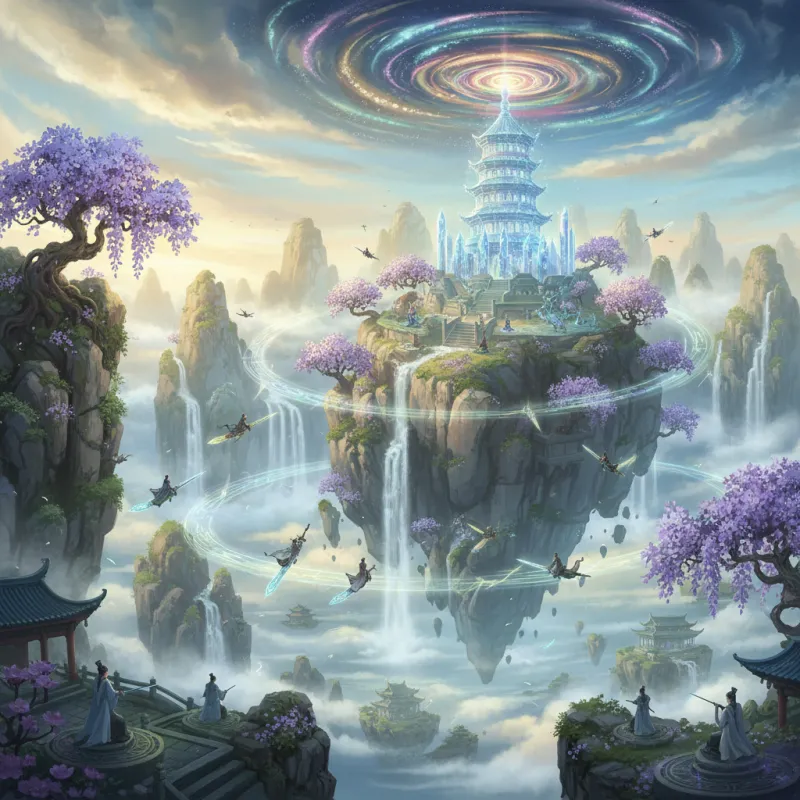
A young scholar stands at the edge of a misty mountain peak, swallowing a single golden pill. His body erupts with light as centuries of mortal limitation shatter like glass. This scene—repeated in countless novels, dramas, and games—captures something the West has never quite grasped: the idea that immortality isn't a gift from gods, but a skill you can learn. Welcome to xianxia, where the boundary between human and divine is just another obstacle to overcome through sheer, stubborn cultivation.
The Daoist Dream That Became Fiction
The obsession with immortality didn't start with novels. During the Warring States period (475-221 BCE), Daoist alchemists were already experimenting with mercury and cinnabar, convinced they could brew physical immortality in a cauldron. Emperor Qin Shi Huang famously sent expeditions across the sea searching for the mythical Penglai Mountain where immortals supposedly lived. These weren't metaphors—these were actual attempts to transcend death through technique and knowledge.
The Zhuangzi (莊子, Zhuāngzǐ) and Daodejing (道德經, Dàodéjīng) laid the philosophical groundwork, but it was the Baopuzi (抱朴子, Bàopǔzǐ) by Ge Hong in 320 CE that gave us the technical manual. Ge Hong described specific breathing exercises, sexual practices, dietary restrictions, and alchemical formulas for achieving xian (仙, xiān)—immortal status. He categorized immortals into hierarchies: celestial immortals who ascended to heaven, earthly immortals who remained in sacred mountains, and corpse-free immortals who shed their mortal bodies entirely. Sound familiar? Modern xianxia novels didn't invent their ranking systems—they inherited them.
When Mythology Met Martial Arts
The leap from religious practice to popular fiction happened during the Ming (1368-1644) and Qing (1644-1912) dynasties. Journey to the West (西遊記, Xīyóujì) gave us Sun Wukong, the monkey who ate immortality peaches, learned 72 transformations, and battled his way through heaven. But the real game-changer was Investiture of the Gods (封神演義, Fēngshén Yǎnyì), which introduced the concept of cultivation levels, magical treasures, and sect warfare that would define the genre centuries later.
These weren't just adventure stories—they were instruction manuals disguised as entertainment. Readers learned about meridians (經絡, jīngluò), the channels through which qi (氣, qì) flows. They discovered dantian (丹田, dāntián), the energy centers where power accumulates. The novels codified what had been scattered across esoteric texts into narrative form that anyone could understand. For more on how these energy systems work in practice, see The Fundamentals of Qi Cultivation.
The Modern Xianxia Explosion
Fast forward to 2000s China, where internet literature platforms like Qidian created a perfect storm. Writers could publish chapters daily, readers could comment in real-time, and the most popular works earned serious money. Stellar Transformations (星辰變, Xīngchén Biàn) by I Eat Tomatoes pioneered the "weak to strong" progression that became genre law. Coiling Dragon (盤龍, Pánlóng) introduced multi-realm cosmologies where entire universes served as stepping stones. A Record of a Mortal's Journey to Immortality (凡人修仙傳, Fánrén Xiūxiān Zhuàn) proved you could write 2,000+ chapters about a protagonist with no special bloodline or destiny—just relentless, methodical cultivation.
What makes modern xianxia different from its classical predecessors? Scale and systematization. Ancient texts were vague about cultivation methods—modern novels give you exact breakthrough requirements. Classical immortals were rare exceptions—xianxia worlds have entire economies built around spirit stones and pill refinement. The genre took Daoist mysticism and ran it through video game logic, creating something that feels both ancient and utterly contemporary.
The Cultivation Ladder: From Mortal to God
Every xianxia novel has its own cultivation system, but they share a common DNA. You start in Qi Condensation (凝氣, Níng Qì), learning to sense and gather spiritual energy. Foundation Establishment (築基, Zhùjī) comes next, where you build a stable base for future growth. Core Formation (結丹, Jié Dān) involves condensing your qi into a golden core—a literal power source inside your body.
Then things get interesting. Nascent Soul (元嬰, Yuán Yīng) means growing a spiritual infant that can survive even if your body dies. Soul Formation (化神, Huà Shén) merges that infant with your consciousness. Void Refinement (煉虛, Liàn Xū) lets you manipulate space itself. And that's just the lower realms—most novels have another 5-10 levels beyond that, each requiring centuries of effort and life-threatening tribulations.
The genius of this system is how it gamifies enlightenment. Buddhist and Daoist cultivation in real life is deliberately non-linear and paradoxical—you can't force enlightenment through effort alone. Xianxia says "actually, you can," turning spiritual development into something with clear metrics and achievable goals. It's philosophically questionable but narratively irresistible.
Tribulations: Heaven's Quality Control
Here's where xianxia gets metal: the universe actively tries to kill you for getting too powerful. Heavenly tribulations (天劫, tiān jié) are lightning storms, fire tempests, or reality-warping catastrophes that strike whenever you attempt a major breakthrough. Fail, and you're ash. Succeed, and your body is reforged stronger than before.
This isn't arbitrary cruelty—it's based on the Daoist concept of balance. Heaven (天, tiān) maintains cosmic order, and immortals represent an imbalance, beings who refuse to die when they should. The tribulations are tests, but also opportunities. Each lightning bolt that doesn't kill you tempers your body like a blacksmith's hammer. Some protagonists even seek out stronger tribulations deliberately, knowing that greater risk means greater reward. For deeper exploration of how tribulation mechanics evolved, check out The Role of Heavenly Tribulations in Cultivation.
Why Xianxia Resonates Globally
Western fantasy gives you chosen ones and prophecies—you're special because destiny says so. Xianxia gives you a technique manual and says "get to work." The appeal is obvious: in a world where social mobility feels increasingly impossible, here's a genre where anyone with enough determination can literally transcend their circumstances. No divine blessing required, just ten thousand hours of meditation and a willingness to eat bitter (吃苦, chī kǔ).
The genre also scratches a particular itch that Western progression fantasy tries to replicate but never quite captures. LitRPG gives you numbers going up, but xianxia gives you existential transformation. Each realm isn't just a power boost—it's a fundamental change in how you perceive and interact with reality. A Nascent Soul cultivator doesn't just have more qi than a Foundation Establishment cultivator; they experience time differently, can perceive spiritual fluctuations invisible to lower realms, and have begun the process of separating from mortal limitations entirely.
The Dark Side of Immortality
Modern xianxia doesn't shy away from the moral implications of its premise. When you've lived for ten thousand years, do mortal lives still matter? When power determines everything, what happens to compassion? The genre is full of "demonic cultivators" (魔修, mó xiū) who harvest others' cultivation, righteous sects that are corrupt to the core, and protagonists who commit casual genocide against anyone who disrespects them.
This moral ambiguity reflects something honest about the pursuit of transcendence: it's inherently selfish. You're trying to escape the natural order, to place yourself above the cycle of birth and death that governs all other beings. Classical Daoism emphasized wu wei (無為, wú wéi)—effortless action in harmony with the Dao. Xianxia cultivation is the opposite: forceful, aggressive, and willing to overturn heaven itself for personal gain. The genre works because it admits what the philosophy couldn't—that the desire for immortality is fundamentally about ego, about refusing to accept your own insignificance.
The Living Tradition
What started as Daoist alchemy experiments two thousand years ago is now a multi-billion dollar industry spanning novels, comics, games, and television. The Untamed brought xianxia to mainstream Chinese television. Grandmaster of Demonic Cultivation became a global phenomenon. Western authors are writing their own cultivation novels, adapting the framework to new settings and cultures.
The essence of xianxia isn't the flying swords or the spirit stones—it's the promise that transformation is possible through systematic effort. That you can study the universe's laws and use them to rewrite your own nature. That mortality is a problem with a solution, if you're willing to pay the price. Whether that's inspiring or terrifying probably depends on how much you're willing to sacrifice for power. But either way, the dream of cultivation endures, as immortal as the xian it depicts.
Related Reading
- Exploring the Intricate World of Chinese Cultivation and Xianxia Fiction
- Unraveling the Essence of Tribulations in Chinese Cultivation Fiction
- Unraveling the Mysteries of Chinese Cultivation and Xianxia Fiction