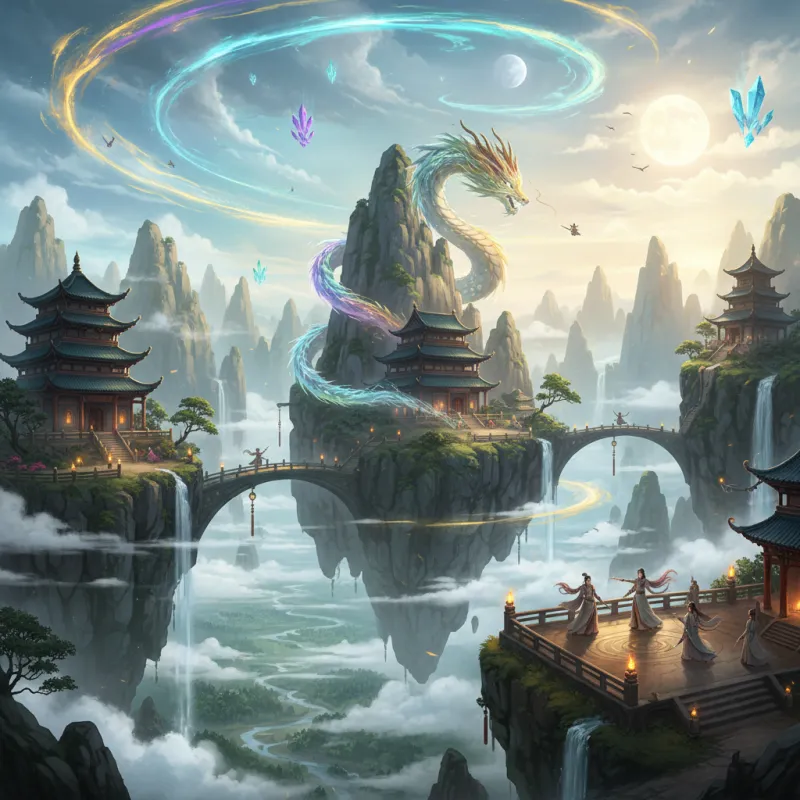
The first time you watch a cultivator shatter mountains with a gesture or fly on a sword through clouds, you might dismiss it as pure fantasy. But dig deeper into Chinese cultivation fiction—xianxia (仙侠, xiānxiá)—and you'll discover something far more intriguing: a literary tradition that's been wrestling with humanity's oldest question for over two millennia. How do we transcend our mortal limitations?
The Daoist Roots: More Than Just Flying Swordsmen
Cultivation fiction didn't emerge from a vacuum. Its DNA traces directly to the Warring States period (475-221 BCE), when Daoist philosophers like Zhuangzi wrote about immortals who "mounted the clouds and mist, rode the flying dragons, and wandered beyond the four seas." The Zhuangzi describes these transcendent beings not as gods, but as humans who achieved perfection through cultivation—a radical idea that placed spiritual evolution in human hands rather than divine whim.
The Baopuzi (抱朴子, Bàopǔzǐ), written by Ge Hong in 320 CE, took this further by cataloging actual cultivation methods: alchemical formulas, breathing techniques, dietary restrictions, and meditation practices. Ge Hong wasn't writing fiction—he genuinely believed these methods could grant immortality. Modern xianxia authors inherited this framework wholesale, transforming Ge Hong's earnest manual into narrative gold. When you read about protagonists consuming spirit herbs or practicing qi circulation, you're seeing echoes of texts that predate the Roman Empire's fall.
The Cultivation Hierarchy: Why Everyone's Obsessed with Realms
Every cultivation novel features the same basic structure: a protagonist ascends through increasingly powerful realms, from Qi Condensation to Foundation Establishment to Golden Core and beyond. This isn't arbitrary game design—it reflects the Daoist concept of progressive refinement, where spiritual advancement occurs in discrete stages, each requiring a qualitative transformation.
The realm system serves a brilliant narrative function. In Western fantasy, power levels remain frustratingly vague—is Gandalf stronger than Saruman? By how much? Cultivation fiction eliminates this ambiguity. When a Golden Core cultivator faces a Nascent Soul expert, readers know exactly how outmatched they are. This creates delicious tension when protagonists must "fight above their realm" (越级战斗, yuèjí zhàndòu), a trope so beloved it appears in virtually every cultivation novel.
But here's what makes it fascinating: the realm system also functions as social commentary. Cultivation societies are ruthlessly meritocratic hierarchies where your realm determines your worth. Sound familiar? Modern Chinese readers recognize this as a fantastical mirror of their own examination-based society, where gaokao scores and university rankings determine life trajectories. The cultivation world's "the strong prey on the weak" (弱肉强食, ruòròu-qiángshí) philosophy reflects anxieties about social mobility in contemporary China.
Alchemy and Artifacts: The Material Culture of Immortality
One aspect that distinguishes xianxia from Western fantasy is its obsessive focus on crafting and consumption. Protagonists don't just find magical swords—they spend chapters gathering materials, studying formation arrays, and refining pills in alchemical furnaces. This reflects the Daoist tradition of external alchemy (外丹, wàidān), where practitioners believed consuming the right substances could grant immortality.
The most successful cultivation novels treat their magic systems like intricate puzzles. In A Record of a Mortal's Journey to Immortality (凡人修仙传, Fánrén Xiūxiān Zhuàn), protagonist Han Li succeeds not through raw talent but through careful resource management and strategic planning. He's less a chosen hero and more a savvy entrepreneur navigating a cutthroat market. This resonates with readers who understand that success requires more than talent—it demands shrewd calculation and relentless effort.
The emphasis on cultivation techniques and methods also creates a unique reading experience. Western fantasy readers might skim past magic system explanations, but xianxia fans devour detailed descriptions of pill refinement and formation arrays. There's genuine pleasure in understanding exactly how a protagonist manipulates spiritual energy to achieve a breakthrough.
The Morality Problem: Are Cultivators Actually Villains?
Here's where cultivation fiction gets uncomfortable. Most protagonists are, by conventional standards, terrible people. They slaughter entire families for perceived slights, steal resources from weaker cultivators, and betray allies without hesitation. The justification? "The cultivation world is cruel" (修仙界残酷, xiūxiān jiè cánkù).
This moral framework stems from a particular reading of Daoist philosophy that emphasizes transcending conventional morality. The Zhuangzi argues that sages operate beyond good and evil, following the natural way (道, dào) rather than human-constructed ethics. Cultivation fiction takes this to its logical extreme: if you're pursuing immortality, why should mortal concerns like compassion or justice constrain you?
Some novels interrogate this premise. Reverend Insanity (蛊真人, Gǔ Zhēnrén) features a protagonist so ruthlessly amoral that the novel was banned in China. Others, like Grandmaster of Demonic Cultivation (魔道祖师, Módào Zǔshī), explicitly critique the cultivation world's moral bankruptcy, showing how "righteous" sects commit atrocities while claiming moral superiority.
The tension between power-seeking and morality remains xianxia's most compelling unresolved question. Can you pursue transcendence without becoming a monster? Or does the path to immortality necessarily require abandoning your humanity?
Modern Evolution: From Web Novels to Global Phenomenon
Cultivation fiction exploded in the 2000s with the rise of Chinese web novel platforms. Suddenly, authors could publish serialized chapters daily, receiving immediate reader feedback through comments and donations. This created an evolutionary pressure toward addictive storytelling—cliffhangers, power escalation, and satisfying face-slapping moments where protagonists humiliate arrogant young masters.
The genre's global spread through translation sites like Wuxiaworld introduced cultivation concepts to international audiences. English-speaking readers now casually discuss "dao comprehension" and "heavenly tribulations" as if these were universal fantasy tropes. This cross-cultural pollination has influenced Western fantasy authors, who've begun incorporating cultivation elements into their own works.
What makes cultivation fiction endure isn't just the power fantasy—though that's certainly part of the appeal. It's the genre's engagement with fundamental questions about human potential, the price of ambition, and whether transcendence is worth the cost. These themes resonated in ancient China, and they resonate now, whether you're reading in Beijing or Brooklyn.
The Path Forward: Where Cultivation Fiction Goes Next
The genre faces creative challenges. After thousands of novels featuring similar realm systems and plot beats, how do you innovate? Some authors experiment with different cultivation systems and power structures, incorporating elements from Buddhism, Confucianism, or even Western occultism. Others focus on character depth and thematic complexity rather than pure power escalation.
The most interesting development might be cultivation fiction's increasing self-awareness. Newer novels often feature protagonists who've read cultivation novels themselves, allowing authors to subvert genre conventions while still delivering the satisfying beats readers expect. This meta-textual approach suggests the genre is maturing beyond its pulp fiction origins.
Whether cultivation fiction will maintain its current popularity remains uncertain. But its core appeal—the fantasy that through sufficient effort and determination, you can transcend your limitations and achieve immortality—taps into something deeply human. As long as readers dream of becoming more than they are, cultivation fiction will find an audience ready to follow protagonists on their journey from mortal to immortal, one realm breakthrough at a time.
Related Reading
- Auction House Economics: How Cultivation Markets Shape Power Dynamics
- Cultivation Worlds: How Web Novels Build Entire Universes
- Formation Arrays: The Magical Engineering of the Cultivation World