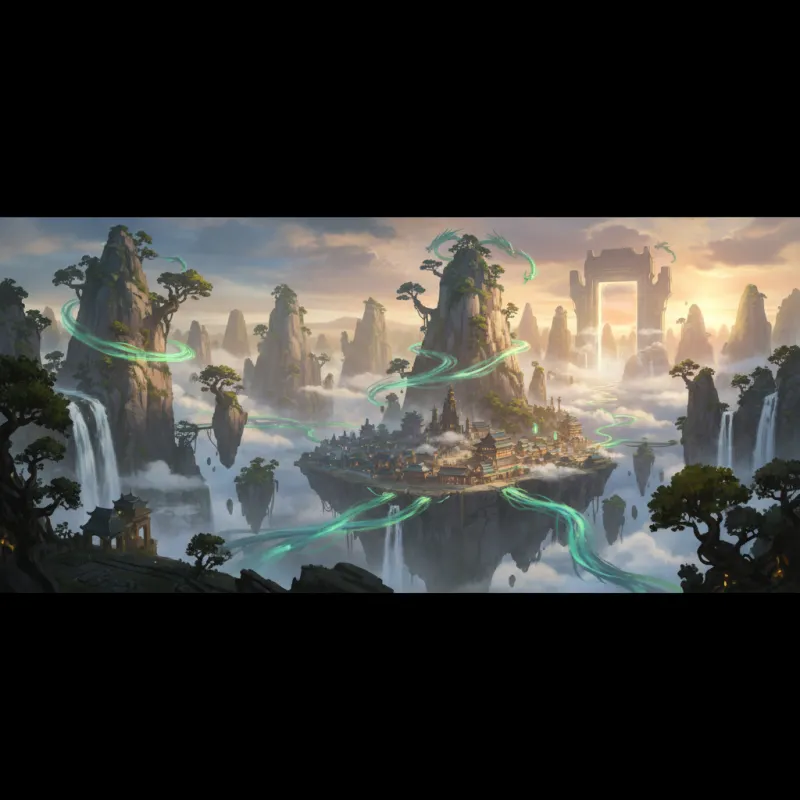
A single cultivator stands at the edge of a cliff, gazing up at the sky. But he's not looking at clouds or stars — he's looking at another world, floating above his own like a celestial island, where the spiritual energy is so dense it forms visible rivers of light. This is the moment readers realize: cultivation novels don't just have big worlds. They have stacked worlds, universes folded into universes, each one a complete setting that makes the previous realm look like a tutorial zone.
The Architecture of Infinity
Western fantasy typically builds outward — more continents, more kingdoms, more distant lands across the sea. Cultivation novels build upward. The structure is almost always the same: a hierarchy of realms stacked like floors in an infinite tower, each one exponentially larger and more powerful than the last.
Take A Record of a Mortal's Journey to Immortality (凡人修仙传, Fánrén Xiūxiān Zhuàn). The protagonist Han Li starts in a small mountain village, advances to dominate his region, then his nation, then his continent. Just when readers think they understand the scope of the world, he ascends to the Spirit Realm — and discovers his entire previous world was just one small lower realm among thousands. Then he ascends again to the Immortal Realm, where the Spirit Realm is considered backwater territory. The pattern repeats across 2,400 chapters.
This vertical structure solves a fundamental problem in long-form serial fiction: power creep. When your protagonist becomes the strongest person in the world by chapter 500, you need somewhere else for them to go. The solution isn't to make them weaker — readers hate that — but to reveal that their "world" was always just one small pond, and there are oceans beyond oceans waiting above.
The Fractal Pattern of Power
What makes cultivation worldbuilding genuinely sophisticated is that each realm mirrors the others in structure. It's fractal — the same organizational patterns repeat at every scale, from the smallest sect to the highest divine realm.
A typical mortal realm contains: nations, which contain sects, which contain peaks or halls, which contain master-disciple lineages. When the protagonist ascends to the Spirit Realm, they find... nations (now called territories), which contain sects (now called holy lands), which contain peaks, which contain lineages. The names change, the power levels increase exponentially, but the social architecture remains recognizable. This isn't lazy writing — it's elegant design. Readers can immediately understand the politics and power structures of a new realm because they follow familiar patterns, even as the stakes escalate to cosmic proportions.
Renegade Immortal (仙逆, Xiān Nì) demonstrates this beautifully. Wang Lin's journey takes him through the Zhao Kingdom, the State of Zhao, the Celestial Realm, the Ancient Celestial Realm, and finally the Cave Realm. Each level contains roughly the same political structures — alliances, betrayals, ancient clans, hidden experts — but the scope expands from a single planet to a galaxy to multiple universes. The fractal pattern lets author Er Gen maintain narrative coherence across a story that spans literally billions of years.
The Geography of Cultivation Density
The vertical structure isn't just about power levels — it's about spiritual energy density, what Chinese novels call lingqi (灵气). This is the fundamental resource that determines everything: how fast cultivators advance, how powerful their techniques become, how long they live, even what kinds of spiritual herbs and beasts can exist in a region.
Lower realms have thin spiritual energy. Cultivators there struggle for centuries to reach Foundation Establishment. Higher realms have dense spiritual energy — what would take a thousand years below might take only ten years above. This creates a brutal logic: talented cultivators must ascend or their potential will be wasted. Staying in a lower realm is like trying to become an Olympic athlete while training at high altitude with limited oxygen. You might be the best in your region, but you'll never reach your true potential.
This geography of cultivation density also explains one of the genre's most common plot devices: the "descending expert." When a cultivator from a higher realm visits a lower one, they're not just more powerful — they're operating with fundamentally better resources. Their casual techniques contain spiritual energy so dense it can shatter the local power structure. It's not just a power gap; it's a resource gap, an environmental advantage that makes fair competition impossible.
Secret Realms and Pocket Dimensions
But cultivation worlds aren't just vertically stacked — they're also folded. Nearly every cultivation novel features secret realms (秘境, mìjìng), pocket dimensions, ancient ruins, and hidden spaces that exist outside normal geography.
These spaces serve multiple narrative functions. They're treasure troves where protagonists find ancient techniques and powerful artifacts. They're training grounds where time flows differently — a year inside might be a day outside, letting cultivators compress decades of training into manageable timeframes. They're also remnants of previous eras, physical evidence that the current cultivation world is built on the ruins of older, more powerful civilizations.
Martial World (武极天下, Wǔjí Tiānxià) takes this concept to extremes. The protagonist Lin Ming discovers that his entire universe exists inside a fragment of a shattered higher realm. What he thought was the ultimate peak of cultivation is actually just the basement level of a much larger cosmos. The "secret realms" he explored weren't hidden spaces — they were glimpses of the true structure of reality, pieces of the original world that survived the shattering.
This creates a sense of archaeological depth. Cultivation worlds aren't just big — they're old, layered with the ruins of previous ages. Every secret realm suggests a history, a fallen civilization, a catastrophe that destroyed something greater. The worldbuilding becomes vertical in time as well as space.
The Economics of Ascension
Ascending between realms isn't just a matter of reaching sufficient cultivation level — it's also an economic and political process. Most novels establish that ascension requires resources: specific treasures, rare materials, or access to ascension platforms controlled by powerful factions.
This transforms ascension from a personal achievement into a social negotiation. In I Shall Seal the Heavens (我欲封天, Wǒ Yù Fēng Tiān), protagonist Meng Hao must navigate complex sect politics and ancient agreements to secure his ascension. The process isn't automatic — it's mediated by institutions, controlled by gatekeepers, and subject to interference by those who want to prevent talented cultivators from reaching higher realms.
This economic dimension adds realism to the worldbuilding. It explains why not every powerful cultivator ascends immediately — they're gathering resources, making preparations, ensuring they won't arrive in the higher realm as helpless newcomers. It also creates natural story tension: the protagonist must become strong enough to ascend, but also wealthy and connected enough to afford the journey.
The Problem of Infinite Escalation
The vertical universe structure creates one significant challenge: where does it end? If every realm has a higher realm above it, the story risks becoming repetitive. The protagonist dominates one level, ascends, struggles in the new environment, eventually dominates that level, ascends again... the pattern can feel mechanical after the third or fourth iteration.
The best cultivation novels solve this by making each realm qualitatively different, not just quantitatively more powerful. Desolate Era (莽荒纪, Mǎnghuāng Jì) by I Eat Tomatoes handles this well — the mortal realm focuses on sect politics and resource competition, the Immortal realm introduces cosmic-scale wars between different Daos, and the final realm becomes a metaphysical exploration of the nature of cultivation itself. Each level changes the type of story being told, not just the power scale.
The alternative is to establish a definite peak from the beginning. Coiling Dragon (盘龙, Pánlóng) does this effectively by introducing the concept of Sovereigns early — readers know there's an ultimate level, even if it takes thousands of chapters to reach it. The journey has a destination, which gives the escalation structure and purpose rather than infinite repetition.
Building Universes That Last
What makes cultivation worldbuilding remarkable isn't just its scale — it's its sustainability. These worlds support millions of words of storytelling because they're built on systematic principles: vertical hierarchy, fractal social structures, resource-based geography, and archaeological depth. Every element serves multiple narrative functions, creating a setting that can generate new stories and conflicts for thousands of chapters.
The vertical universe isn't just a backdrop — it's a narrative engine. Each realm transition resets the power dynamics while maintaining continuity of character and theme. The protagonist's personality and techniques carry forward, but the social context completely changes. It's like starting a new story while continuing the same journey, a structure that lets cultivation novels achieve lengths that would be impossible in more conventional settings.
When done well, as in works like A Record of a Mortal's Journey to Immortality or Renegade Immortal, the result is genuinely impressive: fictional universes with the complexity and depth of constructed worlds like Middle-earth or Westeros, but designed specifically for the demands of million-word serial fiction. These aren't just big worlds — they're sustainable worlds, built to last for the long journey from mortal to immortal and beyond.
Related Reading
- Cultivation World Geography: Understanding the Maps of Xianxia Fiction
- Mortal vs. Immortal Realm: The Two Worlds of Cultivation Fiction
- Mortal Realm to Immortal Realm: The Geography of Cultivation Worlds
- The Dao and Heavenly Laws: The Cosmic Rules of Cultivation
- Exploring the Fascinating Characters of Chinese Cultivation and Xianxia Fiction
- Unraveling the Mysteries of Chinese Cultivation and Xianxia Fiction
- Flying Swords: The Iconic Vehicles of Cultivation Fiction