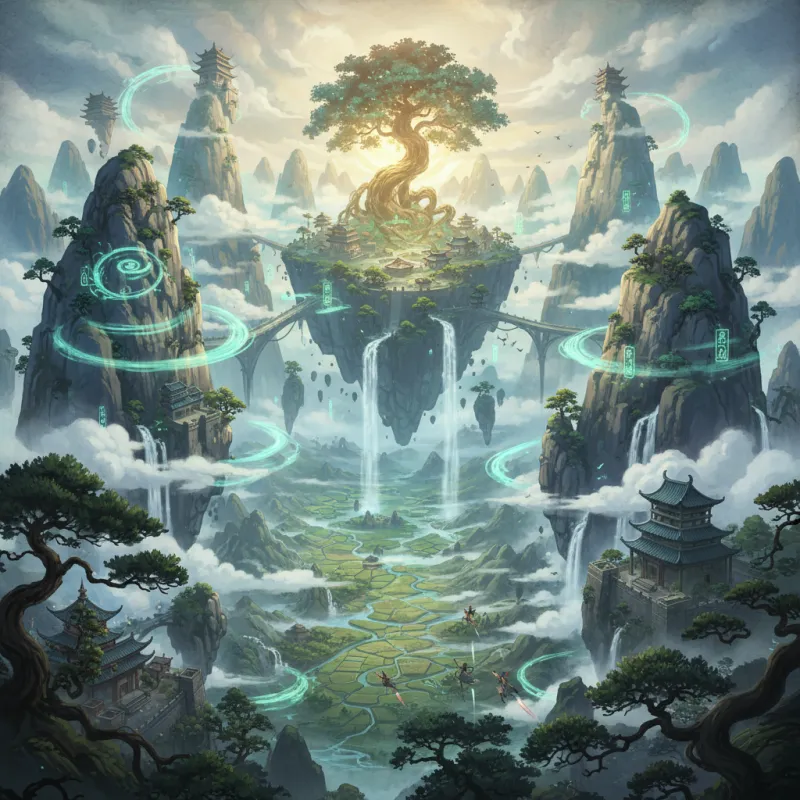
Every cultivation novel protagonist starts in the same place: a backwater so spiritually barren that reaching Foundation Establishment makes you a local legend. Then they discover their village sits on the absolute edge of a continent nobody important has visited in ten thousand years. This isn't coincidence or lazy writing—it's geographic determinism baked into the genre's DNA. The map is the power system, and understanding why these worlds all look the same reveals something fundamental about how xianxia stories work.
The Concentric Ring Model: Geography as Game Levels
Open any cultivation novel's map and you'll see the same structure: nested circles of increasing spiritual density, like a cosmic onion designed by a game developer. The outer rings have thin spiritual energy (灵气 língqì), producing weak cultivators who think Nascent Soul is mythical. The inner regions overflow with qi so dense it crystallizes into spirit stones. This isn't just worldbuilding—it's a progression system disguised as geography.
I Shall Seal the Heavens makes this explicit. Meng Hao starts in the State of Zhao, where Core Formation cultivators are legendary. Then he discovers the State of Zhao is one small region in the Southern Domain, which itself is the weakest of nine domains, which together form just the lower realm of a much larger cosmos. Each geographic revelation is a power ceiling being shattered. The protagonist doesn't just get stronger—he discovers he was always playing on easy mode.
This structure serves a narrative function that flat geography can't: it makes power progression feel like exploration rather than grinding. When your character breaks through to Soul Transformation, they don't just get new abilities—they unlock access to the Central Continent where Soul Transformation is the minimum requirement. Geography and cultivation realms synchronize perfectly, turning level-ups into literal world expansion.
The Four-Region Template: Why Every World Has the Same Borders
Here's the standard template, repeated across hundreds of novels: Four major regions (often called domains, continents, or lands) arranged around a central zone. The regions typically map to cardinal directions and elemental associations—Northern Ice Wastes, Southern Fire Territories, Eastern Wood Kingdoms, Western Metal Deserts. The center? That's where the real cultivators live.
Against the Gods uses this so literally it's almost parody. The Azure Cloud Continent has four divine regions surrounding the central God Realm. Each region has its own power hierarchy, but everyone knows the God Realm is where actual power resides. The protagonist spends hundreds of chapters climbing the local ladder before discovering he's been competing in the minor leagues.
Why this specific structure? It comes from Chinese cosmology's five-phase system (五行 wǔxíng)—wood, fire, earth, metal, water—mapped onto cardinal directions plus center. But cultivation novels weaponize this traditional framework. Each region becomes a self-contained arc with its own power ceiling, letting authors extend stories indefinitely by revealing new regions. Finished with the Eastern Divine Region? Time to visit the Western one, which conveniently has completely different power structures to explore.
The genius is that readers accept this because it feels mythologically grounded. We're not just reading about Random Fantasy Land #4—we're exploring a cosmos structured according to principles from actual Chinese philosophy. The fact that every novel uses the same structure becomes a feature, not a bug. We know what we're getting, and we're here for the execution, not the innovation.
Forbidden Zones: The Geography of "Don't Go There Yet"
Every cultivation world has places marked "certain death" on the map. Ancient battlefields where Immortal Emperors fought. Sealed demon realms. Mystic forests where space itself is unstable. These forbidden zones serve a crucial function: they're content the author is saving for later.
Martial World does this brilliantly with the Sky Spill Continent's forbidden areas. Early in the story, these zones are mentioned as places where even Divine Sea cultivators die instantly. By the time the protagonist reaches Divine Sea, those same zones become training grounds. The geography hasn't changed—the protagonist's power level has, and with it, his access to the map.
This creates a beautiful narrative tension. The world isn't expanding—it was always this big. You were just too weak to see it. That mountain range that seemed like the edge of the world? It's actually a protective barrier keeping weaklings out of the real cultivation world beyond. Those "impassable" oceans? They're only impassable if you can't fly for ten thousand miles without rest.
Forbidden zones also solve a worldbuilding problem: how do you have ancient ruins and treasures lying around without someone having looted them already? Answer: put them in places where 99.9% of cultivators die on entry. The protagonist's ability to survive these zones becomes proof of their special destiny, while also explaining why powerful artifacts are still available after millions of years of civilization.
Vertical Geography: When the Real Map is Up and Down
Here's where cultivation geography gets weird: the most important direction isn't north, south, east, or west—it's up. Many cultivation worlds stack their power structures vertically, with lower realms, middle realms, and upper realms literally existing at different altitudes or dimensional frequencies.
A Record of a Mortal's Journey to Immortality structures its entire cosmos this way. The mortal world sits at the bottom. Above it, the Spirit Realm, accessible only to those who've reached Spatial Tempering stage. Above that, the True Immortal Realm, where the story's real power players exist. Each realm has its own complete geography, but they're layered like floors in a building, with ascension being literal upward movement.
This vertical stacking solves the power creep problem elegantly. When your protagonist becomes too strong for the current realm, you don't need to invent a new continent—you send them to a higher dimensional plane where their hard-won power makes them a beginner again. It's the concentric ring model rotated 90 degrees, but it feels fresh because the protagonist isn't traveling to a new place—they're ascending to a new level of reality.
The vertical model also plays into Daoist cosmology's concept of heavenly realms and earthly realms. Immortals don't just live far away—they live above, in a more refined plane of existence. When cultivation novels make this literal, they're tapping into deep cultural associations between height, purity, and spiritual advancement. The protagonist's journey isn't just about getting stronger—it's about becoming refined enough to exist at higher frequencies of reality.
Secret Realms and Pocket Dimensions: Geography That Doesn't Follow Rules
Beyond the standard map, cultivation worlds are riddled with spaces that don't obey normal geography. Secret realms (秘境 mìjìng) that only open once every thousand years. Pocket dimensions created by ancient cultivators. Mystic pagodas that are bigger on the inside. These spaces serve as narrative pressure valves—places where normal rules don't apply and anything can happen.
Coiling Dragon uses this extensively with its countless planes of existence, each with different laws of physics and power systems. The protagonist doesn't just travel to new continents—he travels to entirely different universes with their own complete geographies. This lets the author reset the power scale repeatedly without breaking the world's internal logic.
Secret realms also solve the "why hasn't this been discovered before" problem. If a treasure vault only appears once every ten thousand years and kills most people who enter, it's plausible that powerful artifacts remain unclaimed. These spaces exist outside normal time and space, making them perfect repositories for plot-relevant items that need to appear exactly when the protagonist is ready for them.
The best cultivation novels use secret realms sparingly, as special events rather than constant occurrences. When every other chapter features a new pocket dimension, the main world starts feeling irrelevant. But used well, these spaces add mystery and unpredictability to otherwise formulaic geography. They're the wild cards in an otherwise structured deck.
Why This Geography Works: The Map as Progression System
The real genius of cultivation world geography isn't the specific structures—it's how perfectly the map synchronizes with character progression. In Western fantasy, characters might travel to new lands, but geography and power are separate systems. In cultivation novels, they're the same system. The map is the level progression chart.
This creates a unique reading experience where geographic discovery feels like character growth. When the protagonist learns about the Central Continent, we're not just learning lore—we're seeing the next stage of their journey materialize. The world expands in lockstep with the protagonist's power, making both feel earned rather than arbitrary.
It also explains why these novels can run for thousands of chapters without feeling repetitive. Each new geographic region is essentially a soft reboot—new power hierarchies, new factions, new challenges—while maintaining continuity through the protagonist's growth. The map provides structure for what could otherwise become an endless power escalation with no narrative framework.
Understanding cultivation world geography means recognizing it's not really about places—it's about stages. The Outer Regions, Inner Domains, Central Continent, and Upper Realms aren't locations on a map. They're chapters in a story about transcendence, dressed up as geography to make the journey feel like exploration rather than grinding. And once you see the pattern, you can't unsee it—but that doesn't make it any less effective at what it does.
Related Reading
- Mortal vs. Immortal Realm: The Two Worlds of Cultivation Fiction
- Mortal Realm to Immortal Realm: The Geography of Cultivation Worlds
- The Dao and Heavenly Laws: The Cosmic Rules of Cultivation
- Cultivation Worlds: How Web Novels Build Entire Universes
- The Inscription Arts: Talismans, Runes, and the Written Word as Weapon
- Mystical Beasts in Chinese Cultivation Fiction: Guardians of the Immortal Spiritual Realms
- Unraveling the Mysteries of Formations in Chinese Cultivation and Xianxia Fiction