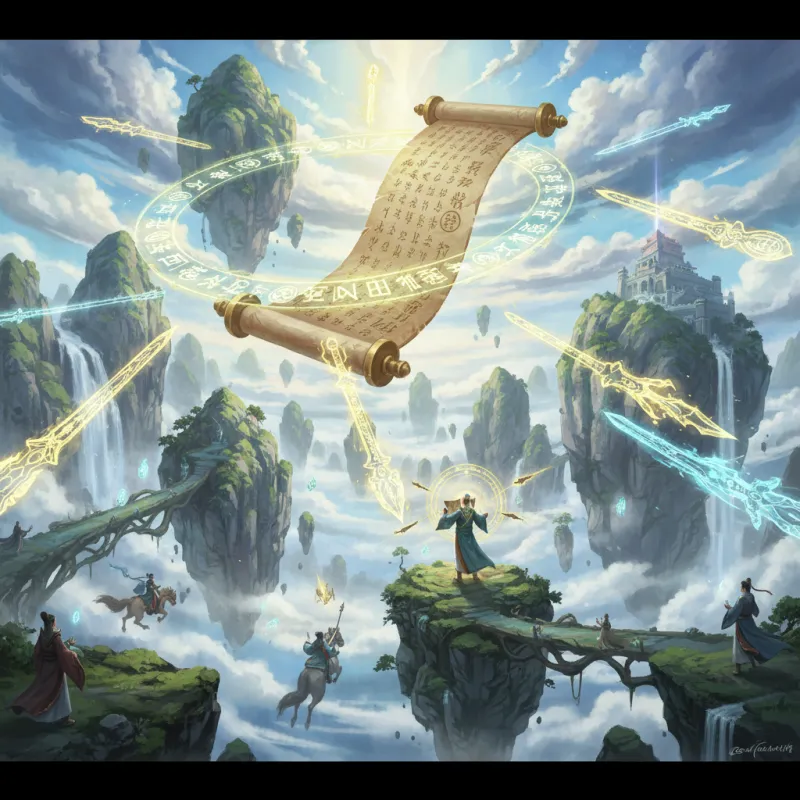
A cultivator's brush hovers over blank yellow paper. One stroke. Two. Three. The ink gleams with spiritual energy, and suddenly the paper erupts into flames that don't burn, or freezes the air around it, or explodes with the force of a Foundation Establishment expert's full-power strike. This isn't calligraphy practice. This is the inscription arts (铭文 míngwén) — where every brushstroke is a weapon, every character a spell, and the difference between a masterwork and a dud might be a single misplaced dot.
Why Chinese Fantasy Writes Its Magic
Most fantasy traditions speak their magic into existence. Wizards chant incantations. Sorcerers recite spells. But in cultivation fiction, power flows through the written word. This isn't arbitrary worldbuilding — it's baked into Chinese civilization at the foundational level.
The earliest Chinese writing system, oracle bone script (甲骨文 jiǎgǔwén), was literally a magical technology. Shang Dynasty priests carved questions onto turtle shells and ox bones, applied heat, and interpreted the resulting cracks as divine answers. Writing wasn't just communication — it was the interface between human and supernatural realms. By the time Confucius was compiling the classics, the written word had accumulated two thousand years of numinous weight.
This cultural DNA runs through every xianxia novel. When a character in I Shall Seal the Heavens learns inscription arts, they're not just picking up a useful skill. They're tapping into the same tradition that produced the Daoist talismans (符箓 fúlù) that have been used for exorcisms, healing, and protection since the Han Dynasty. The fictional and historical practices mirror each other so closely that sometimes you can't tell where one ends and the other begins.
The Three Pillars: Talismans, Runes, and Arrays
The inscription arts split into three main branches, though the boundaries blur in practice.
Talismans (符 fú) are single-use items, typically paper inscribed with characters and symbols, then activated with spiritual energy. Think of them as magical grenades — portable, powerful, and disposable. A Qi Condensation cultivator might carry a dozen talismans to punch above their weight class. The classic fireball talisman, lightning strike talisman, or barrier talisman are staples of the genre. In Renegade Immortal, Wang Lin's early survival depends heavily on talismans since his cultivation speed is glacial. The beauty of talismans is their accessibility — even mortals can activate pre-made ones if they know the trick.
Runes (符文 fúwén) are permanent inscriptions carved or etched into objects. Where talismans are consumable, runes are infrastructure. Weapons get runes to enhance sharpness or add elemental damage. Armor gets defensive runes. Storage rings — those ubiquitous spatial treasures — are basically rune-work masterpieces. The difference between a mortal sword and a spiritual weapon is often just the quality of its runes. In Martial World, Lin Ming's early breakthrough comes from understanding the rune patterns on an ancient tablet, which lets him forge weapons far beyond his apparent skill level.
Formation arrays (阵法 zhènfǎ) are large-scale inscription systems, usually covering an area rather than a single object. These range from simple alarm formations to continent-spanning defensive arrays that can hold off armies. The classic sect-protecting grand formation is a staple — think of the Violet Fate Sect's mountain-sized defensive array in I Shall Seal the Heavens, which requires multiple Nascent Soul experts just to maintain. Arrays are where inscription arts become strategic rather than tactical, shaping battlefields and protecting territories for generations.
The Inscription Master's Toolkit
Creating inscriptions isn't just about knowing the right symbols. It's a craft with specific material requirements and technical demands.
Materials matter intensely. Low-grade talismans use yellow paper and cinnabar ink. Mid-grade ones might use spirit beast leather and blood from specific creatures. High-grade inscriptions require increasingly exotic materials — phoenix feathers, dragon scales, void stone, chaos jade. The material limits the inscription's power ceiling. You can't inscribe a Soul Formation level talisman on Qi Condensation grade paper any more than you can run modern software on a calculator.
The inscription medium varies by purpose. Paper for talismans. Metal, jade, or bone for runes. The ground itself for arrays, though some masters use spirit stones arranged in patterns. Each medium has properties that affect the inscription's behavior. Metal conducts energy differently than jade. Paper burns cleanly when activated; leather might smolder and release toxic fumes if the inscription fails.
Tools are specialized. Inscription brushes aren't regular brushes — they're often made from spirit beast hair, capable of channeling spiritual energy without degrading. Some masters use carving knives for runes, etching symbols into metal or stone with precision measured in fractions of a millimeter. The truly advanced might inscribe with pure spiritual energy, bypassing physical tools entirely, but that's Nascent Soul level technique at minimum.
The process demands perfect focus. One shaky line, one misplaced stroke, and the inscription fails — sometimes catastrophically. Exploding talismans are a real occupational hazard. This is why inscription masters are often portrayed as meticulous, patient types. The hot-headed young master who rushes everything? He's not becoming an inscription grandmaster anytime soon.
The Economics of Written Power
Inscription arts create interesting economic dynamics in cultivation worlds. Unlike alchemy, where pills get consumed and disappear, inscriptions persist. A well-made formation array might protect a sect for ten thousand years. This permanence makes inscription masters valuable in different ways than alchemists.
Talismans are the consumable goods market. Every cultivator needs them, uses them, and needs more. A skilled talisman master can make steady income just producing standard defensive and offensive talismans. The profit margins aren't spectacular, but the demand is constant. It's the cultivation world's equivalent of manufacturing ammunition.
Rune-work is the luxury goods market. Custom weapons, enhanced armor, spatial treasures — these are big-ticket items that wealthy cultivators commission. A master rune-smith might spend months on a single weapon, but the payment could fund their cultivation for years. This is where reputation matters. The difference between a decent rune-master and a legendary one might be subtle in the actual work, but massive in the price they can command.
Array formation is the infrastructure market. Sects hire array masters to establish protective formations, resource-gathering arrays, or training facilities. These are often long-term contracts with ongoing maintenance requirements. An array master might become a sect's permanent employee, enjoying steady resources and protection in exchange for maintaining and upgrading the sect's formations.
The really successful inscription masters diversify across all three branches, but specialization is more common. Each branch requires years of study and practice to master, and most cultivators don't have unlimited time.
When Inscriptions Go Wrong
The inscription arts have a dark side that novels love to explore. Failed inscriptions can explode, leak toxic energy, or create spatial tears. Malicious inscriptions are a whole category of plot device — cursed talismans that seem helpful but contain hidden triggers, weapons with runes that betray their wielders, formations that trap rather than protect.
In Reverend Insanity, Fang Yuan frequently encounters ancient formations that have degraded over millennia, becoming unpredictable death traps. The original purpose might have been benign, but time and damage have twisted them into something dangerous. This is realistic worldbuilding — complex systems fail in complex ways.
There's also the problem of inscription pollution. Powerful inscriptions leak energy. A battlefield covered in shattered talismans and broken formations becomes spiritually contaminated, sometimes for centuries. Some novels use this as environmental storytelling — ancient battlefields where the very ground is dangerous because of residual inscription energy.
The most interesting failures are the subtle ones. An inscription that works perfectly but has unintended side effects. A formation that protects against external threats but slowly poisons everyone inside. A weapon rune that enhances power but gradually corrupts the wielder's cultivation. These create better stories than simple explosions.
The Path to Inscription Mastery
Becoming an inscription master follows a predictable progression in most novels, though the details vary.
Foundation stage: Learning basic symbols and their meanings. Practicing brushwork until you can draw perfect circles and straight lines with spiritual energy. Studying the theory of energy flow and pattern formation. This is tedious work that takes years, which is why many protagonists either skip it (because they have ancient memories) or accelerate it (because they have special comprehension abilities).
Apprentice stage: Creating simple talismans under supervision. Learning to identify materials and their properties. Beginning to understand how different symbols interact. Failure rates are high — maybe one in ten talismans actually works. The rest are expensive trash.
Journeyman stage: Producing reliable basic inscriptions. Beginning to experiment with modifications and improvements. Understanding not just the "how" but the "why" of inscription patterns. This is where most inscription masters plateau. They can make a living, but they're not innovating.
Master stage: Creating original inscriptions or significantly improving existing ones. Understanding the deep principles that govern how spiritual energy interacts with matter and symbols. Teaching others. At this level, an inscription master's work becomes recognizable — they develop a personal style.
Grandmaster stage: Rewriting the rules. Creating entirely new inscription systems or discovering fundamental principles that change how everyone understands the art. There might be three or four inscription grandmasters in an entire realm. Their works become treasures that sects fight wars over.
The protagonist's path usually involves shortcuts — ancient jade slips with lost techniques, inherited memories from a dead expert, or sudden enlightenment that lets them skip steps. Because watching someone practice brushwork for ten years doesn't make compelling fiction.
The Deeper Magic
Here's what makes inscription arts fascinating beyond the surface mechanics: they're a meditation on the relationship between symbol and reality. In our world, words describe things. In cultivation fiction, words create things. The gap between signifier and signified collapses.
This isn't just fantasy logic — it's drawing on real Chinese philosophical traditions. Daoist talismans work (in traditional belief) because the characters aren't representing divine power, they're channeling it. The symbol and the thing symbolized are connected at a fundamental level. When a cultivation novel has a character inscribe the character for "fire" (火 huǒ) and produce actual flames, it's taking this traditional concept and making it literal.
The best novels explore this philosophically. What does it mean that reality can be rewritten with the right symbols? If inscriptions can alter the fundamental laws of an area, what does that say about how stable those laws really are? Formation arrays that create pocket dimensions or alter time flow aren't just cool powers — they're statements about the malleability of reality itself.
This connects to broader cultivation themes about transcending mortal limitations. If you can write new rules for reality, you're not just powerful — you're approaching the divine. The ultimate inscription master isn't someone who makes really good talismans. It's someone who can inscribe new laws of physics.
Why It Works
The inscription arts succeed as a fantasy system because they're concrete and visual. A reader can imagine a glowing talisman or a complex array pattern. The craft aspects — choosing materials, practicing brushwork, studying ancient texts — create natural progression and training arcs. The economic aspects generate plot hooks and social dynamics.
But more than that, they tap into something culturally resonant. Chinese readers grow up in a tradition where calligraphy is art, where written characters carry aesthetic and spiritual weight, where the stroke order of a character matters. The inscription arts take that cultural background and amplify it into fantasy.
For Western readers, it's exotic enough to feel fresh but structured enough to understand. The basic concept — writing creates magic — is simple. The execution can be as complex as the author wants. It's a flexible system that works for everything from low-level survival tactics (cheap talismans) to realm-shaking powers (continent-spanning formations).
The inscription arts also create natural specialization and interdependence. Not every cultivator can be an inscription master, which means they need to trade with or employ those who are. This generates economic activity, social structures, and plot complications. It's worldbuilding that does multiple jobs simultaneously.
In the end, the inscription arts are about control — control over energy, over matter, over reality itself. And that's what cultivation fiction is fundamentally about: the journey from powerlessness to power, from being subject to the rules to writing new ones. When a character learns to inscribe their will onto reality, they're taking one more step on that infinite path. The brush becomes a sword, the ink becomes law, and the written word becomes the ultimate weapon.
Related Reading
- Jade Slips: The USB Drives of the Cultivation World
- Talisman Crafting in Cultivation Fiction: Writing Magic Into Reality
- Rune and Inscription Systems in Cultivation Fiction
- Talisman Crafting: The Art of Writing Magic
- Weapon Spirits: When Your Sword Has a Personality
- Flying Swords: The Cultivator's Signature Weapon
- Exploring the Fascinating Characters of Chinese Cultivation and Xianxia Fiction