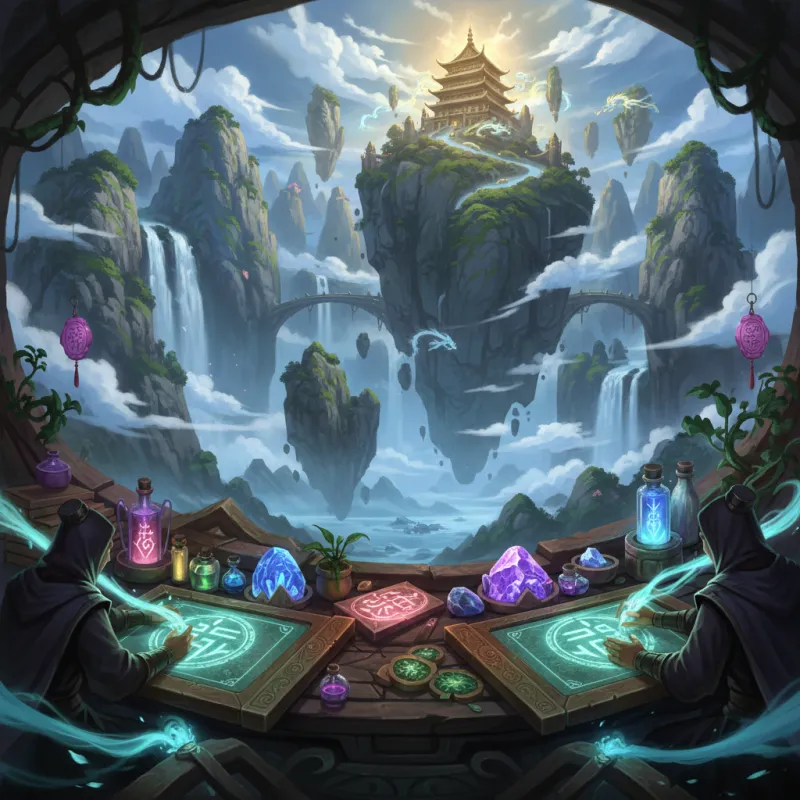
A talisman master stands before a demon beast, outnumbered and outmatched. While other cultivators would draw their swords or channel qi into devastating techniques, she reaches into her robe and pulls out a stack of yellow paper. Three seconds later, the beast is frozen in ice, wrapped in binding chains, and missing its head. The paper crumbles to ash. She walks away. This is talisman crafting (画符 huàfú) — the art of writing magic into reality, one disposable spell at a time.
The Programmer's Path to Immortality
Talisman crafting is what happens when you give a cultivator a compiler. A talisman master (符师 fúshī) doesn't just draw pretty symbols on paper — they're encoding spiritual energy into executable instructions. The paper is the hardware. The ink, mixed with spirit beast blood or crushed spirit stones, is the conductive medium. The symbols themselves? That's the code. And when you activate the talisman by channeling qi into it, you're hitting "run" on a program that might summon lightning, create illusions, or punch a hole through space itself.
The beauty of this system is its reproducibility. A sword cultivator needs decades to master a single technique. A talisman master can mass-produce that same effect, stuff fifty copies in their storage ring, and sell the extras for spirit stones. It's the difference between being a craftsman and running a factory. In A Record of Mortal's Journey to Immortality (凡人修仙传 Fánrén Xiūxiān Zhuàn), Han Li survives countless deadly situations not because he's the strongest fighter, but because he's prepared. He walks into every battle with an arsenal of talismans covering every possible scenario. Frozen by an ice technique? He's got a fire talisman. Ambushed by multiple enemies? Smoke screen talisman, followed by explosive talismans, followed by a teleportation talisman to get the hell out.
From Daoist Temples to Xianxia Novels
Real Daoist talismans (符箓 fúlù) have existed for over two millennia. During the Han Dynasty (206 BCE – 220 CE), Daoist priests wrote charms on yellow paper using cinnabar ink, believing these symbols could command spirits, ward off evil, or cure diseases. The Celestial Masters sect, founded by Zhang Daoling in 142 CE, systematized talisman writing into a formal religious practice. These weren't fictional — people genuinely believed in their power, and Daoist priests still create talismans today for protection, healing, and spiritual purposes.
Cultivation fiction took this real tradition and cranked it up to eleven. Instead of warding off bad luck, fictional talismans can level mountains. The fundamental concept remains the same — symbols as containers for power — but the scale explodes. Where a historical talisman might protect a household, a cultivation talisman might shield an entire city from a demonic invasion. The progression mirrors how formation arrays evolved from feng shui arrangements to reality-warping megastructures.
The Three Pillars: Paper, Ink, and Intent
Every talisman requires three components, and each one matters more than beginners realize.
The paper (符纸 fúzhǐ) isn't just any paper. Low-grade talismans use spirit beast hide or specially treated mulberry paper. High-grade talismans require materials that sound like fantasy item drops: thousand-year-old spirit tree bark, scales from a flood dragon, or paper made from fibers grown in a spiritual vein. The material determines the talisman's durability and power ceiling. Try to inscribe a Nascent Soul-level technique onto Qi Condensation paper, and it'll burst into flames before you finish the first stroke.
The ink (符墨 fúmò) is where things get expensive. Basic spirit ink mixes cinnabar with spirit beast blood. Advanced versions incorporate crushed spirit stones, rare herbs, or essence extracted from elemental sources. A fire talisman works better with ink made from fire-attribute materials — phoenix blood if you're rich, fire python blood if you're practical, and regular cinnabar with fire-attribute spirit stones if you're broke. The ink is the conductor. Better conductors mean more efficient energy transfer and more powerful effects.
Intent (意境 yìjìng) is the invisible third component. A talisman isn't just copied symbols — it requires the crafter's understanding of what those symbols mean. Two people can draw identical talismans using identical materials, and one will work while the other is decorative garbage. The difference is comprehension. You need to understand fire to create a fire talisman. Not just "fire is hot," but the essence of combustion, the transformation of matter into energy, the way flames consume and spread. This is why talisman masters often specialize. A master of fire talismans might be mediocre at water talismans, not because they can't draw the symbols, but because their comprehension lies elsewhere.
The Hierarchy of Destruction
Talismans follow the same ranking system as everything else in cultivation: mortal, spirit, treasure, and so on, usually corresponding to cultivation realms. A Qi Condensation cultivator can create basic talismans that might produce a small fireball or a gust of wind. A Foundation Establishment talisman master can craft talismans that rival martial techniques. By Core Formation, they're creating talismans that can kill people several realms above them — if those people are stupid enough to let the talisman activate.
The catch is activation time. Most talismans require a second or two to channel qi into them before they trigger. In a fight between cultivators, a second is an eternity. This is why talismans work best as ambush tools, defensive measures, or overwhelming alpha strikes. You don't pull out a talisman mid-sword-fight unless you've got someone covering you. But set up a dozen talismans as traps before the fight starts? Now you're thinking like a proper talisman master.
Some novels introduce "instant talismans" that activate on contact or with a thought, but these are exponentially harder to create and usually reserved for masters at the Soul Formation realm or higher. In Renegade Immortal (仙逆 Xiān Nì), Wang Lin encounters ancient talismans that activate automatically when certain conditions are met — essentially magical landmines left behind by long-dead experts. The sophistication required to create conditional triggers makes these treasures rather than consumables.
The Economics of Disposable Magic
Here's where talisman crafting gets interesting from a worldbuilding perspective: it's one of the few cultivation professions that directly converts time into money. An alchemist needs rare herbs and risks failure. A pill refiner might waste months of ingredients on a single failed batch. A talisman master just needs paper, ink, and time. The materials are relatively cheap, the failure rate is lower, and the market is constant because talismans are consumable.
This makes talisman crafting the go-to profession for poor protagonists. Can't afford expensive pills? Learn to make talismans and sell them. Need combat power but lack talent? Buy talismans. The profession creates a middle class in cultivation economies — people who aren't strong enough to compete at the top but skilled enough to make a comfortable living supplying consumables to those who do.
A Record of Mortal's Journey to Immortality demonstrates this perfectly. Han Li learns talisman crafting early specifically because it's profitable. He's not trying to become the world's greatest talisman master — he's funding his cultivation by selling basic talismans to other cultivators. It's a side hustle that pays for his main career. Later, when he's stronger, he uses his talisman knowledge to create custom defensive talismans that compensate for his relatively average combat abilities. The profession scales with him, remaining useful from Qi Condensation to Nascent Soul.
When Paper Beats Sword
The best talisman moments in cultivation fiction come when someone underestimates the paper-wielding nerd. Sword cultivators are flashy. Body refiners are intimidating. Talisman masters look like accountants until they bury you under an avalanche of explosive paper.
In Forty Millenniums of Cultivation (修真四万年 Xiūzhēn Sìwàn Nián), the protagonist Li Yao combines talisman theory with modern engineering principles to create talismans that function like programmable grenades. He doesn't just throw talismans — he creates talisman arrays that trigger in sequence, each one setting up the next, turning a simple ambush into a cascading chain reaction of destruction. It's talisman crafting as tactical warfare rather than individual spells.
The versatility is what makes talismans dangerous. A sword cultivator has a sword. A talisman master has options. Need to fly? Flight talisman. Need to breathe underwater? Water-breathing talisman. Need to fake your death? Corpse-puppet talisman plus illusion talisman. The limitation isn't capability — it's inventory space and budget. A well-prepared talisman master with deep pockets is scarier than most people three realms higher, because they've got a counter for everything and the disposable income to use it.
The Master's Brush
At the highest levels, talisman crafting transcends mere symbol-writing and becomes something closer to reality programming. Immortal-level talisman masters don't just create single-use spells — they craft talismans that can alter fundamental laws, create pocket dimensions, or seal ancient evils for ten thousand years. These aren't consumables; they're artifacts that happen to be made of paper.
The legendary talismans in cultivation fiction often serve as plot devices or MacGuffins, but they demonstrate the theoretical ceiling of the craft. A talisman that can resurrect the dead. A talisman that grants temporary immortality. A talisman that rewrites someone's fate. At this level, the distinction between talisman crafting and divine inscription blurs — both are methods of imposing will onto reality through written symbols.
The path from "I can make a fireball talisman" to "I can write a talisman that creates a new law of physics" is what makes talisman crafting compelling as a cultivation profession. It starts practical and ends metaphysical. It's accessible to beginners but has a skill ceiling that reaches the heavens. And unlike sword cultivation, where you're limited by your personal power, talisman crafting lets you punch above your weight class by leveraging preparation, knowledge, and resources.
That's the real magic of talisman crafting — it's the cultivation world's great equalizer. You don't need heaven-defying talent or ancient bloodlines. You need steady hands, good comprehension, and enough spirit stones to buy materials. The rest is just practice, and practice is something anyone can do. Even if it takes ten thousand failed talismans to create one masterpiece, at least those failures only cost paper and ink. Better than the sword cultivator who loses an arm learning their technique the hard way.
Related Reading
- Rune and Inscription Systems in Cultivation Fiction
- The Inscription Arts: Talismans, Runes, and the Written Word as Weapon
- Jade Slips: The USB Drives of the Cultivation World
- Talisman Crafting: The Art of Writing Magic
- The Philosophical Underpinnings of Chinese Cultivation Fiction and Immortal Realms
- Auction Houses in Cultivation Fiction: Where Fortunes Change Hands
- Body Refinement: The Physical Path to Power