A single misplaced stroke, and the formation array explodes in your face. Get it right, and you've just turned an ordinary sword into a weapon that can slice through space itself. This is the razor's edge that inscription masters walk every single day — and it's exactly why they're some of the most respected (and well-paid) cultivators in any sect.
The Language That Rewrites Reality
Runes and inscriptions in cultivation fiction operate on a principle that would make any programmer nod in recognition: reality has an underlying code, and if you know the syntax, you can hack it. These aren't just decorative symbols carved into weapons and armor. They're functional commands written in what cultivation novels often call the "primordial script" (原始文字 yuánshǐ wénzì) or "heavenly characters" (天文 tiānwén) — a symbolic language that predates human civilization and supposedly originates from the Dao itself.
The mechanics vary by novel, but the core concept remains consistent. Each rune represents a fundamental concept or force: fire, sharpness, durability, speed, concealment. String them together in the correct sequence with the proper energy flow, and you create an inscription formation (铭文阵 míngwén zhèn) that enforces that concept onto physical reality. It's why a thin jade slip can become harder than steel, or why a formation plate the size of your palm can generate a defensive barrier strong enough to stop a Nascent Soul cultivator's attack.
What makes this system fascinating is the precision required. In novels like "A Record of a Mortal's Journey to Immortality" (凡人修仙传 Fánrén Xiūxiān Zhuàn), Han Li spends chapters studying ancient texts just to understand a single complex formation. The difference between a stroke that curves slightly left versus slightly right can mean the difference between a successful inscription and a catastrophic energy backlash. It's not enough to know what the runes mean — you need to understand the flow of spiritual energy through each line, the interaction between adjacent symbols, and how the entire formation harmonizes with the material it's carved into.
The Hierarchy of Inscription Complexity
Not all inscriptions are created equal, and cultivation novels typically establish clear hierarchies based on complexity and power. At the bottom, you have basic enhancement runes (强化符文 qiánghuà fúwén) — single characters or simple two-character combinations that provide straightforward effects. A sharpness rune on a blade. A lightness rune on boots. These are the bread and butter of low-level inscription work, the kind of thing outer disciples practice on scrap materials until their hands cramp.
Mid-tier inscriptions involve formation arrays (阵法 zhènfǎ) — multiple runes working in concert to produce more sophisticated effects. A sword might have a formation that not only increases sharpness but also channels the wielder's spiritual energy more efficiently and repairs minor damage automatically. These require understanding not just individual runes but how they interact, how energy flows between them, and how to balance the formation so it doesn't collapse under stress. In "Martial World" (武极天下 Wǔjí Tiānxià), Lin Ming encounters weapons with dozens of interconnected runes forming elaborate patterns that take years to fully comprehend.
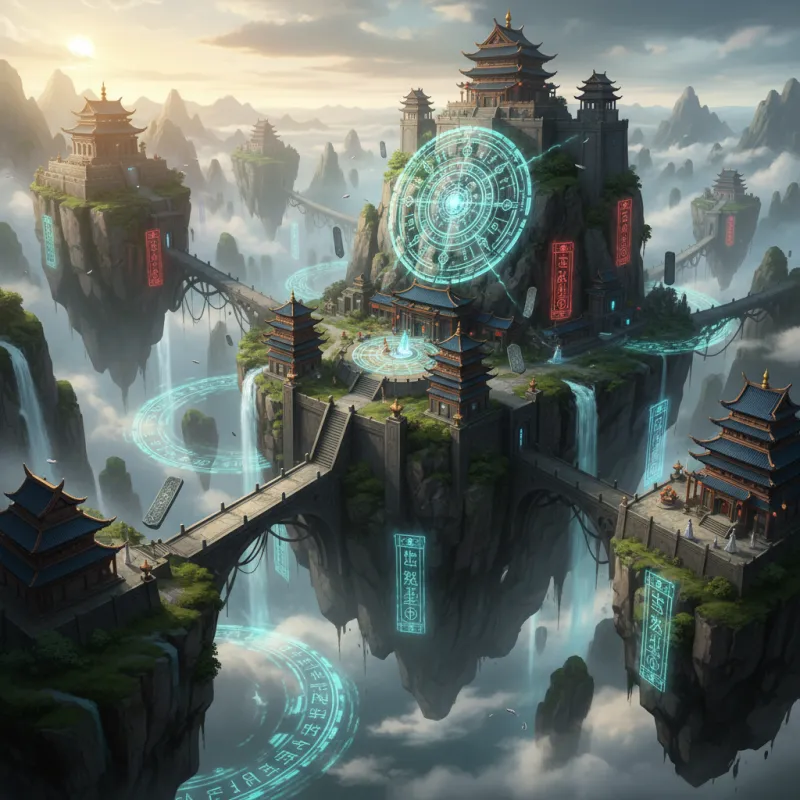
At the apex sit the legendary grand formations (大阵 dàzhèn) and divine inscriptions (神文 shénwén). These are the mountain-protecting arrays that can defend an entire sect, the spatial formations that create pocket dimensions, the sealing inscriptions that can trap immortals for millennia. They're not just carved — they're woven into the fabric of space itself, drawing on ley lines and natural energy convergence points. The formation protecting the Heavenly Sword Sect in countless novels isn't just some runes on the ground; it's a three-dimensional construct of interlocking arrays that extends deep underground and high into the sky, maintained by spirit stones and requiring constant monitoring by dedicated formation masters.
Materials, Tools, and the Art of Inscription
Here's something most cultivation novels get right: you can't just carve runes into anything with any tool and expect them to work. The material matters enormously. Ordinary iron might hold a basic enhancement rune, but try to inscribe anything more complex and the metal's spiritual conductivity becomes a bottleneck. This is why spiritual materials are so valuable — they can handle more complex inscriptions and channel more energy without degrading.
The tools are equally important. Inscription masters use specialized carving knives (刻刀 kèdāo) made from materials with high spiritual conductivity. In "I Shall Seal the Heavens" (我欲封天 Wǒ Yù Fēng Tiān), Meng Hao's inscription work improves dramatically when he acquires a carving knife made from Immortal jade — the material itself helps guide the flow of spiritual energy, making precise work easier. Some novels take this further, describing inscription brushes that use spiritual beast blood as ink, or needles that can inscribe formations directly into a cultivator's meridians for permanent enhancement.
The actual process of inscription is where things get interesting. It's not just mechanical carving. The inscription master must infuse their spiritual energy into each stroke as they work, maintaining perfect control and consistency. One moment of distraction, one fluctuation in energy output, and the entire inscription fails. Advanced inscriptions require the master to enter a meditative state where they can perceive the flow of energy through the material and adjust their work in real-time. It's simultaneously artistic and scientific, requiring both technical precision and intuitive understanding.
The Economics of Being an Inscription Master
Let's talk about why every cultivation protagonist who shows even a hint of inscription talent immediately gets courted by every major sect. Inscription masters are expensive. A single high-quality inscribed weapon can cost more than most cultivators earn in a decade. A formation array to protect a family compound? That's generational wealth. The mountain-protecting grand formation for a major sect? That's a project that might take centuries and consume resources that could fund a small nation.
This creates an interesting dynamic in cultivation fiction. Inscription masters occupy a unique position in the power hierarchy — they might not be the strongest fighters, but they're too valuable to offend. Even a Golden Core inscription master who could be killed by a Nascent Soul cultivator will be treated with respect, because that Nascent Soul cultivator needs their services. It's one of the few paths in cultivation fiction where technical skill can partially substitute for raw power.
The smart protagonists recognize this immediately. In "Forty Millenniums of Cultivation" (修真四万年 Xiūzhēn Sìwàn Nián), Li Yao leverages his inscription and artifact refinement skills to gain resources and connections far beyond what his cultivation level would normally allow. He can't out-fight the geniuses from major sects, but he can make them weapons they desperately want, which turns out to be just as valuable.
Ancient Inscriptions and Lost Knowledge
Every good cultivation novel has its share of mysterious ancient ruins filled with inscriptions nobody can read anymore. This trope works because it taps into something fundamental about the genre: the idea that cultivation civilization has declined from some golden age, and modern cultivators are just rediscovering fragments of ancient knowledge.
These ancient inscriptions (古代铭文 gǔdài míngwén) serve multiple narrative purposes. They're treasure maps, requiring the protagonist to decipher them to find hidden inheritances. They're power-ups, with ancient formation arrays that can be reactivated if you understand them. They're mysteries, hinting at cultivation systems and powers that modern cultivators have forgotten. In "Renegade Immortal" (仙逆 Xiān Nì), Wang Lin's entire cultivation path is shaped by his discovery and gradual understanding of ancient restriction formations that use principles modern cultivators no longer comprehend.
What makes this compelling is the implication that inscription knowledge isn't static. Techniques are lost, rediscovered, and evolved. A modern inscription master might be technically proficient with current methods but completely baffled by ancient approaches that used different principles or drew on energy sources that no longer exist. It creates a sense of depth and history, suggesting that the cultivation world has layers of lost civilizations and forgotten powers waiting to be uncovered.
The Dark Side: Forbidden Inscriptions
Not all inscriptions are benevolent enhancement tools. Cultivation fiction loves its forbidden techniques, and inscriptions are no exception. Blood inscriptions (血铭 xuèmíng) that use human sacrifice to power formations. Soul-binding arrays (锁魂阵 suǒhún zhèn) that trap spirits for eternity. Curse marks (诅咒印记 zǔzhòu yìnjì) that slowly drain a victim's life force. These aren't just evil for evil's sake — they represent the dark potential of a system that can rewrite reality.
The most disturbing forbidden inscriptions are often the ones carved directly onto living beings. Slave seals (奴印 núyìn) that enforce absolute obedience. Tracking marks that let someone monitor your every move. Explosive inscriptions implanted in disciples to ensure loyalty through threat of instant death. These show up frequently in demonic cultivation sects and create some genuinely unsettling scenarios where people become walking inscription platforms, their bodies and souls modified by symbols they can't remove.
What's interesting is how novels handle the moral ambiguity. Is it acceptable to use a soul-binding array on a demonic cultivator who's killed thousands? What about using blood inscriptions if the blood is willingly donated? The best cultivation novels don't provide easy answers, instead showing how the same tools can be used for protection or oppression depending on who wields them.
Integration with Other Cultivation Systems
Inscriptions don't exist in isolation — they interact with every other aspect of cultivation in fascinating ways. Alchemy and inscription work often overlap, with pills that contain temporary inscription effects or formations that enhance pill refinement. Weapon refinement (炼器 liànqì) is essentially applied inscription work, carving formations into materials as they're forged. Even body cultivation can involve inscriptions, with some techniques requiring runes to be carved into bones or meridians for permanent enhancement.
The synergy between inscription mastery and other skills is why the most successful cultivators often have broad knowledge bases. A formation master who understands alchemy can create arrays that automatically refine pills. An inscription master who understands spatial laws can create storage rings and pocket dimensions. The cultivation world rewards polymaths, and inscription work is often the foundation that ties other disciplines together.
This interconnection also means that advances in one field can revolutionize others. A breakthrough in understanding energy flow patterns might improve both inscription efficiency and pill refinement success rates. A new material discovered by alchemists might enable inscription formations that were previously impossible. The cultivation world is a complex system where everything affects everything else, and inscription masters sit at the nexus of many of these connections.
Related Reading
- The Inscription Arts: Talismans, Runes, and the Written Word as Weapon
- Talisman Crafting in Cultivation Fiction: Writing Magic Into Reality
- Jade Slips: The USB Drives of the Cultivation World
- Talisman Crafting: The Art of Writing Magic
- The Allure of Chinese Cultivation Fiction: A Journey Through Immortal Realms
- Unraveling the Essence of Tribulations in Chinese Cultivation Fiction
- Exploring the Intricate World of Chinese Cultivation and Xianxia Fiction