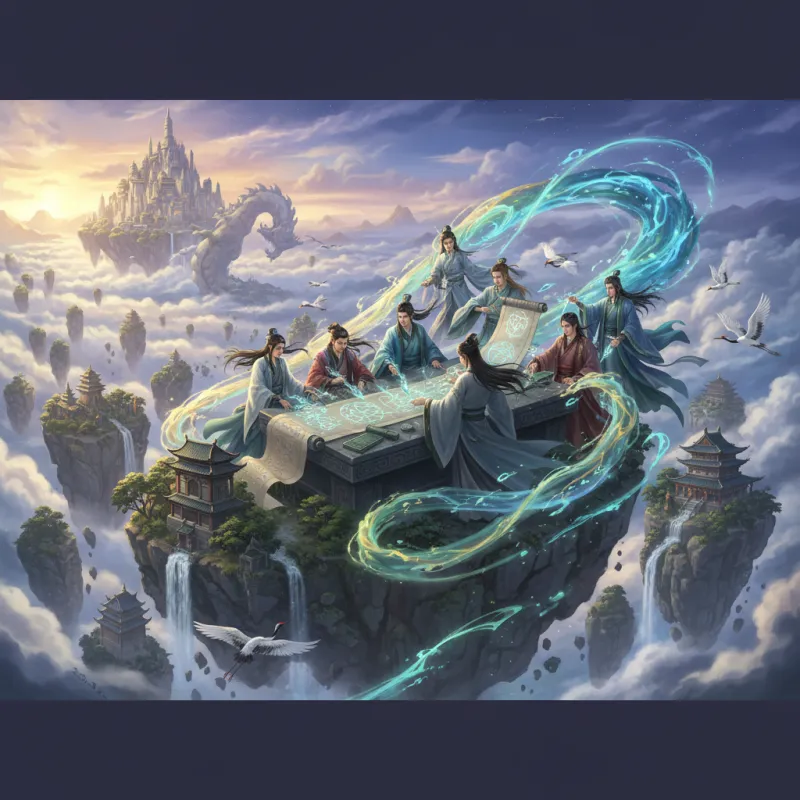
A Foundation Establishment cultivator stares down a Core Formation elder, sweat beading on his forehead. He's outmatched by three entire realms. The elder smirks, gathering spiritual energy for a killing blow. Then the junior cultivator pulls out a stack of paper slips covered in crimson ink, and suddenly the power dynamic shifts. Welcome to talisman crafting (符箓 fúlù), where preparation beats cultivation level, and a good calligraphy brush is deadlier than a sword.
The Economics of Instant Power
Talisman crafting solves cultivation's fundamental inequality problem: not everyone has the talent, resources, or lifespan to reach the heights of power. A Qi Refining (炼气 liànqì) disciple might spend decades trying to master a single offensive technique, or they could buy a stack of Fireball Talismans from the sect's contribution hall and call it a day. This isn't laziness—it's efficiency.
The real genius of talismans lies in their transferability. A Golden Core (金丹 jīndān) master can inscribe hundreds of talismans in a single sitting, each one containing a fraction of their power, then sell them to disciples who won't reach that level for centuries, if ever. It's spiritual energy arbitrage. The master gets contribution points or spirit stones, the disciples get firepower they couldn't otherwise access, and everyone wins except the demonic beasts getting hit with techniques three realms above what they expected.
In novels like I Shall Seal the Heavens, Meng Hao turns this economic principle into an art form, mass-producing talismans and flooding markets. He understands what many protagonists miss: cultivation isn't just about personal power, it's about leverage. One master talisman crafter can arm an entire generation of disciples.
The Three Sacred Materials
You can't write a talisman on notebook paper with a ballpoint pen, though plenty of transmigrated protagonists have tried. Traditional talisman crafting requires three components, each more expensive than the last: talisman paper (符纸 fúzhǐ), spiritual ink (灵墨 língmò), and a proper inscription brush (符笔 fúbǐ).
Talisman paper isn't paper in the mundane sense. It's typically made from spiritual plants—bamboo that's absorbed moonlight for a hundred years, mulberry bark soaked in beast blood, or in high-level cases, the shed skin of spiritual creatures. The paper must be able to contain and channel spiritual energy without degrading. Cheap paper burns out after one use. Quality paper might survive multiple activations, though this is rare enough to be noteworthy when it happens.
Spiritual ink is where crafters really spend their money. Basic ink might be ground from spirit stones mixed with beast blood and medicinal herbs. Advanced formulas include phoenix ash, dragon blood, or the distilled essence of elemental materials. The ink's quality directly determines the talisman's power ceiling—you can't inscribe a Heaven-rank technique with Earth-rank ink, no matter how skilled you are. This is why Alchemy and talisman crafting often go hand-in-hand; the best crafters brew their own inks.
The brush matters less than you'd think, but it still matters. A proper inscription brush needs to channel spiritual energy smoothly and maintain consistent line width under pressure. Hair from spiritual beasts makes the best bristles—wolf for aggressive techniques, fox for illusions, crane for flight talismans. The handle should be carved from spiritual wood that resonates with the crafter's energy.
The Inscription Process: Where Calligraphy Meets Cultivation
Here's what separates talisman crafting from regular calligraphy: intent. Every stroke must carry not just ink but spiritual energy, shaped by the crafter's understanding of the technique being inscribed. This is why you can't just copy a talisman design and expect it to work. The symbols (符文 fúwén) aren't just decorative—they're a programming language for reality itself.
The process starts with meditation. A crafter must achieve perfect mental clarity before beginning, because any distraction, any wavering of intent, will corrupt the inscription. Then comes the actual writing, which must be completed in a single session. Stop halfway through a talisman and the spiritual energy dissipates, leaving you with expensive scratch paper.
Each stroke follows a specific order and direction, building on the previous strokes to create a complete spiritual circuit. The main symbol typically goes in the center, with supporting characters arranged around it in patterns that vary by tradition. Daoist talismans favor vertical arrangements and flowing curves. Buddhist-influenced crafters use more geometric patterns with Sanskrit characters mixed in. Demonic cultivation traditions—well, those tend to involve more blood and screaming, but the principle remains the same.
The final step is the seal (印 yìn), where the crafter stamps their spiritual signature onto the completed talisman. This activates the inscription and binds it into a stable state. A properly sealed talisman can last for years or even decades before the spiritual energy naturally dissipates. An improperly sealed one might explode in your face, which is why talisman crafting has such high injury rates among beginners.
Ranks, Grades, and Why Your Talisman Exploded
Talismans follow the standard cultivation ranking system: Mortal, Spirit, Earth, Heaven, and beyond into increasingly ridiculous territory. But within each rank, there are grades—low, middle, high, and peak. A low-grade Spirit Rank talisman might produce a fireball the size of your fist. A peak-grade Spirit Rank talisman could level a building. Same rank, vastly different results.
What determines grade? Three factors: material quality, crafter skill, and the technique being inscribed. You can have perfect materials and master-level skill, but if you're trying to cram a Heaven-rank technique onto Spirit-rank paper, you're going to have a bad time. The talisman will either fail to form, activate incorrectly, or—most entertainingly—explode during the inscription process.
This is why Formation Arrays and talismans work so well together. Arrays can stabilize volatile inscriptions, allowing crafters to push materials beyond their normal limits. A Spirit-rank talisman inscribed within a proper stabilization array might perform at Earth-rank levels, at least for a single use.
The explosion risk is real and frequently underestimated by beginners. Spiritual energy wants to be free. Binding it into a two-dimensional paper prison goes against its nature. When the binding fails, that energy releases all at once, usually into the face of whoever was holding the talisman. Smart crafters work behind protective barriers. Dead crafters didn't.
Combat Applications: The Talisman Bomber Build
In actual combat, talismans shine in three scenarios: ambushes, emergencies, and when you're fighting someone stronger than you. The activation time is near-instant—just channel a thread of spiritual energy into the talisman and throw. No hand seals, no lengthy incantations, no charging time. This makes talismans perfect for surprise attacks.
The classic talisman bomber strategy involves carrying dozens or hundreds of talismans and overwhelming opponents with sheer volume. Can't dodge a fireball? How about twenty fireballs, plus ten ice spears, five lightning strikes, and a partridge in a pear tree? This approach is expensive but effective, especially in the early realms where cultivators haven't developed sophisticated defensive techniques.
Defensive talismans are equally valuable. Shield talismans (护盾符 hùdùnfú) can block attacks several realms above the user's level, at least once. Escape talismans (遁符 dùnfú) provide instant teleportation over short distances, perfect for getting out of bad situations. Concealment talismans hide your presence from spiritual sense, useful for both infiltration and avoiding fights you can't win.
The downside is cost. A single high-grade talisman might cost as much as a low-grade magical artifact, and unlike artifacts, talismans are single-use. This creates an interesting strategic tension: do you save your best talismans for emergencies, or use them proactively to prevent emergencies from happening? Many cultivators die with unused talismans in their storage rings, having waited for the "right moment" that never came.
Beyond Combat: Utility Talismans That Actually Matter
Everyone focuses on combat talismans because explosions are exciting, but utility talismans are what keep cultivation society functioning. Communication talismans (传音符 chuányīnfú) allow instant messaging across vast distances, essential for sect coordination and emergency alerts. Without them, large-scale sect operations would be impossible.
Preservation talismans keep food fresh, medicines potent, and corpses from decaying—the last one being more important than you'd think, given how often cultivators need to transport bodies for identification or resurrection attempts. Storage talismans create temporary spatial pockets, though they're inferior to proper storage rings in every way except cost.
Detection talismans reveal hidden formations, concealed cultivators, or the presence of spiritual materials. Treasure hunters live and die by these. A good detection talisman can mean the difference between finding a hidden inheritance and walking past it like an idiot. They're also crucial for avoiding ambushes, which is why assassins hate them.
Then there are the weird specialty talismans that show up in specific novels. Disguise talismans that change your appearance. Puppet control talismans that let you operate spiritual constructs remotely. Luck enhancement talismans that probably don't work but people buy them anyway. The variety is limited only by author imagination and the laws of spiritual physics, which are more guidelines than actual rules.
The Master Crafter's Path: Why Most People Quit
Becoming a true talisman master takes decades of practice, mountains of wasted materials, and a tolerance for repetitive failure that borders on masochism. The skill ceiling is absurdly high. A beginner might have a 10% success rate on basic talismans. An expert might hit 90% on the same talismans but only 10% on advanced ones. A true master maintains 70%+ success rates even on Heaven-rank inscriptions, and there are maybe a dozen people per generation who reach that level.
The learning curve is brutal because there's no shortcut. You can't just read a manual and understand talisman crafting—you have to develop muscle memory, spiritual energy control, and an intuitive grasp of how symbols interact. This requires inscribing thousands of talismans, most of which will fail. The material costs alone bankrupt most aspiring crafters before they reach competency.
But for those who persist, the rewards are substantial. Master crafters are always in demand, can name their own prices, and have leverage in sect politics that rivals Core Formation elders. They're also harder to kill than you'd expect, because anyone who can inscribe talismans can definitely use them, and a master crafter's personal talisman collection is usually terrifying.
The real secret that separates masters from experts? Innovation. Anyone can copy existing talisman designs. Masters create new ones, combining symbols in novel ways, adapting techniques from other disciplines, pushing the boundaries of what's possible. This is where Inscription Arts intersect with genuine creativity, and why the greatest crafters are remembered for centuries after their deaths.
Related Reading
- Jade Slips: The USB Drives of the Cultivation World
- Talisman Crafting in Cultivation Fiction: Writing Magic Into Reality
- The Inscription Arts: Talismans, Runes, and the Written Word as Weapon
- Rune and Inscription Systems in Cultivation Fiction
- Unveiling the Essence of Chinese Cultivation: A Journey Through Xianxia and Immortal Realms
- Exploring the Intricate World of Chinese Cultivation and Xianxia Fiction
- Cultivation Artifacts: Swords That Think, Rings That Store, and Robes That Protect