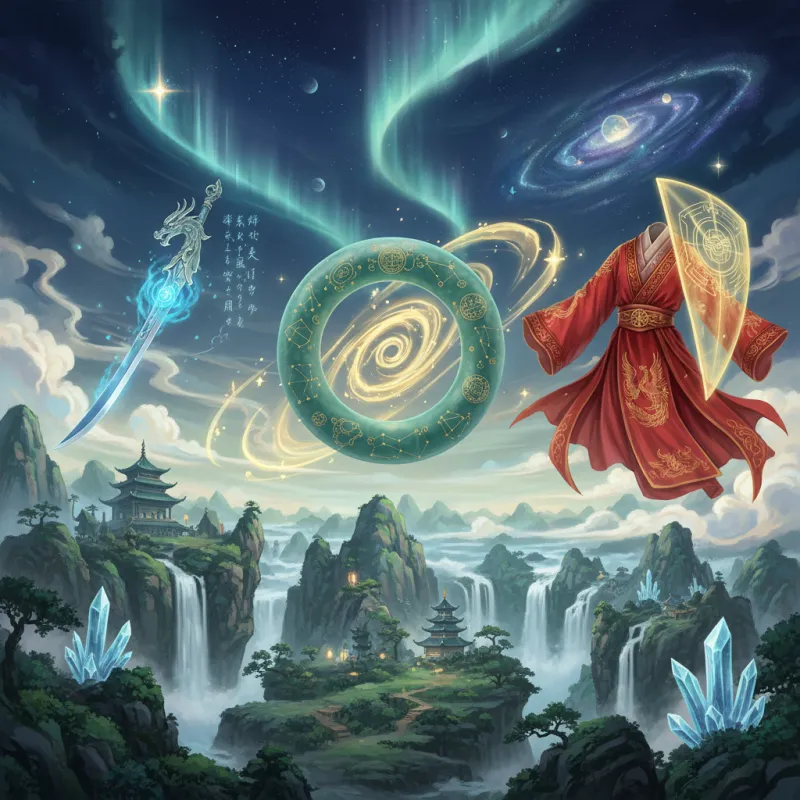
The sword trembled in the merchant's hands, and not from fear. It was laughing. The young cultivator who'd just insulted its previous owner — calling him a "third-rate sword cultivator with delusions of adequacy" — now stood frozen as the blade's spiritual consciousness rippled through the auction house. Everyone present felt it: amusement, disdain, and a hint of curiosity about whether this arrogant junior would be worth the trouble. Welcome to cultivation fiction, where your equipment has opinions about you.
Why Cultivation Artifacts Are Actually Characters
In Western fantasy, Excalibur waits in a stone. In cultivation novels, Excalibur would have left three centuries ago because the stone's feng shui was terrible. Magical treasures (法宝 fǎbǎo) in xianxia fiction possess varying degrees of consciousness, from vague spiritual impressions to full personalities that rival their wielders in complexity. This isn't just flavor text — it's fundamental to how these stories work.
Take the Profound Heaven Treasure in I Shall Seal the Heavens. Meng Hao's copper mirror doesn't just copy techniques; it has preferences, moods, and what can only be described as a sense of humor about when it chooses to activate. The mirror's personality shapes entire arcs of the story. Or consider the brick in A Will Eternal — yes, a brick — that Bai Xiaochun refines into a sentient weapon. The brick develops enough personality that readers genuinely care about its "feelings" when Bai Xiaochun considers upgrading to a different treasure.
This sentience creates narrative possibilities impossible in other fantasy genres. Your sword can betray you. Your storage ring (储物戒 chǔwù jiè) can refuse to open because you've been neglecting its maintenance rituals. Your protective robe can decide you're not worthy and fly off to find a better cultivator. The relationship between cultivator and artifact becomes a genuine relationship, complete with trust issues, compatibility problems, and the occasional divorce.
The Grading System: From Trash to Transcendent
Cultivation artifacts follow hierarchies as rigid as the cultivation realms themselves. The standard progression runs: Mortal, Spiritual, Treasure, Dao, and Immortal grades, with each tier subdivided into low, middle, high, and peak quality. But here's what the wikis don't tell you: these grades matter less than the artifact's origin story.
A low-grade spiritual sword forged by a legendary craftsman and tempered in tribulation lightning will outperform a mid-grade treasure sword mass-produced by a sect's artifact pavilion. The grading system provides structure, but cultivation novels are obsessed with exceptions. The protagonist's "trash" artifact that everyone mocks? It's actually a sealed Immortal-grade treasure that lost 99% of its power. The priceless Dao-grade formation disk the young master flaunts? It's a fake, and the real one is buried in a random cave our hero will stumble into next chapter.
Coiling Dragon demonstrates this beautifully with Linley's Coiling Dragon ring. Initially appearing as a simple storage ring, it houses Doehring Cowart, a Saint-level grand magus whose knowledge proves infinitely more valuable than the ring's actual grade. The artifact's true worth lies not in its classification but in its hidden depths — a pattern repeated across thousands of cultivation novels.
The grading system also drives the genre's economy. Cultivators don't just fight over artifacts; they appraise them, trade them, auction them, steal them, and occasionally get killed over authentication disputes. The Treasure Pavilion scenes in Martial World read like high-stakes antique dealing, complete with expert appraisers, forgery scandals, and the ever-present risk that the "broken" artifact you just bought for cheap is actually priceless.
Storage Rings: Bigger on the Inside, Complicated on the Outside
Storage rings (储物戒 chǔwù jiè) or spatial rings (空间戒 kōngjiān jiè) deserve their own discussion because they've become cultivation fiction's most ubiquitous artifact. Every cultivator has one. Most have several. The genre has spent two decades exploring every possible variation on "bag of holding" mechanics.
Basic storage rings offer simple dimensional space — ten cubic meters, fifty cubic meters, whatever the plot requires. But advanced versions include time dilation (your spirit herbs age faster inside), preservation functions (that demon beast corpse won't rot), or even miniature ecosystems (raise your spirit beasts in pocket dimensions). Tales of Demons and Gods features Nie Li's temporal demon spirit book, which functions as both storage and a training space where time flows differently.
The real genius is how storage rings create narrative tension. When a cultivator dies, their storage ring becomes loot — and looting a dead enemy's ring is cultivation fiction's version of opening a loot box. Will it contain priceless treasures? Worthless junk? A trapped soul that possesses you? The moment when the protagonist cracks open a defeated enemy's storage ring and discovers unexpected wealth has been repeated so many times it's become a genre trope, yet it still works.
Storage rings also solve and create plot problems simultaneously. They explain how cultivators carry arsenals of weapons, libraries of jade slips, and enough spirit stones to buy a small kingdom. But they also raise questions: Why doesn't everyone just store their enemies in spatial rings? (Answer: living beings require special rings, which are rarer and more expensive.) Can you store a storage ring inside another storage ring? (Usually no, spatial instability.) What happens if your ring breaks while you're storing something? (Nothing good.)
Sentient Weapons: When Your Sword Has Standards
Sentient weapons (灵器 língqì) represent the peak of artifact personality. These aren't just tools with vague spiritual impressions — they're full characters with preferences, grudges, and character development arcs. The relationship between cultivator and sentient weapon often mirrors master-disciple or even romantic partnerships in complexity.
Desolate Era explores this through Ji Ning's relationship with his Darknorth swords. The twin swords don't just fight for him; they grow alongside him, developing new abilities as his comprehension deepens. Their bond becomes so profound that the swords' power fluctuates based on Ji Ning's emotional state. When he's confident, they're unstoppable. When he doubts himself, they underperform. It's equipment that requires therapy.
The weapon spirit (器灵 qìlíng) — the consciousness inhabiting a sentient artifact — can take various forms. Some manifest as ethereal figures only the wielder can see. Others communicate through emotional impressions or dreams. The most powerful can materialize physically, like the sword spirits in Martial God Asura that occasionally manifest to fight alongside their masters.
But sentient weapons come with complications. They can be jealous of other artifacts. They can disagree with your combat tactics mid-battle. They can develop romantic feelings for you, which gets awkward when your weapon is technically an object. Against the Gods leans into this weirdness with the Heaven Smiting Devil Slayer Sword, whose weapon spirit has definite opinions about Yun Che's life choices and isn't shy about expressing them.
The bonding process between cultivator and sentient weapon provides some of cultivation fiction's most interesting scenes. It's not just blood-binding or soul-binding — it's mutual recognition. The weapon must accept you as much as you claim it. This creates scenarios where the protagonist must prove themselves worthy not to a person but to an object, which somehow feels more meaningful than typical "chosen one" narratives.
Protective Artifacts: Fashion That Fights Back
Defensive artifacts — robes, armor, talismans, and accessories — get less attention than flashy swords, but they're equally creative. Cultivation fiction has spent considerable effort imagining protective gear that's both functional and narratively interesting.
Protective robes (法袍 fǎpáo) in cultivation novels aren't just enchanted clothing; they're layered defense systems. A typical high-grade robe might include: automatic barrier activation when attacked, self-repair functions, temperature regulation, spiritual energy circulation enhancement, and occasionally flight capabilities. The robes in A Record of a Mortal's Journey to Immortality function almost like secondary characters, with Han Li constantly upgrading and modifying his defensive gear as he advances through realms.
Defensive talismans (护身符 hùshēnfú) create another layer of protection — literally. Cultivators stack defensive talismans like insurance policies, each providing a separate barrier that must be broken through. This creates combat scenes where breaking through an enemy's defenses becomes a puzzle: which barrier is the weakest? Which talisman will regenerate fastest? Should you overwhelm all defenses at once or systematically dismantle them?
The jade pendant that activates when you're in mortal danger has become a cultivation fiction staple, usually given by a powerful elder who "just happened" to have a life-saving treasure lying around. These emergency protective artifacts drive plot in predictable but satisfying ways. The protagonist survives an assassination attempt because of a protective jade. The protective jade shatters, enraging the elder who gave it. The elder investigates, uncovering a conspiracy. It's formulaic, but formulas exist because they work.
Renegade Immortal subverts this with Wang Lin's various protective artifacts, which often come with hidden costs. That life-saving treasure? It belonged to a dead cultivator whose soul fragment is now attached to you. The protective formation? It's powered by your lifespan. Defensive artifacts in darker cultivation novels aren't just protection — they're deals with varying levels of devil in the details.
Artifact Refinement: Crafting as Character Development
The process of creating or upgrading artifacts — artifact refinement (炼器 liànqì) — deserves mention because it's become a major subplot in countless cultivation novels. Protagonists who learn artifact refinement gain economic independence, narrative flexibility, and an excuse to experiment with increasingly absurd combinations of materials.
Artifact refinement follows patterns similar to alchemy, requiring precise control of spiritual energy, rare materials, and often tribulation lightning to temper the final product. But where alchemy creates consumables, artifact refinement creates permanent additions to a cultivator's arsenal. The stakes feel different when you're forging a sword that might serve you for centuries versus brewing a pill you'll consume immediately.
The materials used in artifact refinement reveal cultivation fiction's creative worldbuilding. Forget simple iron and steel — artifacts require demon beast cores, meteorite fragments, thousand-year-old spirit wood, phoenix feathers, dragon scales, and the occasional piece of a shattered immortal treasure. Martial World features Lin Ming collecting materials across multiple realms, with each component's properties affecting the final artifact's abilities. It's crafting systems taken to their logical extreme.
Some protagonists specialize in artifact refinement to the point where it becomes their primary power system. They don't fight with artifacts; they fight by creating artifacts mid-combat. Imagine a cultivator who responds to every attack by instantly forging a counter-artifact from available materials. It's absurd, it's overpowered, and it's absolutely something cultivation novels have done.
The Artifact Economy: Where Plot and Commerce Collide
Artifacts drive cultivation fiction's economy in ways that make medieval fantasy's gold-based systems look primitive. Spirit stones (灵石 língshí) serve as currency, but high-level transactions use artifacts as barter. A Dao-grade sword might be worth more than an entire sect's treasury. A spatial ring with a thousand cubic meters of storage could buy a small kingdom.
This creates an entire subplot genre: auction arcs. The protagonist attends an auction, sees an artifact they need, gets into a bidding war with a young master, somehow acquires the artifact through cleverness or violence, and makes enemies in the process. It's been done ten thousand times, yet cultivation novels keep finding new variations. Emperor's Domination features auction scenes where the items being sold include fragments of dead worlds, imprisoned demon gods, and techniques that can destroy heavens — and the bidding still follows recognizable auction dynamics.
Artifact theft drives countless plot threads. Stealing another cultivator's storage ring is both robbery and murder of their future potential. Sect treasuries full of artifacts become heist targets. Ancient ruins containing lost artifacts spark wars between factions. The entire genre runs on artifact-based economics, where power is literally something you can hold, trade, or steal.
The black market for artifacts adds another layer. Forbidden artifacts, stolen treasures, and items too dangerous for legitimate trade all flow through underground channels. Protagonists inevitably end up in these black markets, either selling loot they can't explain owning or buying desperate power-ups before a crucial battle. These scenes capture cultivation fiction's amoral pragmatism — morality matters less than survival, and survival often requires artifacts of questionable provenance.
Related Reading
- Storage Rings and Spatial Equipment: Pocket Dimensions on Your Finger
- Exploring Artifacts and Their Role in Chinese Cultivation and Xianxia Fiction
- Spirit Beasts and Magical Companions in Cultivation Fiction
- Flying Swords: The Iconic Vehicles of Cultivation Fiction
- Cauldrons: Essential Tools for Pill Refining
- Exploring the Enigmatic Realms of Chinese Cultivation and Xianxia Fiction
- The Black Market: Forbidden Goods in the Cultivation World
- The Philosophical Underpinnings of Chinese Cultivation Fiction and Immortal Realms