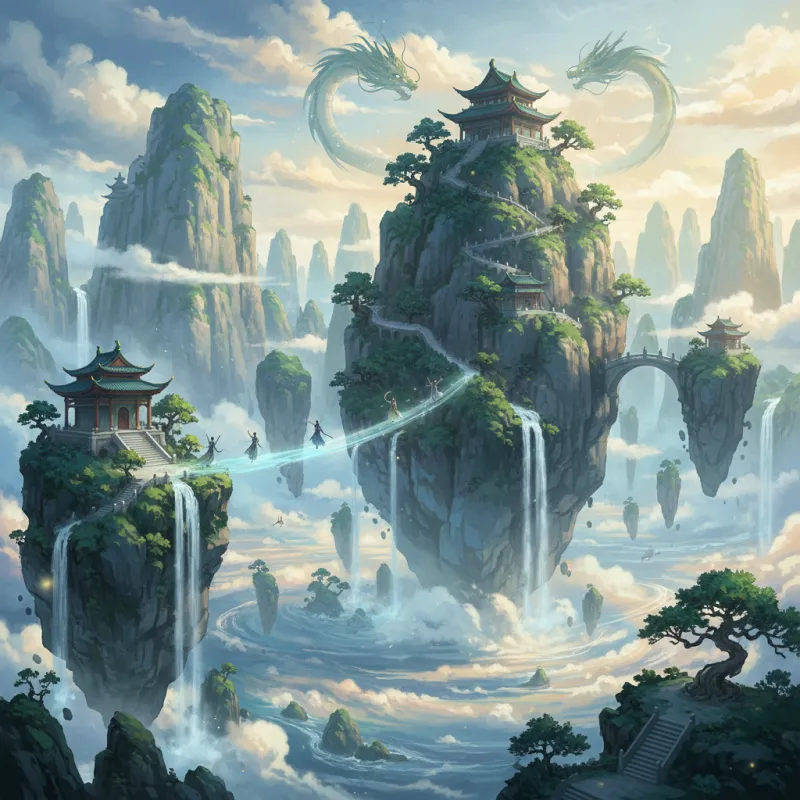
A young cultivator stands at the edge of a cliff, staring into swirling clouds that hide entire worlds. Below him lies the Mortal Realm, where he spent his first sixteen years. Above, invisible to ordinary eyes, float the legendary Nine Heavens—each one a battlefield where immortals wage wars that reshape reality itself. This isn't just fantasy worldbuilding. It's the cosmological framework that's driven Chinese cultivation fiction for decades, and understanding these realms is like learning the rules of a game where the stakes are literal godhood.
The Vertical Universe: Why Cultivation Worlds Stack
Western fantasy loves its horizontal maps—kingdoms side by side, oceans between continents. Chinese xianxia fiction thinks vertically. The universe in these stories operates like a cosmic apartment building, with the Mortal Realm (凡界, fán jiè) as the ground floor and progressively more powerful realms stacking upward. This isn't arbitrary. It reflects Daoist cosmology from texts like the "Huainanzi" (compiled around 139 BCE), which described heavens in layers, each governed by different celestial bureaucracies.
In "I Shall Seal the Heavens" by Er Gen, protagonist Meng Hao spends hundreds of chapters in the Mortal Realm before even glimpsing the Spirit Realm (灵界, líng jiè). When he finally ascends, he discovers that cultivators he thought were invincible gods are merely average in the higher realm. This pattern repeats—the Spirit Realm gives way to the Immortal Realm (仙界, xiān jiè), which itself might be dwarfed by the God Realm (神界, shén jiè). Each transition resets the power scale, letting authors extend stories for thousands of chapters without breaking internal logic.
The genius here is narrative sustainability. A cultivator who reaches the peak of one realm doesn't end the story—they graduate to a new school where they're a freshman again. It's why "Martial God Asura" by Kindhearted Bee runs over 5,000 chapters. Chu Feng keeps discovering that his "ultimate" realm has another realm above it, each with its own politics, sects, and ancient grudges.
The Lower Realms: Where Mortals Dream of Flying
The Mortal Realm isn't just Earth with magic sprinkled on top. In most xianxia, it's a prison. Spiritual energy (灵气, líng qì) is thin, lifespans are short, and the heavens themselves seem to suppress human potential. Cultivators in these realms practice what's essentially spiritual poverty—scraping together enough qi to break through to the next minor realm, knowing that even their greatest achievements are footnotes in the cosmic hierarchy.
Take "Renegade Immortal" by Er Gen. Wang Lin's home planet is so spiritually depleted that reaching Foundation Establishment (筑基, zhù jī) is considered legendary. Meanwhile, in the higher realms, Foundation Establishment is what children achieve before puberty. This disparity isn't just worldbuilding flavor—it's social commentary. The lower realms are backwaters, forgotten by the powers above, their resources extracted by higher-realm cultivators who treat them like colonial territories.
The cultivation stages within the Mortal Realm typically follow a pattern: Qi Condensation, Foundation Establishment, Core Formation (金丹, jīn dān), Nascent Soul (元婴, yuán yīng), and Soul Formation (化神, huà shén). But here's what makes it interesting—these stages aren't standardized across novels. "Coiling Dragon" by I Eat Tomatoes uses completely different terminology, while "A Record of a Mortal's Journey to Immortality" adds extra stages that other novels skip. The lack of standardization reflects how these stories emerged from web novel culture, where authors innovated rather than following a genre bible.
The Middle Realms: Immortal Bureaucracies and Sect Politics
Once cultivators ascend beyond mortality, they enter realms where the rules change fundamentally. The Spirit Realm and Immortal Realm aren't just more powerful versions of the Mortal Realm—they're governed by different physics. Time flows differently. Space can be folded. And most importantly, these realms have established power structures that have existed for millions of years.
In "A Will Eternal" by Er Gen, the protagonist Bai Xiaochun ascends to discover that the Immortal Realm is divided into territories controlled by ancient clans and sects, each with genealogies stretching back to the primordial era. These aren't the scrappy underdog sects from the Mortal Realm. These are institutions with resources that would make lower-realm cultivators weep—spirit stone mines that produce more wealth in a day than entire mortal planets generate in centuries, alchemy gardens where thousand-year-old herbs are considered common weeds.
The middle realms introduce a concept that's crucial to understanding xianxia: the Heavenly Dao (天道, tiān dào). This isn't a god or a person—it's the universe's operating system, the set of laws that govern cultivation itself. In these realms, cultivators don't just fight each other; they negotiate with cosmic law. Breaking through to higher stages requires comprehending aspects of the Dao, which is why you'll see characters sitting in meditation for decades, trying to understand a single concept like "the nature of water" or "the essence of slaughter."
The Higher Realms: Where Concepts Become Weapons
Beyond the Immortal Realm lie territories that most xianxia novels only hint at—the God Realm, the Primordial Realm, the Chaos Realm. These aren't just more powerful; they operate on different ontological levels. In "Desolate Era" by I Eat Tomatoes, the protagonist Ji Ning eventually reaches realms where cultivators don't just manipulate energy—they manipulate the fundamental concepts that underlie reality.
At these heights, combat becomes philosophical. A fight between two peak cultivators might involve one trying to erase the concept of "existence" while the other defends by embodying "eternal persistence." It sounds abstract because it is. These sections of xianxia novels often read like Buddhist sutras mixed with physics papers, and honestly, they're not for everyone. But they represent the genre's ultimate ambition: to literalize the Daoist pursuit of understanding the fundamental nature of reality.
What's fascinating is how few novels actually reach these realms in detail. "Stellar Transformations" by I Eat Tomatoes does, spending its final arc in a realm beyond the conventional universe. But many authors keep their stories in the lower and middle realms, where the stakes feel more grounded. There's a reason for this—once your protagonist can rewrite the laws of physics with a thought, dramatic tension becomes difficult to maintain.
Secret Realms and Pocket Dimensions: The Realms Within Realms
Here's where xianxia cosmology gets delightfully complicated. Beyond the main vertical stack of realms, there are countless pocket dimensions, secret realms, and independent spaces. These are the dungeons of xianxia, but with more narrative weight. A secret realm might be the remnants of an ancient cultivator's personal dimension, preserved after their death, filled with their legacy treasures and techniques.
In "Martial World" by Cocooned Cow, protagonist Lin Ming spends significant time in the "Sky Spill Continent," which is actually a fragment of a shattered higher realm that fell into the lower realms millions of years ago. Its existence creates a power anomaly—a place where lower-realm cultivators can access resources and opportunities that shouldn't exist at their level. This is a common pattern: secret realms are narrative devices that let authors break their own rules in controlled ways.
These pocket dimensions often have their own time dilation. A year inside might be a day outside, or vice versa. This lets characters undergo training arcs without the main plot waiting for them. It's also rooted in Buddhist concepts of different temporal flows in different realms—the idea that heavenly beings experience time differently than mortals appears in texts like the "Abhidharmakośa" from the 4th century CE.
The Void and the Chaos: What Lies Between
Between the established realms lies the Void (虚空, xū kōng)—not empty space, but a turbulent non-place filled with spatial storms, dimensional rifts, and fragments of destroyed worlds. Traveling through the Void is how cultivators move between realms, but it's incredibly dangerous. Even Immortal Realm cultivators can be shredded by Void storms if they're careless.
The Void serves a crucial narrative function: it's the wilderness between civilizations, the place where rules break down. In "Against the Gods" by Mars Gravity, the protagonist Yun Che uses Void rifts to escape enemies, hide treasures, and access forgotten realms. The Void is where the universe's mistakes accumulate—failed experiments by ancient cultivators, battlefields from primordial wars, and occasionally, things that predate the current cosmic order.
Beyond even the Void lies Primordial Chaos (混沌, hùn dùn), the state of undifferentiated potential from which all realms emerged. This is pure Daoist cosmology—the "Dao De Jing" describes the Dao as emerging from chaos, and xianxia takes this literally. Some novels feature cultivators who reach such heights that they can manipulate Primordial Chaos directly, essentially becoming universe-creators themselves.
Why the Realm System Works: Narrative Architecture
The multi-realm structure isn't just exotic worldbuilding—it's a solution to a specific narrative problem. How do you write a story about someone becoming progressively more powerful without either ending the story or making the power scaling absurd? The answer: keep revealing that the universe is bigger than previously understood.
This structure also enables what I call "nested underdog narratives." The protagonist is an underdog in the Mortal Realm, fights their way to the top, then becomes an underdog again in the Spirit Realm. Each realm transition resets the dramatic tension without resetting character development. The protagonist keeps their hard-won insights and techniques, but faces new challenges that require new growth.
Compare this to Western progression fantasy, which typically features a single world with a power ceiling. In "Cradle" by Will Wight—a Western series heavily influenced by xianxia—the protagonist progresses through stages, but all within one world. The xianxia approach of stacking entire realms creates a sense of infinite possibility that's harder to achieve in a single-world setting.
The realm system also reflects something deeper about Chinese philosophical traditions: the idea that reality has layers, that what seems ultimate from one perspective is merely preliminary from another. It's the same principle behind the Buddhist concept of progressive enlightenment or the Daoist idea of returning to the source. The journey through realms is a metaphor for spiritual development, literalized into a fantasy adventure where you can punch your way to enlightenment.
Related Reading
- Exploring Immortal Cultivation and Spiritual Realms in Chinese Xianxia Fiction
- Heavenly Tribulation and Ascension: The Final Test of Cultivation
- Bottlenecks and Breakthroughs: The Emotional Core of Cultivation Fiction
- Cultivation Realms Explained: The Ladder to Immortality
- From Mortal to Immortal: Every Stage Explained
- The Allure of Chinese Cultivation Fiction: A Journey Through Immortal Realms
- Mystical Beasts in Chinese Cultivation Fiction: Guardians of the Immortal Spiritual Realms
- Exploring the Intricate World of Chinese Cultivation and Xianxia Fiction