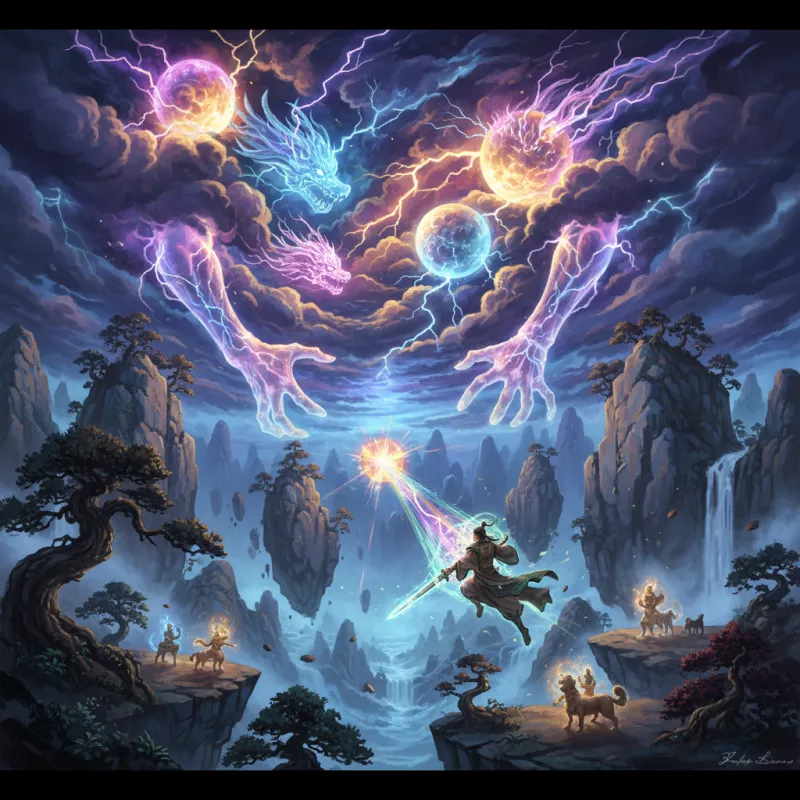
Lightning doesn't ask permission. When Zhang Sanfeng reached for the Golden Core in Stellar Transformations, the sky split open like a wound, and nine bolts of purple-white fire tried to erase him from existence. He survived—barely—with third-degree burns across 60% of his body and a core that pulsed with stolen heavenly energy. This is heavenly tribulation (天劫 tiānjié), and it's the cultivation world's most brutal truth: the universe will literally try to kill you for getting too strong.
What Heavenly Tribulation Actually Is
Heavenly tribulation isn't punishment—it's quality control. The Heavenly Dao (天道 tiāndào), that impersonal cosmic operating system governing reality, has rules. When a cultivator accumulates enough power to break through to a higher realm, they're essentially hacking the universe's source code. The tribulation is the system's antivirus response.
The mechanics are brutally simple: accumulate enough qi (气 qì) to trigger a breakthrough, and the heavens respond with lightning. Not metaphorical lightning—actual bolts of tribulation lightning (劫雷 jiéléi) that carry the concentrated will of heaven itself. Each bolt is calibrated to your specific cultivation level, your techniques, even your karma. A righteous cultivator faces "pure" tribulation lightning. A demonic cultivator? Their tribulation comes laced with karmic fire (业火 yèhuǒ) that burns the soul.
The term itself—渡劫 (dùjié), literally "crossing tribulation"—reveals the philosophy. You're not fighting the heavens; you're crossing a threshold. The tribulation is the river, and you're trying not to drown.
The Major Tribulation Checkpoints
Not all breakthroughs attract tribulation. Foundation Establishment (筑基 zhùjī) cultivators can relax—they're still too weak to register on heaven's radar. But once you start condensing a Golden Core (金丹 jīndān), the game changes.
Golden Core Tribulation typically involves three to nine lightning bolts, depending on your core's quality. In I Shall Seal the Heavens, Meng Hao's Perfect Golden Core attracted a nine-bolt tribulation so violent it created a crater visible from orbit. Standard cores get three bolts. Perfect cores? The heavens take it personally.
Nascent Soul Tribulation (元婴劫 yuányīng jié) is where cultivators start dying in statistically significant numbers. The Nascent Soul represents a second life—a spiritual infant that can survive even if your physical body is destroyed. The heavens respond by sending tribulation clouds (劫云 jiéyún) that can cover entire mountain ranges. Six waves of lightning, each stronger than the last. Survival rate in most novels hovers around 30%.
Ascension Tribulation (飞升劫 fēishēng jié) is the final exam. Pass, and you transcend to the Immortal Realm (仙界 xiānjiè). Fail, and you're ash. This tribulation doesn't just test your cultivation—it tests your Dao heart (道心 dàoxīn), your willpower, your very reason for seeking immortality. In Desolate Era, Ji Ning's ascension tribulation manifested as a recreation of every person he'd ever killed, forcing him to face his karmic debts before the lightning even started.
Why the Heavens Are So Aggressive
Here's the uncomfortable truth most cultivation novels dance around: the Heavenly Dao doesn't want you to succeed. Not because it's malicious—it's not sentient enough for malice—but because every successful cultivator represents a drain on the world's finite qi resources. The heavens maintain balance. Too many immortals, and the mortal realm's spiritual energy collapses.
This explains why tribulation difficulty scales with potential. A cultivator with a trash-tier spiritual root (灵根 línggēn) faces easier tribulations because they're not a threat to cosmic equilibrium. But someone like Wang Lin from Renegade Immortal, who cultivates both the orthodox and demonic paths simultaneously? His tribulations are apocalyptic because he's breaking multiple cosmic laws at once.
The historical context matters here. In classical Daoist texts like the Baopuzi (抱朴子), written by Ge Hong during the Jin Dynasty (317-420 CE), the concept of heavenly tests appears as "celestial examinations" (天考 tiānkǎo). Alchemists seeking immortality had to prove their virtue through trials. Modern xianxia novels weaponized this concept, turning philosophical tests into literal combat encounters.
Surviving Your Tribulation: Practical Strategies
Cultivators don't face tribulation naked and screaming (usually). Preparation is everything.
Tribulation-Resisting Treasures (渡劫法宝 dùjié fǎbǎo) are the most common defense. Defensive formations, lightning-absorbing talismans, protective robes woven from thunder-attribute spirit beast hide—anything to blunt the initial strikes. In A Record of a Mortal's Journey to Immortality, Han Li spent two hundred years collecting materials for a single tribulation-resisting formation. It saved his life three times.
Location matters. Never face tribulation near populated areas—the collateral damage will add to your karmic burden and strengthen the next wave. Ocean tribulations are popular because seawater conducts lightning away from your body. Mountain peaks work if you can anchor yourself properly. Some desperate cultivators even trigger their tribulations inside ancient ruins, hoping the residual formations will interfere with heaven's targeting.
Body cultivation (体修 tǐxiū) provides the most reliable defense. A body refined to the strength of spiritual metal can tank lightning bolts that would vaporize normal flesh. This is why dual cultivation of body and qi is so valued—your body becomes your ultimate tribulation treasure.
The most controversial strategy? Tribulation substitution (替劫 tìjié). Some sects use expendable disciples as lightning rods, having them stand near the tribulation-taker to "share" the heavenly wrath. It's considered deeply unorthodox, and the karmic backlash usually manifests in later tribulations. The heavens keep receipts.
When Tribulation Goes Wrong
Tribulation failure isn't always fatal, but it's always catastrophic. A failed Golden Core tribulation shatters your core, crippling your cultivation permanently. Failed Nascent Soul tribulation can trap your soul in a half-formed state—alive but unable to advance or retreat, slowly dissipating over decades.
The worst outcome is tribulation deviation (走火入魔 zǒuhuǒ rùmó during tribulation). This happens when a cultivator's Dao heart wavers mid-tribulation, creating an opening for heart demons (心魔 xīnmó). The tribulation lightning doesn't just strike your body—it invades your sea of consciousness (识海 shíhǎi), burning away memories, personality, cultivation insights. Survivors become shells, their minds scorched clean.
Martial World's Lin Ming witnessed this firsthand when a senior brother's tribulation went wrong. The man survived the lightning but lost everything that made him human—cultivation intact, soul destroyed. The sect kept him in a sealed chamber for three hundred years before his body finally gave out.
The Tribulation Paradox
Here's what makes heavenly tribulation fascinating from a narrative perspective: it's simultaneously the greatest threat and the greatest opportunity in cultivation. Each bolt of tribulation lightning carries pure heavenly energy. Cultivators who can absorb even a fraction of it during their tribulation experience explosive growth. Your body is being destroyed and reforged simultaneously.
This is why some arrogant young masters actively seek stronger tribulations. They'll consume forbidden pills, practice conflicting cultivation methods, or deliberately accumulate karmic debt—anything to provoke heaven into sending more powerful lightning. The logic is sound: survive a nine-nine heavenly tribulation (九九天劫 jiǔjiǔ tiānjié, eighty-one bolts total), and your foundation becomes unshakeable.
The mortality rate for nine-nine tribulations exceeds 99%. But that remaining 1%? They become legends.
Tribulation in the Modern Xianxia Meta
Contemporary xianxia novels have evolved tribulation mechanics in interesting directions. Lord of the Mysteries introduced "acting tribulations" where the test isn't lightning but maintaining your persona under cosmic scrutiny. Reverend Insanity made tribulations psychological warfare, with the heavens attacking through your deepest regrets and fears.
The trend reflects a broader shift in cultivation fiction—from external combat to internal struggle. Modern readers want tribulations that test character, not just power levels. The most memorable tribulation scenes aren't about dodging lightning; they're about cultivators confronting who they are and who they're willing to become.
Still, there's something primal about the classic tribulation scene: a lone cultivator standing beneath roiling black clouds, lightning illuminating their defiant face, betting everything on one final breakthrough. It's the cultivation world's ultimate statement—I refuse to accept my limits, even if the universe itself disagrees.
The heavens strike back. But sometimes, just sometimes, the cultivator strikes harder.
Related Reading
- Heavenly Tribulation: Why Lightning Strikes the Powerful
- Spiritual Roots: The Innate Talent System of Cultivation
- Nascent Soul Formation: The Critical Breakthrough
- Heavenly Tribulation and Ascension: The Final Test of Cultivation
- Cultivation Realms Explained: The Ladder to Immortality
- Essential Cultivation Terms: The Complete Xianxia Glossary
- Dual Cultivation: Partnership in the Path to Immortality
- Best Cultivation Web Novels in 2024-2025: Updated Reading List