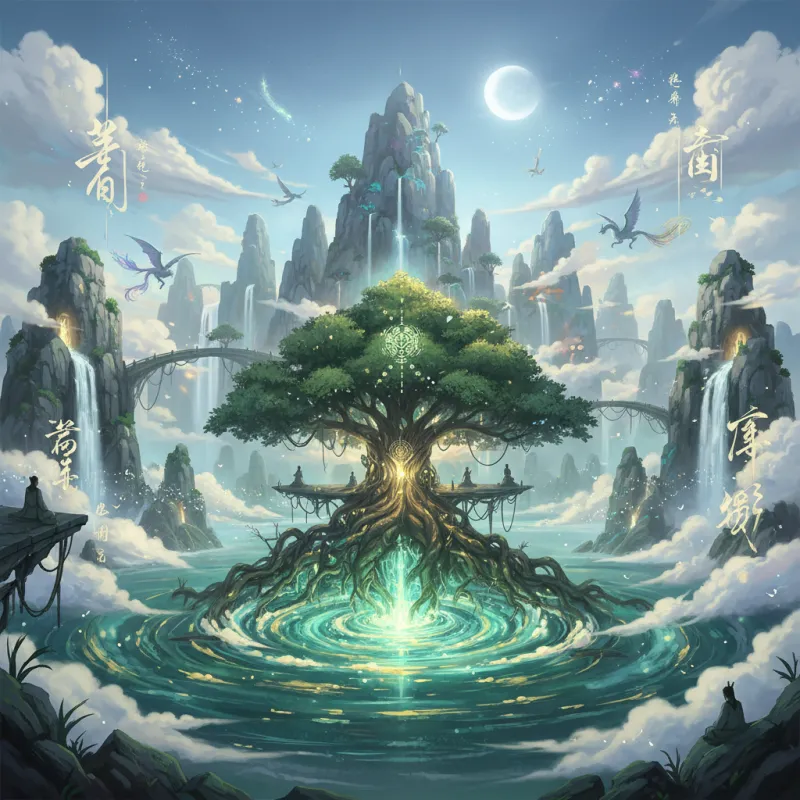
A twelve-year-old stands before the Testing Stone, palms sweating. The entire village watches. The stone glows — then flickers out. No spiritual root. The elders shake their heads. The protagonist of someone else's story walks away. This scene plays out in a thousand cultivation novels, and it reveals the genre's most brutal truth: talent isn't earned. It's assigned at conception, coded into your spiritual DNA, and there's almost nothing you can do about it.
The Biological Lottery of Immortality
Spiritual roots (灵根 línggēn) are the hardware that makes cultivation possible. Think of them as spiritual organs — invisible, intangible, but absolutely essential. They're the interface between your mortal body and the ambient spiritual energy (灵气 língqì) saturating the world. Without them, you're like someone trying to charge a phone without a charging port. The energy is there, all around you, but you have no way to absorb it.
The concept emerged in early cultivation fiction as a narrative necessity. If anyone could cultivate, why would there be mortals? Why would sects be selective? The spiritual root solved this elegantly: cultivation requires innate talent, and that talent is randomly distributed. You're either born with it or you're not. It's the genetic lottery that decides whether you spend your life farming rice or pursuing immortality.
Most cultivation novels establish spiritual roots as fixed at birth, determined by factors beyond anyone's control — bloodline, karma from past lives, cosmic chance, or the whims of heaven itself. The Testing Stone (测灵石 cè líng shí) ceremony, usually conducted around age twelve, is where children learn their fate. It's a moment of pure drama: will the stone light up, revealing hidden potential? Or will it stay dark, confirming a lifetime of mediocrity?
The Five Elements and Their Hierarchies
The most common system divides spiritual roots by elemental affinity: Metal (金 jīn), Wood (木 mù), Water (水 shuǐ), Fire (火 huǒ), and Earth (土 tǔ). These aren't just labels — they determine which cultivation methods you can practice, which techniques you can learn, and which spiritual herbs will benefit you most.
But here's where it gets complicated: not all spiritual roots are created equal. The hierarchy typically breaks down like this:
Single Spiritual Root (单灵根 dān línggēn): The absolute pinnacle. One element, pure and undiluted. Cultivation speed is 5-10 times faster than average. These are the chosen ones, the protagonists, the disciples that sects go to war over. In I Shall Seal the Heavens, Meng Hao's unique spiritual root situation makes him a target for both opportunity and danger. Single spiritual roots appear in maybe one in ten thousand people.
Dual Spiritual Roots (双灵根 shuāng línggēn): Two elements. Still excellent, still rare. Cultivation is 3-5 times faster than average. These disciples become inner sect members, receive significant resources, and have genuine shots at reaching high realms. The trade-off is versatility — you can practice techniques from two elements, though neither as efficiently as a single-root cultivator.
Triple Spiritual Roots (三灵根 sān línggēn): Three elements. This is where "talented" becomes "acceptable." Cultivation speed is maybe twice normal. You'll probably make it to Foundation Establishment if you work hard and don't die. Most inner sect disciples fall into this category.
Quad Spiritual Roots (四灵根 sì línggēn): Four elements. You're outer sect material. Cultivation is slow, resources are limited, and you'll spend decades stuck at Qi Condensation while your betters soar past you. But hey, at least you can cultivate.
Penta Spiritual Roots (五灵根 wǔ línggēn): All five elements. Paradoxically, this is the worst possible outcome. Your spiritual energy is so diluted across five elements that cultivation becomes glacially slow. Many novels treat penta-root cultivators as effectively talentless. They're the tragic figures who spend fifty years reaching Qi Condensation 3rd layer while single-root geniuses hit Core Formation in their twenties.
Mutant Spiritual Roots (变异灵根 biànyì línggēn): The wild cards. Lightning, ice, wind, darkness — elements outside the standard five. These are even rarer than single spiritual roots and often come with unique advantages. In A Record of a Mortal's Journey to Immortality, Han Li's encounters with mutant root cultivators reveal both their power and their rarity.
The Cruelty of the System
What makes spiritual roots fascinating from a narrative perspective is how unfair they are. Modern readers, raised on stories where hard work conquers all, find this system almost offensive. You can train every day, study every night, push yourself to the absolute limit — and a lazy genius with a single spiritual root will still surpass you effortlessly.
This isn't a bug; it's a feature. Cultivation fiction, particularly Chinese xianxia, doesn't pretend the universe is fair. It's explicitly hierarchical, explicitly elitist. The strong devour the weak. Talent matters more than effort. Heaven plays favorites.
The spiritual root system creates natural drama. Every protagonist who starts with poor spiritual roots (or none at all) becomes an underdog. Every genius with a heaven-defying spiritual root becomes a target. Sects fight wars over single-root disciples. Families arrange marriages to combine bloodlines. Entire plot arcs revolve around treasures that can improve spiritual root quality — because in a world where talent is destiny, anything that changes your talent is worth killing for.
Exceptions, Loopholes, and Protagonist Privileges
Of course, rules exist to be broken, and cultivation fiction loves its loopholes. The most common workarounds include:
Special Constitutions (特殊体质 tèshū tǐzhì): Some protagonists are born with unique body types that bypass spiritual root requirements entirely. The Ancient Sacred Body, the Immortal Physique, the Chaotic Body — these trump normal spiritual roots through sheer cosmic unfairness.
Heavenly Treasures: Pills, fruits, or artifacts that can improve spiritual root quality. These are usually one-of-a-kind, guarded by ancient formations, or require ingredients that haven't existed for ten thousand years. Naturally, protagonists stumble into them.
Cultivation Methods: Certain techniques don't rely on spiritual roots at all. Body cultivation, soul cultivation, or demonic cultivation paths offer alternatives for the "talentless." They're usually harder, more dangerous, and socially stigmatized — perfect for underdog protagonists.
Reincarnation Cheats: The protagonist is actually an ancient immortal reborn, and their "poor" spiritual roots are temporary or illusory. Their true talent awakens later, usually at a dramatically convenient moment.
System/Cheat Abilities: Modern cultivation novels often give protagonists game-like systems that render spiritual roots irrelevant. Why worry about talent when you have a system that grants instant breakthroughs?
The tension between "spiritual roots determine everything" and "the protagonist overcomes their limitations" drives countless cultivation stories. Readers want both the satisfaction of an underdog victory and the power fantasy of being naturally gifted. Smart authors thread this needle by giving protagonists poor spiritual roots but compensating with other advantages.
The Meta-Narrative Function
From a storytelling perspective, spiritual roots serve multiple functions. They're a gatekeeping mechanism that explains why not everyone cultivates. They're a source of conflict and drama. They're a way to quickly establish character potential — when a new character appears with a single spiritual root, readers immediately know they're important.
But more subtly, spiritual roots reflect real-world anxieties about talent, privilege, and social mobility. The child born with penta spiritual roots, watching their peers advance while they stagnate, mirrors real experiences of feeling left behind by more naturally gifted competitors. The sect that hoards resources for single-root disciples while ignoring outer sect members reflects institutional inequality.
Cultivation fiction doesn't always critique these systems — often it reinforces them, suggesting that hierarchy is natural and the talented deserve their advantages. But the best novels interrogate this. They ask: what does it mean to be born without talent in a world that worships it? What happens to the billions of people who fail the Testing Stone? Is there dignity in being ordinary?
Beyond the Standard Model
Not every cultivation novel uses spiritual roots. Some systems replace them with meridians, dantians, or soul strength. Others abandon innate talent entirely, making cultivation purely about resources, luck, and willpower. Reverend Insanity famously uses a completely different system based on Gu worms rather than spiritual roots, creating a world where talent matters less than cunning and ruthlessness.
But the spiritual root system remains dominant because it works. It's simple enough for readers to grasp immediately, complex enough to support detailed worldbuilding, and flexible enough to accommodate whatever plot twists the author needs. Whether you're reading about a trash protagonist with penta spiritual roots who defies heaven, or a genius with a mutant spiritual root who becomes a sect's hope, the system provides a clear framework for understanding power and potential.
The Testing Stone glows or it doesn't. The spiritual root is there or it isn't. And in that moment of revelation, a cultivator's entire future crystallizes. It's unfair, it's arbitrary, it's absolutely central to the genre — and that's exactly why it works.
Related Reading
- Exploring the Enigmatic Realms of Chinese Cultivation and Xianxia Fiction
- From Mortal to Immortal: Every Stage Explained
- Heavenly Tribulation: When the Heavens Strike Back
- Exploring Immortal Cultivation and Spiritual Realms in Chinese Xianxia Fiction
- Bottlenecks and Breakthroughs: The Emotional Core of Cultivation Fiction
- Mortal vs. Immortal Realm: The Two Worlds of Cultivation Fiction
- Exploring the Intricate World of Chinese Cultivation and Xianxia Fiction
- The Allure of Chinese Cultivation Fiction: A Journey Through Immortal Realms