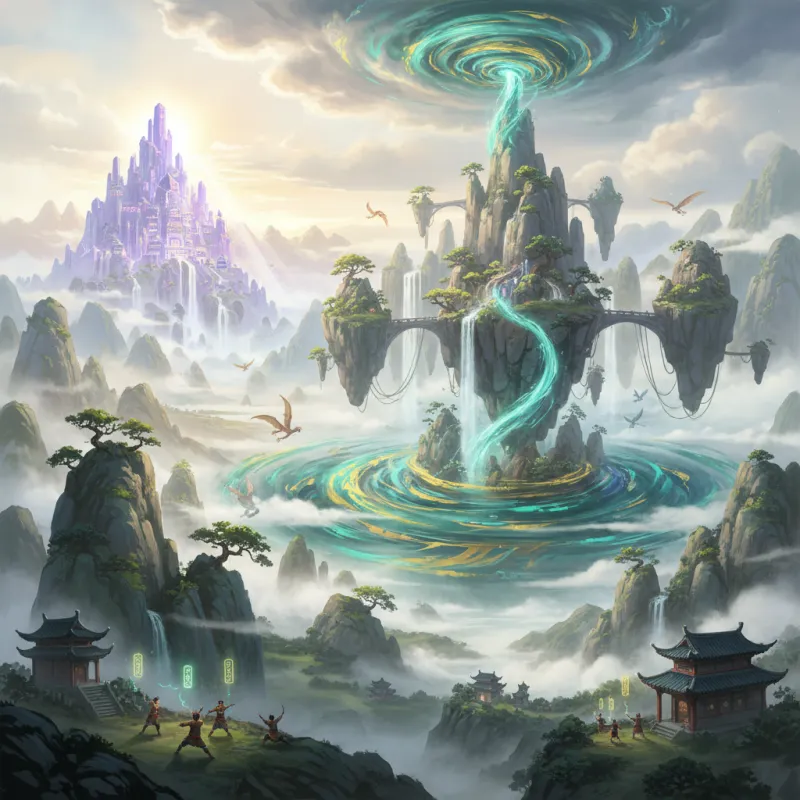
Every cultivator dreams of shattering the void and ascending to immortality, but most die stuck in the Foundation Establishment realm, their dantians cracked from forced breakthroughs and their meridians scorched by spiritual energy they couldn't control. The cultivation realm system isn't just a power ladder—it's a brutal filter that separates the talented from the mediocre, the patient from the reckless, and the destined from the damned.
Understanding the Cultivation Framework
The concept of xiūliàn jìngjiè (修炼境界, cultivation realms) emerged from Daoist internal alchemy practices during the Tang and Song dynasties, where practitioners believed they could refine their bodies and spirits through meditation and energy manipulation. Modern xianxia fiction has transformed these esoteric practices into structured power systems that readers can follow and understand. Unlike Western fantasy's often vague "levels," cultivation realms represent fundamental transformations of body, mind, and soul—each breakthrough is a qualitative leap, not just a quantitative increase in power.
The genius of this system lies in its philosophical depth. Each realm corresponds to Daoist concepts of self-refinement: gathering (Qi Condensation), building (Foundation Establishment), forming (Core Formation), and ultimately transcending (Nascent Soul and beyond). When Er Gen wrote "I Shall Seal the Heavens," he didn't just create power levels—he crafted a metaphysical journey where each realm forced his protagonist Meng Hao to confront deeper truths about existence itself.
The Mortal Realms: Where Most Stories Begin
Qi Condensation (Liàn Qì Qī, 炼气期) is where every cultivator starts, and it's far more dangerous than most novels admit. You're essentially teaching your body to process energy it wasn't designed to handle. In "Coiling Dragon," Linley spends years just sensing the elemental essences around him before he can even begin proper cultivation. The mortality rate at this stage is actually quite low—not because it's safe, but because you're too weak to attempt anything truly stupid yet.
The real bloodbath begins at Foundation Establishment (Zhù Jī Qī, 筑基期). This is where your dantian transforms from a loose collection of qi into a solid foundation capable of supporting higher-level cultivation. The breakthrough requires compressing vast amounts of spiritual energy into your lower abdomen while simultaneously reinforcing your meridians to handle the increased flow. Fail, and your dantian shatters. Succeed, and your lifespan extends to roughly 200 years—your first real taste of transcending mortal limitations.
Here's what most guides won't tell you: Foundation Establishment is where cultivation novels separate protagonists from cannon fodder. In "A Record of a Mortal's Journey to Immortality," Han Li spends decades carefully preparing for this breakthrough, gathering rare pills and choosing the perfect environment. Meanwhile, arrogant young masters rush the process and end up as cautionary tales. The difference between a flawless foundation and a cracked one determines your entire future potential—it's the cultivation equivalent of building a skyscraper on sand versus bedrock.
Golden Core (Jīn Dān Qī, 金丹期) represents your first true transformation beyond mortality. The scattered qi in your dantian condenses into a single golden sphere—a miniature sun of spiritual energy that rotates perpetually within your body. This isn't metaphorical. In proper xianxia, you can literally see the golden core if you cut open a cultivator at this stage (not recommended for obvious reasons). Your lifespan jumps to 500 years, you can fly using spiritual energy, and you become a genuine powerhouse in the mortal world.
The quality of your golden core matters immensely. A nine-revolution golden core, formed through perfect cultivation and rare treasures, shines like a miniature star. A three-revolution core looks more like a dull brass marble. Wang Lin from "Renegade Immortal" famously spent 300 years refining his core to perfection, understanding that rushing this stage would cripple his future potential. This patience is what separates true immortal candidates from those who'll forever remain stuck in the lower realms.
The Immortal Threshold: Nascent Soul and Beyond
Nascent Soul (Yuán Yīng Qī, 元婴期) is where you stop being human in any meaningful sense. Your golden core cracks open like an egg, and from it emerges a miniature version of yourself—your nascent soul, also called your yuanying. This tiny spiritual body is your true self; your physical body becomes more like a shell or vehicle. Destroy a Nascent Soul cultivator's body, and they can survive as a disembodied soul, eventually possessing a new vessel or reconstructing their form from spiritual energy.
This is the realm where cultivation techniques truly diverge. Some nascent souls appear as infants, others as miniature adults, and some take on beast or demonic forms depending on the cultivation method used. In "Stellar Transformations," Qin Yu's nascent soul transforms into a golden dragon, reflecting his unique cultivation path. The nascent soul can leave your body to fight independently, scout ahead, or even cultivate separately—it's like having a second self that exists on a spiritual plane.
Lifespan at Nascent Soul? Roughly 1,000 years, though this varies wildly by novel. More importantly, you've crossed the threshold into true immortality. You're no longer bound by mortal concerns like food or sleep. Your nascent soul can survive in the void of space, and you can teleport short distances by moving your soul directly through space while your body follows.
Soul Formation (Huà Shén Qī, 化神期) and Void Refinement (Liàn Xū Qī, 炼虚期) represent the upper limits of what most cultivation worlds can support. At Soul Formation, your nascent soul matures and gains the ability to split into multiple avatars. At Void Refinement, you begin comprehending the laws of space and time themselves. These cultivators can destroy mountains with a gesture and live for thousands of years. They're essentially demigods, and most mortal worlds have maybe a handful of them at any given time.
The Tribulation System: Heaven's Quality Control
Here's the part that makes cultivation genuinely terrifying: heavenly tribulations (Tiān Jié, 天劫). Starting from Nascent Soul (or sometimes Golden Core, depending on the novel), each major breakthrough attracts the attention of the Heavenly Dao—the universe's operating system, essentially. It sends down lightning tribulations to test whether you're worthy of transcending mortal limits.
These aren't gentle tests. Tribulation lightning is specifically designed to destroy cultivators. It targets your weaknesses, exploits flaws in your cultivation, and adapts to your defenses. In "Desolate Era," Ji Ning watches fellow cultivators get reduced to ash by tribulations they weren't prepared for. The lightning doesn't just attack your body—it strikes your soul directly, burning away impurities but also threatening to annihilate your consciousness entirely.
The philosophy behind tribulations is actually quite elegant: Heaven doesn't want defective immortals cluttering up the higher realms. If you can't survive the tribulation, you don't deserve to advance. It's brutal, but it ensures that only the truly capable reach the higher stages. This is why preparation matters so much—gathering defensive treasures, perfecting your cultivation base, and choosing the right location for your breakthrough can mean the difference between ascension and obliteration.
Beyond the Mortal World: Ascension Realms
Once you reach the peak of what your world can support (usually around Void Refinement or Dao Integration), you face a choice: ascend to a higher realm or remain as a local powerhouse. Ascension (Fēi Shēng, 飞升) is the ultimate goal of most cultivation novels—breaking through the spatial barriers of your world and entering a higher plane where spiritual energy is denser and cultivation can continue.
The realms beyond ascension vary wildly between novels. Some use Immortal (Xiān, 仙) as a catch-all term for anyone who's ascended. Others have elaborate hierarchies: Earth Immortal, Heaven Immortal, Golden Immortal, Immortal King, Immortal Emperor. "I Shall Seal the Heavens" goes even further with Ancient Realm, Dao Realm, and ultimately the Transcendor realm where you become a living universe.
What's consistent is the pattern: each higher realm represents another fundamental transformation. You're not just getting stronger—you're becoming a different type of being entirely. An Immortal Emperor doesn't relate to a Golden Core cultivator the way a human relates to an ant; it's more like how a human relates to a single cell in their body. The power gap becomes so vast that lower realm cultivators literally cannot perceive higher realm beings unless those beings choose to reveal themselves.
The Variations and Innovations
Not every novel follows this exact system. "Martial World" uses a completely different framework based on martial cultivation rather than qi refinement. "Lord of the Mysteries" blends Western occultism with cultivation concepts, creating sequences and potions instead of traditional realms. "Reverend Insanity" has its own unique Gu cultivation system where practitioners refine and use spiritual insects.
The best novels use their realm systems to drive character development and plot tension. In "A Will Eternal," Bai Xiaochun's comedic personality clashes hilariously with the serious, life-or-death nature of cultivation breakthroughs. In "Forty Millenniums of Cultivation," the realm system gets deconstructed and rebuilt with a sci-fi twist, treating cultivation as a form of biological and spiritual engineering.
What makes a cultivation realm system work isn't complexity—it's consistency and consequence. Readers need to understand the rules so they can appreciate when the protagonist breaks them or finds clever workarounds. The realms should feel earned, not arbitrary. When Meng Hao finally reaches Immortal Ascension after 1,600 chapters, it feels monumental because we've watched him struggle through every single stage, facing tribulations and setbacks that would have killed lesser cultivators a hundred times over.
The Philosophy Behind the Power
The cultivation realm system reflects a fundamentally Chinese approach to self-improvement and transcendence. Unlike Western fantasy where power often comes from external sources (magic swords, divine blessings, genetic luck), cultivation is about internal refinement. You're not given power—you forge it through discipline, comprehension, and willpower.
This connects to Daoist concepts of neidan (内丹, internal alchemy) where practitioners believed they could create an immortal spiritual body through meditation and energy work. The golden core isn't just a cool power-up—it's a literal interpretation of the "golden elixir" that Daoist alchemists spent lifetimes trying to create. The nascent soul represents the yangshen (阳神, yang spirit), the immortal spiritual body that can exist independently of physical form.
Modern xianxia has gamified these concepts, but the philosophical core remains: transcendence requires transformation. You can't become immortal while remaining fundamentally human. Each realm strips away another layer of mortality until what remains is something that can exist beyond the constraints of normal reality. It's body horror and spiritual evolution wrapped in a power fantasy, and that's exactly why it works.
The cultivation realm system has become so influential that it's spread beyond Chinese web novels into Korean manhwa, Japanese light novels, and even Western fantasy. Everyone wants that satisfying progression, that sense of climbing an impossible ladder toward godhood. But the best cultivation stories remember that realms aren't just numbers—they're transformations, each one a small death and rebirth on the path to immortality.
Related Reading
- Exploring the Enigmatic Realms of Chinese Cultivation and Xianxia Fiction
- The Ultimate Guide to Cultivation Fiction (Xiuxian): From Mortal to Immortal
- Heavenly Tribulation: When the Heavens Strike Back
- Spiritual Roots: The Innate Talent System of Cultivation
- From Mortal to Immortal: Every Stage Explained
- Formation Arrays: The Strategic Art of Cultivation Warfare
- Auction House Economics: How Cultivation Markets Shape Power Dynamics
- Ancient Sects and Spiritual Realms in Chinese Cultivation and Xianxia Fiction