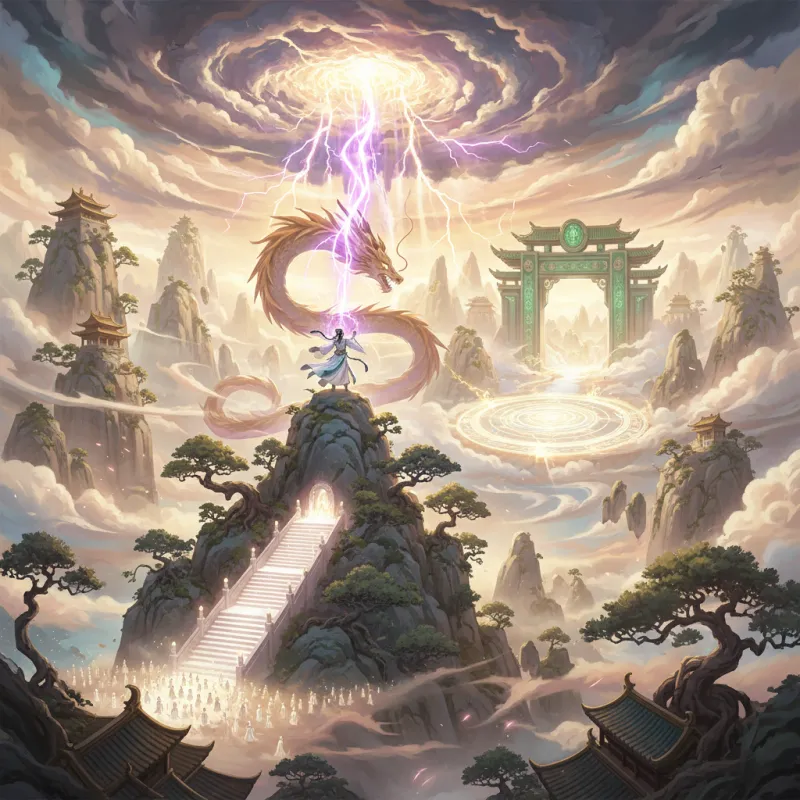
The sky splits open, and lightning the color of divine judgment descends. A cultivator who has spent three hundred years perfecting their dao stands alone on a mountain peak, watching nine layers of tribulation clouds gather above them. This is the moment every xianxia novel builds toward — the heavenly tribulation (天劫 tiānjié) that separates the immortal from the ash. Yet most readers skip past these scenes without understanding what makes them the philosophical and narrative climax of cultivation fiction. Tribulation isn't just a boss fight with weather. It's the universe's final answer to the question: "Do you deserve to exist beyond the rules that govern everyone else?"
The Metaphysics of Divine Punishment
Heavenly tribulation (渡劫 dùjié, literally "crossing tribulation") operates on a principle that Western fantasy rarely touches: the universe has an immune system, and you're the infection. When a cultivator approaches the threshold of ascension (飞升 fēishēng), they're not just getting stronger — they're violating the natural order. The Heavenly Dao (天道 tiāndào) maintains cosmic balance, and immortality represents an imbalance so severe that reality itself mobilizes to eliminate the threat.
This isn't arbitrary cruelty. In Daoist cosmology, which underlies most xianxia worldbuilding, the universe tends toward equilibrium. Mortals are born, live, and die, returning their energy to the cycle. An immortal breaks that cycle, hoarding spiritual energy and consciousness indefinitely. The tribulation is the Dao's attempt to restore balance — either by tempering the cultivator into something that can exist in harmony with cosmic law, or by destroying them entirely.
The nine-layer tribulation (九重天劫 jiǔchóng tiānjié) that appears in novels like I Shall Seal the Heavens isn't random numerology. Nine is the ultimate yang number in Chinese metaphysics, representing completion and the peak of transformation. Each lightning strike carries the accumulated karma of the cultivator's actions, their defiance of natural law, and the weight of every life they've taken or saved. This is why tribulation lightning can't be blocked by simple defensive formations — it's not just energy, it's judgment made manifest.
The Three Types of Tribulation
Not all tribulations are created equal, and understanding the distinctions reveals how cultivation systems think about power and worthiness. The minor tribulation (小劫 xiǎojié) occurs at breakthrough moments within the mortal realms — typically when advancing from Foundation Establishment to Core Formation, or from Nascent Soul to Soul Transformation. These are tests of readiness, checking whether your cultivation base can handle the next stage. They're dangerous but survivable with proper preparation.
The major tribulation (大劫 dàjié) arrives when attempting to cross from mortality to immortality, usually at the transition from the Tribulation Transcendence realm to True Immortal. This is the tribulation that defines the genre. It's not testing whether you're ready for the next stage — it's testing whether you have the right to exist outside the mortal cycle at all. The lightning here carries the weight of the Heavenly Dao's full attention, and survival rates in most novels hover around thirty percent for even talented cultivators.
Then there's the heart demon tribulation (心魔劫 xīnmó jié), which doesn't come from the sky at all. This internal tribulation manifests as illusions, regrets, and the darkest aspects of the cultivator's psyche. Coiling Dragon handles this brilliantly when Linley faces visions of everyone he's failed to protect. The heart demon tribulation recognizes that the greatest threat to a cultivator's dao isn't external force — it's their own doubt, guilt, and unresolved trauma. You can have a perfect cultivation technique and still fail if you can't face yourself.
Ascension: The Reward and the Trap
Surviving tribulation opens the gate to ascension (飞升 fēishēng), but here's where most novels reveal their philosophical cards. Ascension isn't escape — it's graduation to a harder school. The mortal realm has limits, yes, but it also has protections. Once you ascend to the immortal realm (仙界 xiānjiè), you're playing by different rules, and the power ceiling is exponentially higher.
A Record of a Mortal's Journey to Immortality treats this honestly. Han Li spends hundreds of chapters as a dominant force in the mortal realm, only to ascend and immediately become a bottom-tier nobody again. The immortal realm has its own hierarchies, its own tribulations, and cultivators who've been immortal for millions of years. Ascension solves the mortality problem but introduces the irrelevance problem.
The ascension platform (飞升台 fēishēng tái) that appears in many novels serves as a one-way portal, and that directionality matters. You can't come back. Every relationship, every sect, every mortal you knew becomes permanently inaccessible. This is why the best ascension scenes carry emotional weight — they're not just power-ups, they're permanent goodbyes. When a protagonist ascends, they're not just leaving a place, they're leaving an entire tier of existence.
Some cultivation systems include forced ascension, where the mortal realm itself rejects cultivators who exceed a certain power threshold. This appears in Martial World and similar novels, where the realm's laws physically expel anyone above True Immortal level. It's a clever worldbuilding choice that prevents overpowered immortals from dominating mortal affairs, but it also means ascension becomes mandatory rather than optional — another way the universe enforces its rules.
The Politics of Tribulation
Here's what most readers miss: tribulation is when cultivators are most vulnerable, and everyone knows it. The moment those tribulation clouds gather, every enemy within a thousand miles knows exactly where you are and that you can't run. Tribulation interference (劫杀 jiéshā, literally "tribulation killing") is a common assassination method in higher-level cultivation politics.
The rules around interference vary by novel, but most follow a pattern: direct intervention draws the tribulation's attention to the interferer, potentially triggering their own premature tribulation. But indirect methods — weakening the cultivator beforehand, destroying their recovery pills, or attacking immediately after the tribulation ends — remain fair game. This is why powerful cultivators often ascend from hidden locations or under the protection of their sect's grand formation.
Renegade Immortal explores this brutally. Wang Lin faces multiple assassination attempts during his tribulations, and the novel doesn't shy away from showing how tribulation timing becomes a strategic consideration. Do you attempt breakthrough when you're ready, or do you wait until your enemies are distracted? Do you ascend from your sect's protected grounds, or do you hide your breakthrough to avoid drawing attention?
Tribulation Treasures and Preparation
The cultivation economy revolves around tribulation preparation. Tribulation-resisting treasures (渡劫法宝 dùjié fǎbǎo) form their own category of artifacts, and their scarcity drives entire plot arcs. A good tribulation-resisting robe might reduce lightning damage by thirty percent — enough to mean the difference between survival and annihilation.
The most valuable items are tribulation substitution talismans (替劫符 tìjié fú), which can redirect one strike of tribulation lightning to a prepared object or formation. These are phenomenally rare because creating them requires materials that have already survived tribulation, creating a bootstrap problem. In Stellar Transformations, entire wars are fought over tribulation-assisting treasures, and the novel treats this as perfectly rational behavior.
Body cultivation (体修 tǐxiū) becomes crucial here. Cultivators who've tempered their physical form can endure tribulation lightning more effectively than those who focused purely on spiritual cultivation. This is why many protagonists pursue dual cultivation paths — not for the power boost in normal combat, but for the survival advantage during tribulation. Your Golden Core might be flawless, but if your body can't handle the lightning, you're still dead.
The Ascension Loophole
Some novels introduce ascension alternatives, and these reveal interesting philosophical tensions. Forced ascension through external means — using an ascension pill (飞升丹 fēishēng dān) or an ancient formation — allows cultivators to skip tribulation entirely. But there's always a cost. Tribulation tempers the cultivator's foundation, burning away impurities and forcing their dao to crystallize under pressure. Skip that process, and you ascend with a weaker foundation than those who survived the traditional path.
Martial God Asura plays with this through its protagonist's unique constitution, which allows him to endure tribulations meant for higher realms. This isn't just a power-up — it's a statement about the relationship between suffering and worthiness. The novel argues that tribulation isn't punishment, it's refinement. The cultivators who suffer the most intense tribulations emerge with the strongest foundations.
Then there's the question of tribulation failure. Most novels treat this as instant death, but some explore the aftermath. Failed tribulation can leave a cultivator crippled, their cultivation base shattered, forced to restart from a lower realm. This fate is often portrayed as worse than death — you survive, but everything you built is gone, and you're left with the knowledge of what you almost achieved.
Why Tribulation Matters to the Genre
Heavenly tribulation serves a narrative function that Western fantasy's "level up" systems can't replicate. It's a hard gate that can't be bypassed through cleverness or luck alone. You can't talk your way out of tribulation. You can't make a deal with it. You either have the strength, will, and foundation to survive, or you don't.
This creates genuine tension in a genre that often struggles with power scaling. When a protagonist can defeat any mortal opponent, tribulation remains the one challenge that doesn't care about plot armor. The heavens don't have motivations to exploit or weaknesses to discover. They're not evil or good — they're law made manifest, and law doesn't negotiate.
The best cultivation novels use tribulation as a mirror. The lightning that descends reflects the cultivator's dao, their choices, their karma. A righteous cultivator faces tribulation that tests their conviction. A demonic cultivator faces tribulation that tries to burn away their darkness. The tribulation you face reveals who you are, and whether that person deserves to exist beyond mortality's limits.
When that final lightning strike fades and the ascension light descends, it's not just a power-up scene. It's the universe's grudging acknowledgment that you've earned the right to break its rules. And in a genre built on the fantasy of transcendence through effort, that acknowledgment is everything.
Related Reading
- Heavenly Tribulation: When the Heavens Strike Back
- The Ultimate Guide to Cultivation Fiction (Xiuxian): From Mortal to Immortal
- Exploring the Enigmatic Realms of Chinese Cultivation and Xianxia Fiction
- Nascent Soul Formation: The Critical Breakthrough
- Spiritual Roots: The Innate Talent System of Cultivation
- Merchant Guilds and Trade Routes in Cultivation Worlds
- Unraveling the Mysteries of Formations in Chinese Cultivation and Xianxia Fiction
- Cultivation Worlds: How Web Novels Build Entire Universes