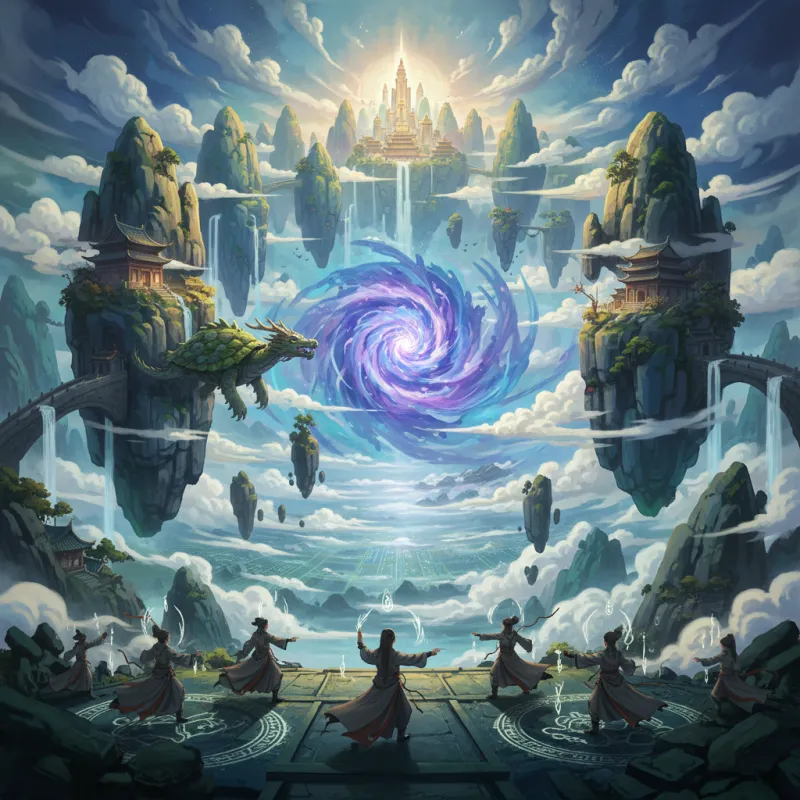
A single misplaced stone could mean the difference between ascension and annihilation. In I Shall Seal the Heavens, when Meng Hao first encounters the Nine Seas God World formation, he realizes that these intricate arrays aren't just magical barriers—they're living expressions of the Dao itself, capable of trapping souls for ten thousand years or catapulting a cultivator straight into the Immortal Realm. Formations (阵法, zhènfǎ) represent one of the most sophisticated and underappreciated elements in Chinese cultivation fiction, blending ancient cosmological principles with pure imaginative firepower.
The Architecture of Reality: What Formations Actually Are
Unlike the flashy sword techniques or pill-refining scenes that dominate most xianxia novels, formations operate on a fundamentally different level. They're not just spells—they're restructured pockets of reality. A formation master doesn't simply cast magic; they rewrite the local laws of physics, redirect spiritual energy flows, and create semi-permanent alterations to space-time itself.
The classical formation structure typically consists of three core components: formation flags (阵旗, zhènqí) or stones that serve as anchor points, formation patterns (阵纹, zhènwén) that channel spiritual energy, and a formation core (阵眼, zhènyǎn) that powers and controls the entire array. Think of it like circuit design—the flags are your resistors and capacitors, the patterns are your wiring, and the core is your power source. Mess up any component, and the whole thing either fizzles out or explodes spectacularly.
What makes formations particularly fascinating is their scalability. A novice Qi Condensation cultivator might set up a simple Spirit Gathering Formation (聚灵阵, jùlíng zhèn) in their courtyard to accelerate cultivation. Meanwhile, ancient sects deploy continent-spanning defensive formations that have protected their mountain gates for millennia. In Coiling Dragon, the Gebados Planar Prison is essentially a formation so massive it contains an entire dimensional plane—a concept that would make even the most ambitious Feng Shui master's head spin.
Ancient Roots: From Bagua to Battlefield Arrays
The fictional formations in xianxia didn't materialize from thin air. They draw heavily from genuine historical practices, particularly the Eight Trigrams (八卦, bāguà) system attributed to the mythical Emperor Fu Xi around 2800 BCE. The trigrams—combinations of broken and unbroken lines representing fundamental forces like heaven, earth, water, and fire—form the theoretical backbone of formation theory in cultivation fiction.
More directly, formations inherit from actual military tactics used during China's Warring States period (475-221 BCE). The legendary strategist Zhuge Liang supposedly created the Stone Sentinel Maze (八阵图, bāzhèn tú), an arrangement of rocks that could confuse and trap enemy armies. While historical accounts are murky—and likely exaggerated—this concept of using spatial arrangement to create tactical advantages translates perfectly into cultivation fiction's magical arrays.
The Taoist tradition contributes another layer through its emphasis on natural energy flows and the concept of ley lines (龙脉, lóngmài, literally "dragon veins"). Daoist practitioners believed that proper arrangement of objects could redirect qi flows for healing, protection, or spiritual cultivation. Modern xianxia authors have turbocharged these ideas, transforming gentle energy redirection into reality-warping superweapons.
Formation Hierarchies: From Mortal Arrays to Heaven-Defying Constructs
Not all formations are created equal, and the genre has developed elaborate classification systems that mirror cultivation realm hierarchies. Most novels employ a tiered structure: Mortal Formations, Earth Formations, Heaven Formations, and various transcendent categories above that. Each tier requires progressively deeper understanding of Dao principles and more refined spiritual energy control.
A Record of a Mortal's Journey to Immortality handles this particularly well. Han Li, the protagonist, starts by painstakingly studying basic defensive formations, spending months just to understand the energy flow patterns. By the novel's midpoint, he's analyzing ancient formations left by Nascent Soul cultivators, reverse-engineering their principles, and eventually creating hybrid arrays that combine multiple formation types. This progression feels earned rather than handed to him through plot convenience.
The complexity escalates dramatically at higher levels. Immortal-grade formations might incorporate concepts like temporal loops, dimensional folding, or karmic binding. In Renegade Immortal, Wang Lin encounters the Ancient Celestial Realm's foundational formation—a construct so sophisticated it maintains the structural integrity of an entire realm and regulates the flow of spiritual energy for billions of cultivators. Breaking such a formation doesn't just disable a defensive barrier; it could collapse reality itself.
The Formation Master's Path: A Cultivation Specialty
While most protagonists focus on combat cultivation or alchemy, formation mastery represents an alternative specialization that demands different talents. Formation masters need geometric intuition, pattern recognition abilities, and what amounts to multidimensional calculus skills. They're the engineers of the cultivation world, and novels that feature formation-focused protagonists offer refreshingly cerebral alternatives to endless fighting tournaments.
The investment required is substantial. A formation master must memorize thousands of formation patterns, understand how different materials conduct spiritual energy, and develop the ability to perceive energy flows invisible to normal cultivators. In World of Cultivation, Zuo Mo's formation studies consume years of effort, and even then he's considered merely competent rather than exceptional. The novel doesn't shy away from showing the tedious trial-and-error process, the expensive material costs, and the frequent failures that accompany formation research.
What's particularly interesting is how formation mastery intersects with other cultivation paths. A formation master who also practices sword cultivation might inscribe formation patterns directly onto their blade, creating weapons that deploy arrays mid-combat. Alchemists use formations to regulate pill furnace temperatures and contain volatile spiritual energies. The synergies are endless, which is why many high-level cultivators dabble in formation theory even if they don't specialize in it.
Offensive vs. Defensive: The Tactical Applications
Formations serve wildly different purposes depending on their design intent. Defensive formations are the most common—every sect worth its spiritual stones maintains protective arrays around their territory. These range from simple alarm formations that detect intruders to multilayered defensive constructs that can withstand attacks from cultivators several realms higher than the formation's creator.
The Illusion Formation (幻阵, huànzhèn) represents a particularly nasty defensive variant. Rather than blocking attacks directly, these arrays trap intruders in false realities, causing them to wander in circles while their spiritual energy slowly depletes. Desolate Era features several memorable scenes where Ji Ning must break through illusion formations by finding the single "true" path among thousands of false ones—essentially solving a deadly puzzle while under time pressure.
Offensive formations flip the script, turning arrays into weapons. Killing formations (杀阵, shāzhèn) actively attack anyone who enters their range, launching elemental attacks, spatial tears, or soul-targeting assaults. The most terrifying examples combine offensive and illusion elements: you're trapped in a false reality while invisible formation-generated attacks slowly tear you apart. In Martial World, Lin Ming encounters a formation that creates perfect copies of himself that attack with his own techniques—a nightmare scenario for any cultivator.
Then there are the utility formations that don't fit neatly into combat categories. Teleportation formations enable instant travel across vast distances. Spirit Gathering Formations create cultivation paradises where time flows differently. Sealing formations can imprison demons, suppress cursed artifacts, or lock away forbidden techniques. The versatility makes formations indispensable to any well-developed cultivation world.
Breaking and Countering: The Formation Master's Duel
The most intellectually satisfying scenes in formation-heavy novels involve formation masters facing off, not through direct combat but through array manipulation. One master sets up a killing formation; their opponent analyzes its structure, identifies the formation core's location, and either disrupts the energy flow or hijacks the formation entirely. It's chess played with reality-warping magic.
I Shall Seal the Heavens excels at these confrontations. Meng Hao's formation battles feel like watching a master locksmith work—he probes the formation's defenses, tests different approaches, and exploits tiny flaws in the array's construction. The tension comes not from flashy explosions but from the knowledge that one wrong move means instant death. When he finally cracks a formation that's stumped cultivators for generations, the victory feels genuinely earned.
The concept of formation inheritance adds another layer. Ancient formations left by long-dead masters become puzzles for later generations to solve. Successfully breaking into an ancient formation might grant access to powerful techniques, rare treasures, or cultivation insights. But these aren't simple locks—they're tests designed to kill the unworthy. The formation itself becomes a character, expressing its creator's personality and philosophy through its structure and traps.
Modern Innovations: How Contemporary Xianxia Evolves Formation Theory
Recent xianxia novels have pushed formation concepts in creative directions. Lord of the Mysteries introduces formations that operate on symbolic and conceptual levels rather than pure energy manipulation. Reverend Insanity features formations that incorporate living creatures as components, creating semi-sentient arrays that adapt to threats. These innovations keep the trope fresh and prevent formations from becoming stale background elements.
The integration of formations with modern narrative structures has also improved. Rather than info-dumping formation theory in dry exposition, better novels weave formation principles into plot-critical moments. The protagonist's understanding of formations becomes a character trait that influences their problem-solving approach, not just a convenient power-up when the author needs them to overcome an obstacle.
Formations have evolved from simple magical barriers into complex systems that reflect broader themes about control, understanding, and the relationship between knowledge and power. A cultivator who masters formations doesn't just gain a useful skill—they demonstrate a particular philosophical approach to cultivation itself, one that values systematic understanding over brute force. In a genre often criticized for repetitive power escalation, formations offer a refreshing alternative that rewards intelligence and creativity over raw cultivation level.
Related Reading
- Beast Tides: When Monsters Attack in Cultivation Fiction
- The Essence of Immortality: Understanding Chinese Cultivation and Xianxia Fiction
- Auction Houses in Cultivation Fiction: Where Power Is Bought and Sold