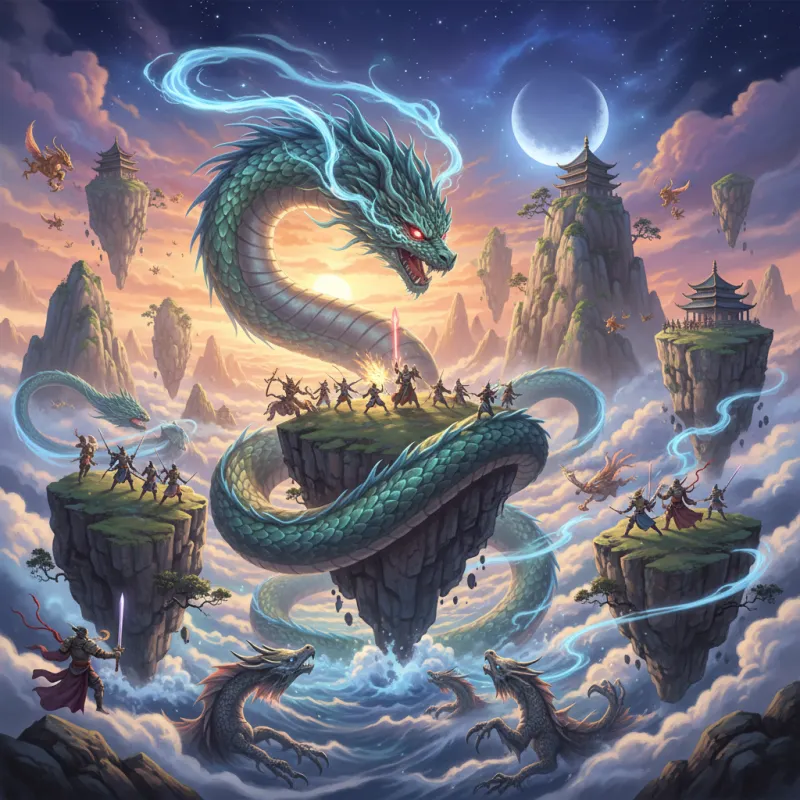
The mountain trembled. Not from an earthquake—cultivators could handle those. This was different. Elder Chen stood at the sect's outer wall, watching the forest below writhe like a living thing. Trees snapped. The ground itself seemed to move. Then he saw them: ten thousand eyes reflecting moonlight, advancing as one. He had three minutes to sound the alarm before the beast tide hit.
A beast tide (兽潮 shòucháo) represents one of cultivation fiction's most visceral threats—a coordinated surge of spirit beasts that transforms peaceful wilderness into a living weapon aimed at human civilization. Unlike individual monster attacks or dungeon breaks, beast tides operate on a scale that can erase sects, depopulate cities, and redraw territorial maps. They're the genre's way of reminding readers that in xianxia worlds, humanity doesn't sit at the top of the food chain—they're just the species that built walls.
The Anatomy of Catastrophe
Beast tides follow predictable patterns that make them terrifying rather than random. The vanguard typically consists of Foundation Establishment (筑基 zhùjī) level creatures—your standard demonic wolves, iron-hide boars, and venomous serpents. Dangerous individually, but manageable. The real problem is quantity. We're talking thousands, sometimes tens of thousands, moving with unnatural coordination.
Behind them come the Core Formation (金丹 jīndān) beasts. These are the ones that force sect elders off their meditation cushions. A single Core Formation beast can level buildings and slaughter dozens of outer disciples. In a beast tide, you might face twenty simultaneously.
Then there's the tide lord—the Nascent Soul (元婴 yuányīng) or higher cultivation beast orchestrating everything. This creature doesn't always participate directly. It doesn't need to. Its presence alone suppresses human cultivators' spiritual energy within a mile radius. In "Renegade Immortal" (仙逆 Xiān Nì), Wang Lin encounters a tide led by a Soul Formation stage Flood Dragon that doesn't throw a single attack—it just exists near the battlefield, and that's enough to turn the tide's victory into a massacre.
Why the Beasts March
Cultivation novels offer competing explanations for beast tides, and the best stories use multiple triggers to keep readers guessing. The most common catalyst is territorial disruption. Sects expand their influence, clear forests for spirit herb gardens, or mine spirit stone veins. Eventually, they cross an invisible line, and the wilderness responds. It's nature's eviction notice, written in blood and claws.
Heavenly tribulations (天劫 tiānjié) trigger tides more often than you'd expect. When a cultivator breaks through to Nascent Soul or higher, the resulting tribulation lightning doesn't just test the cultivator—it terrifies every beast within a hundred miles. The weaker ones flee toward human settlements. The stronger ones get angry and lead the charge. "I Shall Seal the Heavens" (我欲封天 Wǒ Yù Fēng Tiān) features a memorable scene where Meng Hao's tribulation accidentally triggers a three-province beast tide. The sect he was visiting was not pleased.
Then there's the conspiracy angle. Rival sects, demonic cultivators, or ancient formations gone wrong can artificially trigger tides. In "Martial World" (武极天下 Wǔ Jí Tiān Xià), Lin Ming discovers that a supposedly "natural" beast tide was actually orchestrated by a rival kingdom using blood sacrifice arrays to enrage the local beast kings. This transforms the beast tide from natural disaster into act of war.
Some worlds feature cyclical tides tied to celestial events—every hundred years when the Blood Moon rises, every time a certain star constellation appears, or when spiritual energy concentrations hit critical thresholds. These predictable tides create interesting political dynamics. Sects that can survive them gain prestige. Those that can't get absorbed by neighbors.
The Defense That Defines Sects
How a sect handles beast tides reveals everything about its strength, organization, and leadership. The standard defense involves three layers, and watching them fail or hold makes for compelling reading.
The outer perimeter consists of disciples at Qi Condensation (凝气 níngqì) and Foundation Establishment levels, supported by formation arrays. Their job isn't to win—it's to bleed the tide's momentum, thin the numbers, and buy time. Casualties here are expected. Brutal, but expected. The disciples know this. The good novels show their fear and determination anyway.
The middle defense features Core Formation elders and the sect's serious defensive formations—the ones that cost spirit stones to activate and take years to repair. This is where the tide either breaks or breaches. If the tide lord commits here, things get desperate fast. "A Record of a Mortal's Journey to Immortality" (凡人修仙传 Fánrén Xiūxiān Zhuàn) has a fantastic sequence where Han Li watches a sect's middle defense collapse in real-time as three Core Formation beasts coordinate to shatter a formation node. The resulting chaos kills more disciples than the beasts do.
The final layer is the sect's trump cards—Nascent Soul ancestors, ancient protective formations that haven't been activated in centuries, or desperate measures like blood sacrifice techniques. If the fight reaches this stage, the sect survives but emerges crippled. Resources depleted, disciples dead, reputation damaged. Neighboring sects start circling like sharks.
When Protagonists Get Involved
Beast tides serve multiple narrative functions, and smart authors exploit all of them. For protagonists, tides are opportunity wrapped in danger. While everyone else fights for survival, the MC is looting beast cores, stealing spirit herbs from trampled gardens, or using the chaos to settle grudges. In "Coiling Dragon" (盘龙 Pánlóng), Linley uses a beast tide as cover to assassinate a rival family's heir—the perfect crime since everyone assumes the beasts did it.
Tides also force character development. The cowardly merchant's son discovers courage. The arrogant young master learns humility when a demonic bear eats his bodyguards. The protagonist's love interest reveals hidden depths by holding a wall section alone for three hours. These moments work because the stakes are real and immediate.
The best beast tide arcs subvert expectations. Maybe the protagonist realizes the beasts are fleeing from something worse. Maybe the tide lord is intelligent and offers negotiation. Maybe the real threat isn't the beasts but the sect's leadership planning to sacrifice outer disciples to preserve resources. "Reverend Insanity" (蛊真人 Gǔ Zhēn Rén) features a tide where Fang Yuan discovers the beasts are actually being controlled by a rival's beast taming technique, turning a natural disaster into an assassination attempt.
The Aftermath Nobody Talks About
Most novels rush past the cleanup, but the aftermath of a beast tide shapes politics for decades. Surviving sects absorb destroyed ones, redrawing power maps. Disciples who distinguished themselves get promoted. Those who fled get executed or expelled. The sect's treasury is empty, formations are broken, and it'll take years to recover.
Beast materials flood the market, crashing prices. Every merchant has beast cores and hide to sell. This economic disruption creates opportunities for clever protagonists to corner markets or manipulate prices. The smart MCs buy formation materials while they're expensive and everyone else is rebuilding defenses.
Survivor's guilt and trauma affect disciples, though most novels ignore this. The few that address it—like "Lord of the Mysteries" (诡秘之主 Guǐ Mì Zhī Zhǔ) in its cultivation-adjacent sequences—create more realistic, compelling characters. Watching a junior sister freeze in combat six months after a tide because she's having flashbacks adds depth.
Why Beast Tides Work Narratively
Beast tides succeed as plot devices because they're fundamentally democratic disasters. They don't care about your protagonist halo or hidden bloodline. A Foundation Establishment cultivator facing a Core Formation beast dies, period. This creates genuine tension in a genre where protagonists often feel invincible.
They also force large-scale cooperation. The arrogant young master and the protagonist must work together or die. Rival sects send reinforcements because they know they're next. These temporary alliances create complex political situations that outlast the tide itself.
The visual spectacle doesn't hurt either. Thousands of beasts crashing against formation barriers while cultivators rain sword qi and fire techniques from the walls—it's the cultivation equivalent of epic fantasy's siege battles. Done well, these scenes are unforgettable.
Beast tides remind readers that cultivation worlds are genuinely dangerous places where nature pushes back against human expansion. They're not just monster attacks—they're the world itself saying "you've gone far enough." And in the best novels, the cultivators listen. At least until they get strong enough to push back harder.
Related Reading
- Beast Taming in Cultivation Fiction: Your Pet Dragon and You
- Spirit Beasts in Cultivation Fiction: A Bestiary
- The Most Famous Mounts in Cultivation Fiction
- Merchant Guilds and Trade Routes in Cultivation Worlds
- Unraveling the Essence of Tribulations in Chinese Cultivation Fiction
- Unraveling the Mysteries of Chinese Cultivation and Xianxia Fiction