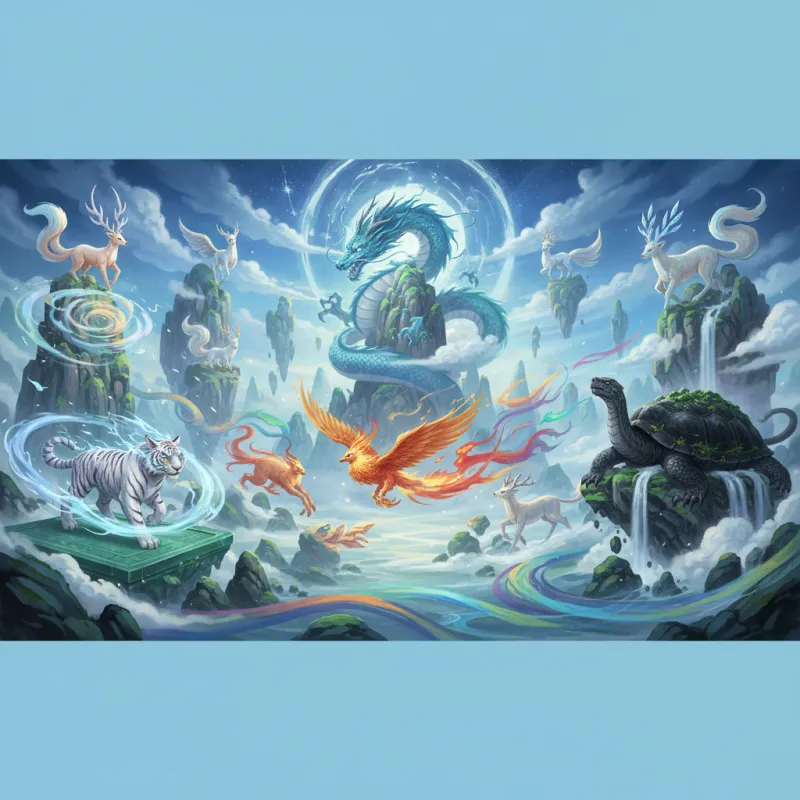
The Azure Dragon coiled around the mountain peak wasn't supposed to exist. According to the Shan Hai Jing (山海经, Shān Hǎi Jīng, "Classic of Mountains and Seas"), compiled during the Warring States period, such creatures belonged to the realm of myth. Yet here it was in Coiling Dragon, I Shall Seal the Heavens, and a thousand web novels besides—breathing fire, hoarding treasures, and forming soul contracts with teenage protagonists. The spirit beasts populating modern cultivation fiction aren't random fantasy creatures dreamed up by web novelists. They're direct descendants of beings that Chinese scholars documented over two millennia ago, creatures that emperors claimed to have seen and alchemists swore could grant immortality.
The Mythological Foundation: Where Spirit Beasts Actually Come From
The Shan Hai Jing, written between the 4th and 1st centuries BCE, reads like a field guide to impossible creatures. It catalogs over 200 mythical beings with the clinical precision of a zoology textbook. The Qilin (麒麟, qílín) appears with "the body of a deer, the tail of an ox, and the hooves of a horse." The Taotie (饕餮, tāotiè) is described as having "a sheep's body, human face, eyes under its armpits, and tiger's teeth." These aren't vague legends—they're detailed anatomical descriptions.
Modern cultivation authors didn't invent these creatures. They inherited them, then systematized them into power hierarchies that would make sense in a progression fantasy. The Huainanzi (淮南子, Huáinánzǐ), compiled in 139 BCE, already divided mythical creatures into categories based on their elemental affinities and spiritual power. Cultivation fiction simply added numbered ranks and made them tameable.
What changed wasn't the creatures themselves but their relationship to humans. In classical texts, these beings were omens, guardians, or catastrophes—forces beyond human control. In cultivation novels, they became partners, pets, and power-ups. The shift reflects a fundamental change in Chinese fantasy: from fatalism to agency, from observing the divine to cultivating alongside it.
The Four Divine Beasts: Guardians Turned Bloodline Sources
The Sì Xiàng (四象, Sì Xiàng, "Four Symbols") represent the cardinal directions and appear in texts dating to the Han Dynasty. The Azure Dragon (青龙, Qīng Lóng) of the East, White Tiger (白虎, Bái Hǔ) of the West, Vermillion Bird (朱雀, Zhū Què) of the South, and Black Tortoise (玄武, Xuán Wǔ) of the North weren't just powerful—they were cosmological principles given form.
In classical mythology, these beings existed at the level of natural law. You didn't tame an Azure Dragon any more than you'd tame gravity. But cultivation fiction saw potential. Stellar Transformations by I Eat Tomatoes features protagonists who inherit divine beast bloodlines, gaining their powers through ancestry rather than encounter. Tales of Demons and Gods has the protagonist merge with a divine beast's soul, essentially becoming a hybrid creature.
The genius of this adaptation is how it preserves the creatures' mythological weight while making them accessible to the power fantasy. A protagonist can't just catch a Vermillion Bird like a Pokémon—but they might awaken a dormant bloodline, find a divine beast egg, or earn the respect of an ancient guardian through trials. The creatures remain legendary, but the path to their power becomes achievable through cultivation.
The bloodline concept specifically draws from the Investiture of the Gods (封神演义, Fēngshén Yǎnyì), a 16th-century novel where divine beings could incarnate in human form or grant their essence to mortals. Modern cultivation fiction simply made this process systematic and repeatable.
Dragons: The Most Overused and Misunderstood Category
Chinese dragons (龙, lóng) bear almost no resemblance to their Western counterparts, yet cultivation novels often blur the distinction. The classical Chinese dragon was a water deity, associated with rain, rivers, and imperial authority. The Shuowen Jiezi dictionary from 100 CE describes it as "the chief of scaled creatures, able to be dark or bright, small or large, short or long."
Cultivation fiction took this shapeshifting aspect and ran with it. Dragons in web novels can take human form, a trait that appears in the Journey to the West (西游记, Xīyóu Jì) from the 16th century, where the Dragon Kings' children frequently disguise themselves as humans. But modern novels added the concept of dragon bloodline purity—the idea that dragons can interbreed with humans, creating half-dragon cultivators with varying degrees of power.
Coiling Dragon by I Eat Tomatoes features an entire hierarchy of dragon subspecies: Armored Razorback Wyrms, Tyrant Wyrms, Thunder Lizards. None of these appear in classical texts. They're original creations that follow the aesthetic and elemental logic of Chinese dragons while serving the needs of a progression system. The protagonist's Azure Dragon bloodline awakening follows a pattern: dormant heritage, triggered by crisis, manifesting as physical transformation and power boost.
The Jiaolong (蛟龙, jiāolóng), or flood dragon, appears in the Shuowen Jiezi as a dragon that hasn't yet ascended to true dragon status. Cultivation novels seized on this as a perfect progression mechanic. Spirit beasts can evolve from serpents to flood dragons to true dragons, mirroring the cultivator's journey through realms. It's elegant worldbuilding that respects the source material while adapting it for serial fiction.
Phoenixes and the Problem of Gender
The Fenghuang (凤凰, fènghuáng), commonly translated as "phoenix," isn't actually a phoenix in the Western sense. It doesn't die and resurrect in flames—that's a Greek myth. The Chinese fenghuang is a composite bird representing yin-yang harmony, with the feng (凤) being male and the huang (凰) being female. The Erya dictionary from the 3rd century BCE describes it as having "the front of a goose, the hindquarters of a unicorn, the throat of a swallow, the bill of a chicken, the neck of a snake, the tail of a fish, the forehead of a crane, the crown of a mandarin duck, the stripes of a dragon, and the back of a tortoise."
Modern cultivation fiction almost universally ignores the male-female distinction and treats the fenghuang as a single species, usually associated with fire and rebirth—borrowing heavily from the Western phoenix myth. Against the Gods features a Phoenix bloodline that grants fire manipulation and resurrection abilities. Martial God Asura has Phoenix flames that can burn souls. These are creative adaptations, but they're not particularly faithful to the source material.
The Vermillion Bird (朱雀, Zhū Què), one of the Four Divine Beasts, is sometimes conflated with the phoenix in cultivation novels, though they're distinct creatures in classical texts. The Vermillion Bird represents the southern direction and the element of fire, while the fenghuang represents harmony and auspicious occasions. Cultivation authors often merge them because having multiple fire birds feels redundant in a power system.
What's interesting is how cultivation fiction handles the fenghuang's association with the empress. In imperial China, the dragon represented the emperor and the phoenix the empress—a gendered cosmological pairing. Modern novels often give phoenix bloodlines to female characters, preserving this association while making it about personal power rather than political position. Beast taming techniques frequently emphasize the bond between female cultivators and phoenix-type spirit beasts.
Qilin, Taotie, and the Auspicious Beasts
The Qilin (麒麟, qílín) appears in texts dating to the 5th century BCE as the gentlest of divine beasts—it walks so carefully it doesn't crush grass, and it only appears during the reign of a benevolent ruler. The Book of Rites (礼记, Lǐjì) describes it as one of the four spiritually endowed creatures, alongside the dragon, phoenix, and tortoise.
Cultivation fiction had to work around the qilin's peaceful nature. You can't have a protagonist riding a creature that refuses to harm living things. The solution: make qilins rare, ancient, and powerful enough that their mere presence intimidates enemies. I Shall Seal the Heavens features a qilin that serves as a mount for a powerful cultivator, emphasizing its speed and spiritual purity rather than combat ability. Other novels give qilins healing abilities or make them guardians of sacred grounds—roles that fit their benevolent nature while keeping them relevant to the plot.
The Taotie (饕餮, tāotiè) went in the opposite direction. In the Zuo Zhuan (左传, Zuǒ Zhuàn), a historical text from the 4th century BCE, the taotie is described as one of the Four Perils—a creature of insatiable greed that devours everything. Its face appears on ancient bronze vessels as a warning against gluttony. Cultivation novels turned this into a power: the ability to devour anything, including other cultivators' energy and techniques.
Tales of Demons and Gods features a protagonist who cultivates a taotie-related technique, allowing him to absorb and integrate other cultivation methods. The creature's mythological association with consumption became a progression mechanic. It's a perfect example of how cultivation fiction identifies the core concept of a mythological being and translates it into a system-compatible ability.
The Bai Ze (白泽, Bái Zé), a creature that appears in the Baize Tu (白泽图, Bái Zé Tú, "Diagram of the Bai Ze"), supposedly knows information about all supernatural beings. In cultivation novels, it often appears as a wise spirit beast that can identify other creatures, assess cultivation levels, or provide exposition. It's essentially a walking encyclopedia, which makes it useful for authors who need to explain their worldbuilding.
Serpents, Turtles, and the Longevity Beasts
The Xuanwu (玄武, Xuánwǔ), or Black Tortoise, is actually a tortoise entwined with a snake—a symbol that appears in Han Dynasty tomb art. It represents the north, winter, and the element of water. In Daoist cosmology, it's associated with longevity and defensive power. The Huainanzi describes it as one of the four directional guardians, emphasizing its protective nature.
Cultivation novels love the Xuanwu because it provides a defensive counterpoint to offensive dragon and phoenix bloodlines. Martial World features Xuanwu bloodline cultivators who specialize in defensive techniques and have extended lifespans. The creature's association with longevity translates directly into cultivation fiction's obsession with lifespan extension—a core concern for cultivators trying to reach higher realms before their mortal bodies fail.
The snake-tortoise combination also provides interesting narrative possibilities. Some novels treat them as separate entities that can merge, others as a single creature with dual aspects. Against the Gods has a Primordial Profound Ark that contains Xuanwu bloodline essence, which the protagonist uses to enhance his defensive capabilities. The mythological weight of the creature makes it feel significant even when it's reduced to a power-up item.
Giant serpents appear throughout Chinese mythology, from the Ba Snake (巴蛇, Bā Shé) in the Shan Hai Jing, which could swallow elephants, to various flood dragons and sea serpents. Cultivation fiction uses them as starter spirit beasts—creatures powerful enough to be impressive but common enough that a protagonist can realistically encounter one early in their journey. The serpent-to-dragon evolution path provides a clear progression that readers can understand intuitively.
Tigers, Apes, and the Terrestrial Hierarchy
The White Tiger (白虎, Bái Hǔ) is one of the Four Divine Beasts, but cultivation novels also feature countless lesser tiger-type spirit beasts. The Shan Hai Jing describes various tiger species, including the Qiongqi (穷奇, Qióngqí), a winged tiger that eats people starting from their heads. This creature appears in Renegade Immortal as a powerful spirit beast that the protagonist must overcome.
What's interesting is how cultivation fiction handles the tiger's symbolic weight in Chinese culture. Tigers represent military prowess, courage, and autumn—they're yang creatures associated with metal and the west. Novels often give tiger-type spirit beasts to military cultivators or those who practice aggressive, straightforward techniques. The symbolism reinforces character archetypes without requiring explicit explanation.
Apes and monkeys occupy a special place because of Sun Wukong (孙悟空, Sūn Wùkōng), the Monkey King from Journey to the West. He's technically not a spirit beast—he's a stone monkey who achieved enlightenment—but his influence on cultivation fiction is enormous. Countless novels feature monkey-type spirit beasts with his characteristics: intelligence, trickery, staff-fighting skills, and transformation abilities.
A Record of a Mortal's Journey to Immortality features intelligent ape-type spirit beasts that can cultivate independently, a direct nod to Sun Wukong's origin story. The idea that spirit beasts can cultivate on their own, potentially reaching human-level intelligence and power, comes from Journey to the West and the earlier Investiture of the Gods. It's a concept that adds depth to spirit beast cultivation systems by making the beasts active participants rather than passive tools.
Modern Innovations: Where Authors Get Creative
While most spirit beasts trace back to classical sources, cultivation authors do innovate. Elemental variants are common—ice phoenixes, lightning tigers, shadow dragons. These follow the logic of Chinese elemental theory (五行, wǔxíng, the Five Phases) while creating visual and mechanical variety for readers.
Hybrid beasts represent another innovation. Novels like Martial God Asura feature creatures that combine traits from multiple mythological beings, creating new species that fit specific narrative needs. A dragon-phoenix hybrid might represent yin-yang balance, while a qilin-tiger mix could symbolize the union of benevolence and martial prowess.
The most significant modern addition is the concept of bloodline awakening and evolution. Classical texts present mythological creatures as fixed entities—a dragon is a dragon, a phoenix is a phoenix. Cultivation fiction made them mutable, capable of growth and transformation that mirrors the protagonist's journey. This isn't entirely without precedent—the Journey to the West features creatures that cultivate and transform—but the systematic application to all spirit beasts is a modern innovation.
Some authors create entirely original creatures while maintaining the aesthetic and logic of Chinese mythology. Lord Xue Ying features the Xue Ying (雪鹰, Xuě Yīng, "Snow Eagle"), a powerful bird-type beast that doesn't appear in classical texts but feels like it could. The key is respecting the underlying principles: elemental associations, symbolic meaning, and the connection between physical form and spiritual essence.
Why This Matters: Mythology as Worldbuilding Infrastructure
Understanding the mythological origins of spirit beasts reveals something important about cultivation fiction: it's not just fantasy with Chinese characteristics. It's a genre built on a foundation of texts that are older than most Western literary traditions. When an author introduces an Azure Dragon, they're not just adding a cool monster—they're invoking thousands of years of cultural meaning.
This creates a shared language between authors and readers. Chinese readers recognize these creatures instantly, understanding their symbolic weight without explanation. International readers might miss some nuances, but the core concepts—dragons are powerful, phoenixes represent rebirth, qilins are auspicious—translate across cultures because the novels themselves teach these associations through context.
The bestiary of cultivation fiction is ultimately a living tradition. Authors draw from classical sources, adapt them to modern storytelling needs, and occasionally add their own innovations. The result is a fantasy ecosystem that feels both ancient and contemporary, rooted in mythology but evolving with each new novel. Every spirit beast carries the weight of history while serving the needs of progression fantasy—a balance that defines the genre itself.
Related Reading
- The Most Famous Mounts in Cultivation Fiction
- Beast Tides: When Monsters Attack in Cultivation Fiction
- Beast Taming in Cultivation Fiction: Your Pet Dragon and You
- Spirit Beast Contracts: The Pokemon System of Cultivation Fiction
- Unraveling the Mysteries of Chinese Cultivation and Xianxia Fiction
- Dual Cultivation: Partnership in the Path to Immortality
- Dual Cultivation: The Most Misunderstood Concept in Cultivation Fiction