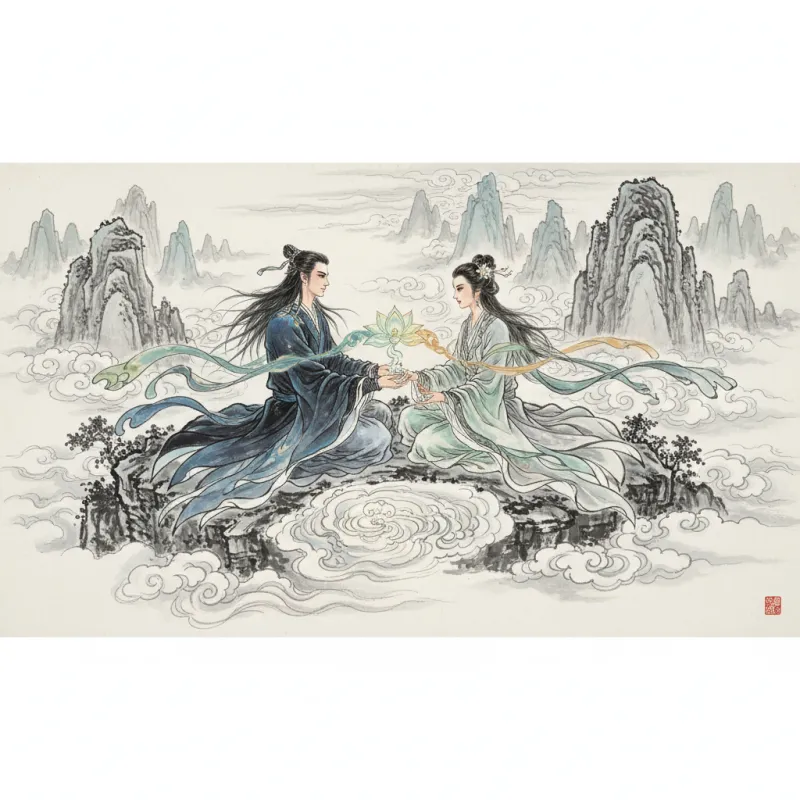
Two cultivators sit facing each other in a moonlit pavilion, their spiritual energies intertwining like silk threads in the night air. One misstep in their synchronized breathing, one moment of distrust, and the backlash could cripple them both. This is dual cultivation—not the sanitized partnership you might imagine, but a practice so intimate and dangerous that most xianxia novels treat it as either a sacred bond or a scandalous shortcut.
What Dual Cultivation Actually Means
Dual cultivation, or shuangxiu (双修), literally "paired cultivation," refers to a practice where two cultivators—traditionally of opposite genders—combine their spiritual energies to accelerate their progress toward immortality. The term originates from Daoist internal alchemy texts dating back to the Tang Dynasty, where it described techniques for balancing yin (阴) and yang (阳) energies within the body.
Here's what most casual readers miss: dual cultivation in classical Daoist texts was never primarily about physical intimacy. The Zhong-Lü Chuandao Ji (钟吕传道集), a foundational text from the Song Dynasty, describes it as a method where practitioners exchange and refine their qi (气) through synchronized meditation and energy circulation. The physical aspect, when present, served as a catalyst for energy exchange—not the goal itself.
Modern xianxia fiction has taken this concept and run wild with it. In novels like Against the Gods and Martial God Asura, dual cultivation often becomes a plot device for romantic development or power-ups. Some authors treat it respectfully as a profound spiritual bond; others use it as barely-disguised fan service. The gap between historical practice and fictional portrayal is wider than the distance between the mortal realm and the heavens.
The Mechanics: How It's Supposed to Work
In traditional cultivation theory, every practitioner accumulates either predominantly yin or yang energy based on their constitution, gender, and cultivation method. Men typically cultivate yang energy—active, hot, expansive. Women cultivate yin energy—receptive, cool, consolidating. The problem? Pure yang without yin becomes unstable fire that burns the meridians. Pure yin without yang becomes stagnant water that freezes the dantian.
Dual cultivation solves this through energy exchange and harmonization. When two cultivators with complementary energies practice together, they create a complete circuit. The yang cultivator's excess fire tempers the yin cultivator's cold, while the yin cultivator's water cools the yang cultivator's flames. It's like two incomplete electrical circuits finally connecting to form a working system.
The actual practice involves several stages. First, both cultivators must achieve perfect synchronization of their breathing and heartbeats—harder than it sounds when you're sitting inches from someone whose spiritual energy could accidentally fry your internal organs. Second, they carefully open specific meridians to allow energy flow between their bodies. Third, they circulate this combined energy through both their systems simultaneously, refining it through each person's unique cultivation base. Finally, they separate the energy back into individual streams, each person retaining the benefits of the harmonized qi.
The risks are substantial. If one partner harbors ill intent, they can drain the other's cultivation base entirely—a plot point that appears in practically every xianxia novel featuring dual cultivation. If their energies clash rather than harmonize, both can suffer qi deviation, potentially dropping entire realms in their cultivation or even dying. This is why dual cultivation traditionally requires absolute trust, compatible cultivation methods, and often a marriage bond.
The Cultural Baggage Nobody Talks About
Let's address the elephant in the cultivation chamber: dual cultivation's reputation is complicated by centuries of misunderstanding and deliberate misrepresentation. During the Ming and Qing dynasties, Confucian scholars condemned certain Daoist sects for "heretical practices," lumping legitimate energy cultivation techniques with sexual rituals. This created a lasting stigma that persists in Chinese culture today.
Many xianxia novels reflect this ambivalence. Characters who practice dual cultivation often face social censure from their sects or families. In I Shall Seal the Heavens, Meng Hao's relationship with Xu Qing involves cultivation partnership, but the novel treats it with unusual restraint compared to more exploitative works. The author seems aware that dual cultivation carries cultural weight beyond mere plot convenience.
The gender dynamics deserve scrutiny too. Classical texts often positioned the male cultivator as the active party and the female as the receptive vessel—a reflection of patriarchal assumptions rather than energetic reality. Progressive modern novels like Forty Millenniums of Cultivation subvert this by showing dual cultivation partnerships where neither party is subordinate, and the energy exchange is genuinely mutual. The difference in how authors handle this reveals their understanding (or lack thereof) of the practice's philosophical foundations.
Dual Cultivation vs. Other Partnership Methods
Dual cultivation isn't the only way cultivators can work together toward immortality. Understanding the alternatives clarifies what makes shuangxiu unique—and why it's so controversial.
Cultivation realms often require different approaches to advancement. In the Foundation Establishment stage, cultivators might form dao companion (道侣) bonds without dual cultivation, simply supporting each other's breakthroughs through protection and resource sharing. This is partnership without energy exchange—safer, but slower.
Some sects practice group cultivation arrays, where dozens of disciples pool their energy under a formation master's guidance. This appears in A Record of a Mortal's Journey to Immortality, where Han Li occasionally participates in sect-wide cultivation sessions. The energy exchange is diffuse and controlled, lacking dual cultivation's intensity and risk.
Then there's master-disciple transmission, where a dying or ascending cultivator transfers their cultivation base to a successor. This one-way energy transfer appears in countless novels, but it's fundamentally different from dual cultivation's reciprocal exchange. The master sacrifices everything; the disciple receives everything. Nobody benefits mutually.
What sets dual cultivation apart is the multiplication effect. When done correctly, both partners don't just exchange energy—they refine and amplify it through the interaction of yin and yang. One plus one equals three. This exponential growth potential explains why dual cultivation can help practitioners break through bottlenecks that might otherwise take decades to overcome. It also explains why so many villains in xianxia novels practice corrupted versions, forcibly draining partners to steal this amplification effect for themselves.
The Fiction vs. Reality Divide
Modern xianxia authors take wild liberties with dual cultivation, and honestly? Some of it works better than the "authentic" version.
In Tales of Demons and Gods, Nie Li's relationship with Ye Ziyun involves cultivation partnership that's more about emotional support and complementary techniques than energy exchange. The novel barely uses the term "dual cultivation," yet their relationship embodies the original concept's spirit—two people helping each other transcend their limits through trust and cooperation.
Contrast this with novels where dual cultivation becomes a harem-building mechanic. The protagonist "must" dual cultivate with multiple partners to advance, conveniently requiring intimate relationships with every beautiful woman he meets. This isn't just lazy writing—it fundamentally misunderstands that dual cultivation requires deep compatibility and synchronized cultivation methods. You can't just swap partners like changing cultivation techniques. The energetic attunement takes years to develop.
Some authors get creative with the concept in ways that actually enhance it. Reverend Insanity features a protagonist who develops a dual cultivation method using Gu (蛊) worms to facilitate energy exchange, removing the traditional requirement for physical intimacy entirely. It's a fascinating exploration of how cultivation methods might evolve with different magical systems.
The best fictional portrayals recognize that dual cultivation is ultimately about vulnerability. You're literally opening your spiritual core to another person, trusting them not to destroy you when you're at your most defenseless. Novels that treat this seriously—showing the emotional weight, the gradual trust-building, the genuine partnership—create far more compelling stories than those using it as a power-leveling shortcut.
Why It Matters to the Genre
Dual cultivation persists in xianxia fiction because it addresses something fundamental to the genre's appeal: the tension between individual achievement and human connection. Cultivation is inherently solitary—you sit alone, meditate alone, break through alone. The path to immortality is lonely by definition.
Dual cultivation offers an alternative. It suggests that maybe you don't have to choose between power and partnership, between transcendence and human bonds. Maybe the path to immortality is better walked together. This resonates with readers who love xianxia's power fantasies but also crave meaningful relationships in their stories.
The concept also provides narrative flexibility. Authors can use it to develop romance naturally within the cultivation framework, create dramatic tension through the inherent risks, or explore themes of trust and betrayal. When a character's dual cultivation partner betrays them, it's not just emotional devastation—it's literal spiritual crippling. The stakes are always high.
Looking at trends in recent xianxia novels, there's a slow shift toward more nuanced portrayals. Readers are getting tired of dual cultivation as mere fan service. They want to see it treated with the complexity it deserves—as a practice that's simultaneously intimate and dangerous, powerful and vulnerable, traditional and transgressive.
Finding Your Own Path
Whether you're reading xianxia for the first time or you're a veteran who's consumed thousands of chapters, understanding dual cultivation's real origins and fictional evolution enriches the experience. You'll start noticing which authors did their homework and which ones are just copying tropes without understanding them.
Next time you encounter dual cultivation in a novel, ask yourself: Is this portrayal respecting the concept's philosophical roots? Are both partners genuinely benefiting, or is one being exploited? Does the story treat it as the profound spiritual bond it's supposed to be, or just as a plot device for the protagonist's advancement?
The best xianxia fiction uses cultivation concepts like shuangxiu to explore what it means to pursue immortality without losing your humanity. Dual cultivation, done right, suggests that maybe the two aren't mutually exclusive. Maybe the path to transcendence runs through connection rather than isolation. Maybe you can reach the heavens without leaving everyone else behind.
That's a message worth cultivating, whether you're reading fiction or walking your own path through life.
Related Reading
- Pill Refining: The Alchemist's Art in Cultivation
- Body Refinement: The Physical Path to Power
- Herb Gathering: The Dangerous Art of Finding Rare Ingredients
- 50 Cultivation Novel Tropes Every Reader Will Recognize
- Cultivation Artifacts: Swords That Think, Rings That Store, and Robes That Protect