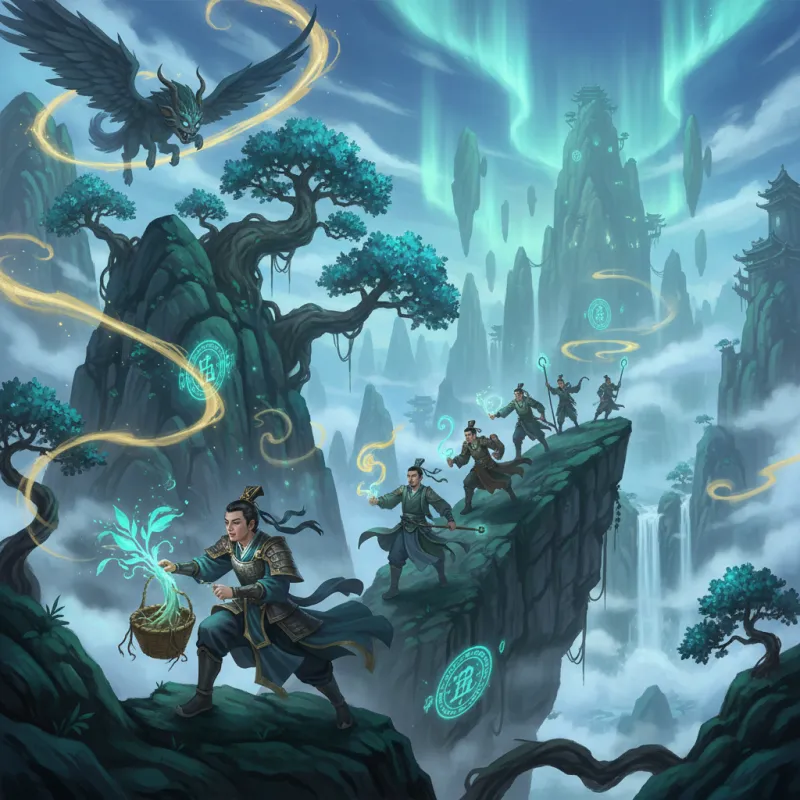
The old alchemist's hands trembled as he held up the withered stalk. "Three hundred years I've been refining pills," he said, "and I've lost more disciples to herb gathering than to demon beasts, tribulation lightning, and sect wars combined." He wasn't exaggerating. In the world of cultivation novels, the herb gathering expedition is where protagonists learn a fundamental truth: the ingredients that make legendary pills don't grow in safe places, and the things guarding them don't negotiate.
The Economics of Spiritual Botany
Spirit herbs (灵草 língcǎo) operate on a brutal logic that makes perfect sense once you understand it. A Thousand Year Blood Ginseng (千年血参 qiānnián xuèshēn) doesn't become valuable because it's rare — it becomes rare because everything that could eat it, has tried to eat it. The herb survives by growing in locations so hostile that most creatures can't reach it, or by developing guardian beasts that treat the surrounding area as their personal territory. This creates the central problem of alchemical cultivation: the ingredients you need for breakthrough pills are defended by creatures you can't defeat until after you've broken through.
The novels that handle this best treat herb locations like ecological systems. In I Shall Seal the Heavens, Meng Hao encounters a Resurrection Lily that's survived for eons by parasitizing cultivators who get too close. The plant isn't just sitting there — it's an active predator with its own cultivation base. Coiling Dragon takes a different approach, placing rare herbs in extreme environments where the ambient spiritual energy (灵气 língqì) is so dense it would kill a weak cultivator before they could even pick the plant. Both systems force the protagonist to solve a puzzle: how do you obtain something when the act of obtaining it might kill you?
The Three Types of Herb Gathering Arcs
The Stealth Mission is the most common variant. Protagonist needs a herb, herb is in a powerful beast's territory, protagonist must sneak in and out without waking the beast. This structure appears in everything from Martial World to A Record of a Mortal's Journey to Immortality, and it works because it inverts the usual power fantasy. Your cultivation level doesn't matter if you wake up the ten-thousand-year-old turtle that's been sleeping under the Spirit Cleansing Pond. The tension comes from watching someone powerful forced to act weak, tiptoeing around a creature they could probably fight but definitely don't want to fight.
The Competitive Gathering arc throws multiple factions into the mix. A rare herb appears, everyone knows about it, and the race is on. Martial God Asura uses this structure repeatedly, turning herb gathering into a battle royale where the real danger isn't the environment but the other cultivators who'll happily kill you for a single stalk of Heaven Rank medicine. These arcs work best when the author remembers that cultivators are supposed to be smart — the interesting conflicts come from strategy and timing, not just from who can punch harder.
The Ecological Disaster variant is rarer but more interesting. The protagonist needs a herb that's part of a larger system, and removing it will have consequences. Desolate Era occasionally touches on this, showing how certain spirit herbs maintain the spiritual energy balance of entire regions. Take the herb, and you might collapse a secret realm or enrage a hidden expert who was using that location for closed-door cultivation. This adds a moral dimension that most cultivation novels ignore: just because you can take something doesn't mean you should.
Guardian Beasts and the Symbiosis Problem
The relationship between rare herbs and their guardian beasts is one of the more thoughtful worldbuilding elements in cultivation fiction, even if most novels don't explore it deeply. A Scarlet Flame Fruit (赤焰果 chìyàn guǒ) growing in a volcano isn't just coincidentally near a fire-attribute demon beast — the beast is there because the fruit's spiritual energy helps its cultivation, and the fruit thrives because the beast's presence keeps other predators away. It's mutualism, and breaking that relationship is harder than just fighting the beast.
A Will Eternal handles this particularly well with Bai Xiaochun's repeated attempts to steal spirit herbs from the Spirit Stream Sect's medicine gardens. The guardian beasts aren't just obstacles — they're intelligent creatures with their own motivations and grudges. When Bai Xiaochun keeps coming back, the beasts start recognizing him, adapting their patrol patterns, and even setting traps. The comedy comes from watching a protagonist who's clever enough to sneak past Foundation Establishment (筑基 zhùjī) cultivators but keeps getting outsmarted by an angry chicken.
The best guardian beast encounters force the protagonist to think like a naturalist. What does this creature eat? When does it sleep? Does it have a mating season when it's distracted? Lord Xue Ying occasionally shows this kind of thinking, with the protagonist studying beast behavior patterns before attempting a theft. The worst versions just have the protagonist fight the beast, win through plot armor, and take the herb. That's not herb gathering — that's just another combat scene with plants as set dressing.
The Timing Problem
Spirit herbs mature on timescales that create natural drama. A herb that takes a thousand years to reach full potency will attract attention as it approaches maturity, turning the gathering site into a convergence point for every cultivator who's been monitoring it. This is the "spiritual herb auction" structure, except the bidding is done with violence and the winner is whoever's still alive when the herb finishes ripening.
The novels that use this well treat the waiting period as part of the arc. In Renegade Immortal, Wang Lin sometimes arrives at a herb location months or years early, then has to decide whether to wait for full maturity (and deal with the crowds) or harvest early (and get a less potent ingredient). This creates actual strategic decisions rather than just "protagonist shows up, protagonist takes herb." The timing also allows for temporary alliances — cultivators who would normally kill each other on sight might cooperate to fend off a stronger faction, planning to betray each other only after the herb is secured.
The maturation timing also explains why pill refinement is such a bottleneck in cultivation. You can't just stockpile ingredients because many spirit herbs lose potency after harvesting. A Jade Spirit Mushroom might need to be refined within three days of picking, or it degrades into a common ingredient. This forces alchemists to either gather herbs themselves or maintain networks of trusted gatherers who can deliver fresh ingredients on demand.
Environmental Hazards Beyond Guardian Beasts
The truly dangerous herb gathering locations don't need guardian beasts because the environment itself is lethal. Miasma valleys where spiritual energy has turned toxic, spatial rifts where gravity fluctuates randomly, ancient battlefields where residual sword intent can shred a careless cultivator — these locations appear throughout cultivation fiction, and they're often more interesting than simple beast encounters.
Stellar Transformations features several arcs where the protagonist must navigate environments that would kill him in seconds without proper preparation. A herb growing in a spatial crack requires precise timing to harvest — reach in when the space is stable, grab the herb, pull back before the crack closes and severs your arm. These scenarios reward intelligence and preparation over raw power, which is refreshing in a genre that often defaults to "punch it harder."
The environmental hazards also create opportunities for creative problem-solving. Need a herb from the bottom of a lake filled with corrosive spiritual water? You could try to resist the corrosion with your cultivation base, or you could find a water-attribute beast core and use it to create a temporary barrier. The novels that show protagonists thinking through these problems feel more earned than the ones where the protagonist just happens to have the perfect technique for every situation.
The Gathering Process Itself
Most cultivation novels gloss over the actual harvesting technique, which is a missed opportunity. Rare spirit herbs aren't like picking tomatoes — they require specific methods to preserve their spiritual energy. A Moonlight Orchid (月光兰 yuèguāng lán) might need to be harvested under a full moon using a jade knife, with the roots carefully preserved in spiritual soil. Mess up the process, and you've just turned a priceless ingredient into an expensive weed.
Tales of Demons and Gods occasionally shows Nie Li using specialized harvesting techniques, treating herb gathering as a skill that requires study and practice. He knows which herbs can be transplanted, which must be consumed immediately, and which parts of the plant contain the most spiritual energy. This kind of detail makes the world feel more real — cultivation isn't just about fighting, it's about understanding the natural laws that govern spiritual energy.
The harvesting process also creates tension in a different way than combat. You've successfully sneaked past the guardian beast, avoided the environmental hazards, and reached the herb. Now you need to spend ten minutes carefully extracting it while knowing that any mistake could alert everything in the area to your presence. It's the cultivation equivalent of defusing a bomb, and when authors actually show this process, it's often more gripping than the fight scenes.
Why This Matters for Pill Refinement
Herb gathering arcs exist because alchemy in cultivation fiction is ingredient-dependent. You can have perfect technique, a legendary cauldron, and a heaven-defying flame, but if your ingredients are mediocre, your pills will be mediocre. This creates a natural progression where protagonists must venture into increasingly dangerous locations to gather increasingly rare herbs, which parallels their cultivation advancement.
The best novels use this to create a sense of earned progression. When the protagonist finally refines a breakthrough pill using ingredients they nearly died to obtain, the achievement feels meaningful. Compare this to novels where the protagonist just buys ingredients from a shop or finds them in a convenient spatial ring — the emotional weight is completely different.
The gathering process also forces protagonists to engage with the world beyond their sect or city. You can't cultivate in isolation if you need specific herbs from specific locations. This naturally creates travel arcs, encounters with different factions, and exposure to various cultivation systems. A protagonist gathering herbs in the Endless Desert will meet different people and face different challenges than one gathering herbs in the Ten Thousand Beast Mountains, and these experiences shape their cultivation path.
The Unspoken Rules
Experienced herb gatherers in cultivation novels follow certain unspoken rules that protagonists often violate (usually successfully, because plot armor). Never take all the herbs from a location — leave some to regenerate. Don't harvest herbs that are clearly being cultivated by someone else unless you're prepared for the consequences. If you encounter another gatherer at a herb site, the one who arrived first has priority, unless you're strong enough to ignore that rule.
These rules exist because the cultivation world, despite its emphasis on individual power, still requires some level of cooperation. If everyone harvests every herb they find down to the roots, spirit herbs go extinct and everyone suffers. If gatherers kill each other on sight, herb gathering becomes impossible for anyone below the Nascent Soul (元婴 yuányīng) realm. The rules are frequently broken, but their existence creates a framework for interesting conflicts beyond simple combat.
The protagonist who understands and occasionally follows these rules feels more like a person navigating a complex world rather than a video game character collecting quest items. When they choose to break the rules, it should be a meaningful decision with consequences, not just the default behavior.
Related Reading
- The Most Famous Pills and Elixirs in Cultivation Fiction
- Pill Refining: The Alchemist's Art in Cultivation Fiction
- The Pill Refining Hierarchy: From Mortal Medicine to Heaven-Defying Elixirs
- Pill Refining in Cultivation Fiction: Chemistry Meets Mysticism
- Unraveling the Mysteries of Chinese Cultivation and Xianxia Fiction
- The Ultimate Guide to Cultivation Fiction (Xiuxian): From Mortal to Immortal
- Unraveling the Mysteries of Formations in Chinese Cultivation and Xianxia Fiction