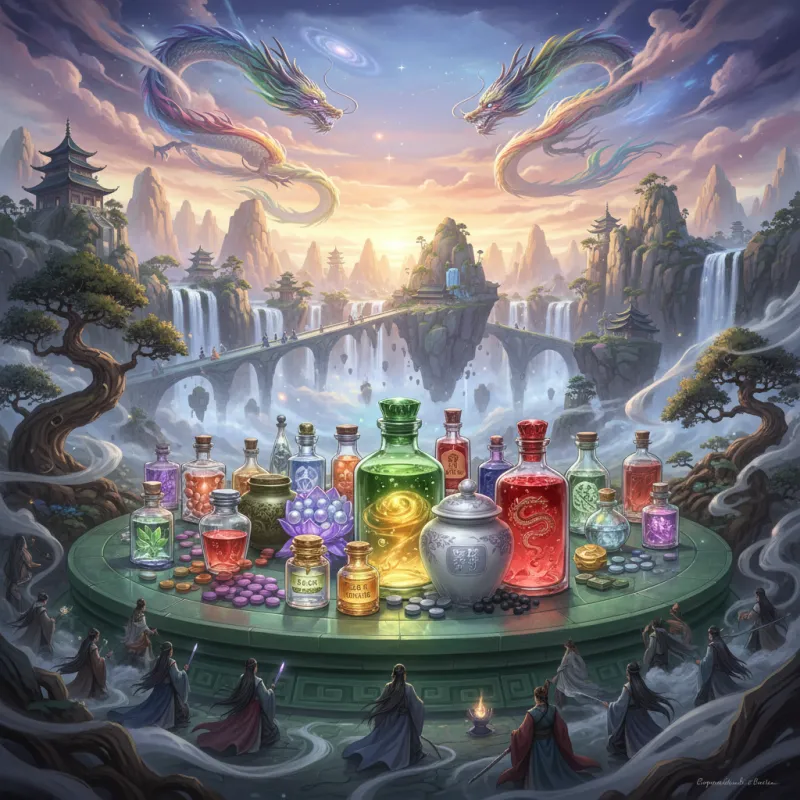
Every alchemist dreams of refining the perfect pill. Most end up with slag, a ruined furnace, and singed eyebrows. But a handful of legendary elixirs have transcended their recipes to become the stuff of cultivation myth — pills so potent that entire sects have risen and fallen over a single dose, so rare that emperors have bankrupted kingdoms pursuing them, so dangerous that even success might kill you. These aren't your friendly neighborhood Qi-Gathering Pills. These are the pills that reshape destinies, trigger blood feuds, and make rational cultivators lose their minds at auction houses.
Foundation Establishment Pill (筑基丹 zhùjīdān)
If there's a "gateway drug" of the cultivation world, this is it. The Foundation Establishment Pill appears in virtually every xianxia novel because it solves the genre's most fundamental problem: how does a mortal with mediocre spiritual roots break through to actual cultivation?
The answer, apparently, is concentrated spiritual essence compressed into pill form, usually requiring at least one ingredient that's 500+ years old and guarded by a spirit beast that really doesn't want to share. In I Shall Seal the Heavens, Meng Hao's entire early arc revolves around these pills — first stealing the recipe, then perfecting it, then using it as leverage against people who'd normally squash him like a bug. The novel makes it clear that a perfect Foundation Establishment Pill (the kind with pill clouds and spiritual markings) is worth more than most cultivators will earn in their entire lives.
What makes this pill fascinating is its economics. It's valuable enough to kill for but common enough that most major sects can produce them in small quantities. This creates a perpetual seller's market where desperate rogue cultivators mortgage their futures for a single dose, often ending up as indentured servants to the very sects that sold them the pill. The Foundation Establishment Pill isn't just medicine — it's a social control mechanism that keeps the cultivation hierarchy intact.
Nine Revolutions Golden Pill (九转金丹 jiǔzhuǎn jīndān)
This is the pill that Daoist alchemists in actual Chinese history killed themselves trying to make, which tells you everything about its reputation. The historical version involved mercury, lead, and sulfur heated in sealed vessels for months — a recipe for heavy metal poisoning that emperors kept taking anyway because immortality seemed worth the risk.
In cultivation fiction, the Nine Revolutions Golden Pill has been upgraded from "toxic mistake" to "legitimate path to immortality," though it's still trying to kill you. The "nine revolutions" refer to nine cycles of refinement, each one purifying the pill's essence and exponentially increasing its potency. A three-revolution pill might help you break through a minor bottleneck. A six-revolution pill could reconstruct your meridians. A true nine-revolution pill? That's the kind of treasure that appears once per millennium and causes sect wars.
Stellar Transformations treats this pill as the ultimate achievement of the Daoist path, contrasting it with Buddhist cultivation methods. The protagonist Qin Yu eventually learns that the pill isn't just about raw power — each revolution represents a deeper understanding of the Dao itself. You can't brute-force your way to nine revolutions; you need comprehension that matches your technique. This philosophical angle elevates the pill from mere power-up to spiritual milestone, which is probably why it's maintained its prestige across so many novels despite being rooted in historical alchemy that definitely didn't work.
Heavenly Tribulation Pill (渡劫丹 dùjiédān)
Here's where cultivation fiction gets delightfully specific about its power scaling. When you try to break through to higher realms, Heaven itself tries to kill you with lightning tribulation (天劫 tiānjié). The Heavenly Tribulation Pill doesn't prevent this — that would be too easy — but it supposedly increases your survival odds from "almost zero" to "maybe 30%."
The pill's reputation comes from its ingredients, which read like a scavenger hunt through the most dangerous locations in any given cultivation world. You need lightning-struck wood from a 10,000-year-old tree, essence from a tribulation cloud (good luck harvesting that), and usually the core of some thunder-attribute spirit beast that can kill you just by looking at you wrong. The refining process itself requires the alchemist to channel tribulation lightning into the furnace, which is exactly as suicidal as it sounds.
What I appreciate about this pill is how it acknowledges the genre's fundamental tension: cultivation is supposed to defy Heaven, but you need Heaven's own power to succeed. The Heavenly Tribulation Pill embodies this paradox — you're using the very force trying to kill you as medicine. In Desolate Era, Ji Ning's master explains that the pill doesn't actually make you stronger; it temporarily aligns your body's energy signature with tribulation lightning so the attacks partially phase through you. It's not protection, it's camouflage, and if the tribulation realizes what you're doing, it gets angry and hits harder.
Immortal Ascension Pill (飞升丹 fēishēngdān)
This pill barely exists in most novels because it's too powerful for the plot to handle. The Immortal Ascension Pill supposedly allows a mortal realm cultivator to directly ascend to the immortal realm without going through the usual tribulations, bottlenecks, and centuries of grinding. It's the ultimate cheat code, which is exactly why most authors either make it impossible to refine or give it crippling side effects.
In the rare stories where it appears, the Immortal Ascension Pill usually comes with a catch: it forces ascension whether you're ready or not, potentially stranding you in the immortal realm as the weakest possible immortal, surrounded by beings who could sneeze you out of existence. It's like skipping from high school directly to a PhD program at Harvard — technically impressive, but you're missing foundational knowledge that will absolutely come back to haunt you.
A Record of a Mortal's Journey to Immortality handles this pill brilliantly by making it a historical artifact. The recipe existed in ancient times but has been lost, with only fragments remaining. The protagonist Han Li spends several arcs piecing together clues about its composition, only to realize that the "lost recipe" was deliberately destroyed by immortal realm cultivators who didn't want mortals showing up unprepared. The pill isn't lost — it's suppressed, which is a much more interesting narrative choice.
Soul Restoration Pill (还魂丹 huánhúndān)
Most cultivation pills make you stronger. The Soul Restoration Pill brings you back from the dead, which is either the most valuable or most terrifying property depending on your perspective. The name literally means "return soul pill," and it does exactly that — recaptures a departing soul and binds it back to the body, assuming the body isn't too damaged and you administer it within a very narrow time window.
This pill appears most often in tragic backstories and desperate rescue attempts. In Coiling Dragon, a Soul Restoration Pill becomes the MacGuffin for an entire arc when the protagonist's loved one is killed and he has roughly 24 hours to find the pill, get back to the body, and administer it before the soul dissipates completely. The time pressure creates genuine tension because even in a world of flying swords and spatial rings, logistics matter.
What makes the Soul Restoration Pill interesting is its moral ambiguity. Some sects consider it blasphemy — you're interfering with the natural cycle of reincarnation, potentially trapping a soul that should move on. Others see it as the ultimate expression of human will defying fate. The pill's main ingredient is usually something deeply uncomfortable, like the crystallized regret of a dying cultivator or essence harvested from the Yellow Springs (黄泉 huángquán), the underworld river. You're not just cheating death; you're stealing from death, and death keeps receipts.
Dragon Tiger Pill (龙虎丹 lónghǔdān)
This pill has the best name and the worst side effects. The Dragon Tiger Pill combines yang energy (dragon) and yin energy (tiger) in a volatile mixture that's supposed to balance your cultivation base and clear meridian blockages. In practice, it's more like swallowing a small war between opposing forces and hoping your body survives as the battlefield.
The pill's reputation comes from its success rate, which hovers around 50-50. Half the people who take it achieve breakthrough. The other half explode, or have their meridians shredded, or develop cultivation deviation so severe they spend the rest of their lives as drooling vegetables. These aren't acceptable odds for most people, but desperate cultivators facing permanent bottlenecks will roll those dice.
Martial World does something clever with this pill by making it a test of character. The Dragon Tiger Pill doesn't just require physical endurance — it forces you to maintain perfect mental balance while two opposing energies try to tear you apart from the inside. If you favor one energy over the other, even slightly, you fail. The pill becomes a meditation on the Daoist concept of balance, where true power comes not from strength but from harmony. Of course, this philosophical insight doesn't help much when you're screaming in agony as dragon fire and tiger frost fight for control of your dantian.
The Pill That Doesn't Exist Yet
Here's my favorite category: the legendary pill that everyone talks about but nobody's successfully refined in 10,000 years. Every major cultivation novel has one — the Eternal Life Pill, the Heaven Defying Pill, the Pill of Ultimate Whatever. These pills exist primarily as motivation, the carrot dangling in front of ambitious alchemists who think they'll be the one to crack the formula.
The genius of these impossible pills is that they let authors explore the limits of their magic systems without actually breaking them. Characters can theorize about ingredients, debate refinement methods, and discover ancient partial recipes without ever having to deal with the narrative consequences of someone actually succeeding. It's the cultivation equivalent of cold fusion — theoretically possible, endlessly fascinating, conveniently unachievable.
What separates good cultivation fiction from great cultivation fiction is how these legendary pills are handled. Weak novels treat them as simple power-ups waiting to be discovered. Strong novels use them to explore themes of obsession, ambition, and the price of pursuing perfection. The best novels reveal that the legendary pill was never really about the pill at all — it was about the journey, the understanding gained, the alchemical insights that transform the seeker regardless of whether they succeed.
Because in the end, that's what all these famous pills represent: shortcuts that aren't really shortcuts, power that comes with a price, and the eternal human desire to transcend our limitations through chemistry, willpower, and occasionally stealing rare herbs from angry spirit beasts. The pills may be fictional, but the hunger for transformation is very real.
Related Reading
- Pill Refining: The Alchemist's Art in Cultivation Fiction
- The Pill Refining Hierarchy: From Mortal Medicine to Heaven-Defying Elixirs
- Herb Gathering: The Dangerous Art of Finding Rare Ingredients
- Pill Refining in Cultivation Fiction: Chemistry Meets Mysticism
- Exploring the Enigmatic Realms of Chinese Cultivation and Xianxia Fiction
- How to Write Cultivation Fiction: A Beginner's Guide for Western Authors
- The Allure of Chinese Cultivation Fiction: A Journey Through Immortal Realms