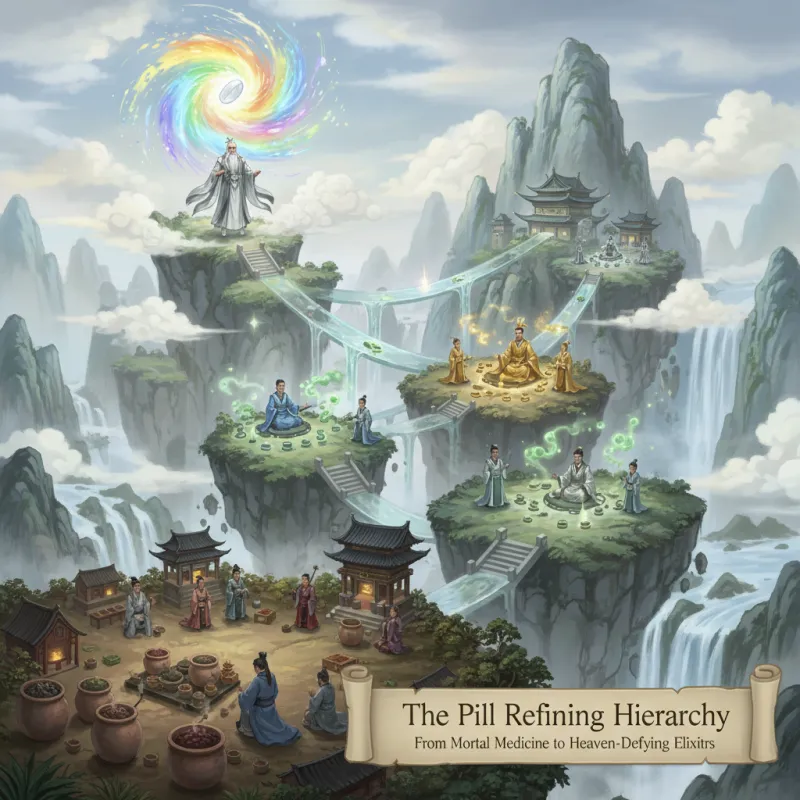
A single pill can bridge the gap between life and death, between stagnation and breakthrough, between mortal and immortal. In the world of cultivation novels, alchemists don't just mix herbs—they command the very laws of heaven and earth, condensing spiritual energy into physical form. But here's what most readers miss: the pill hierarchy isn't just a power scaling system. It's a complete philosophical framework that mirrors the cultivation realms themselves, and understanding it reveals why certain protagonists succeed where others fail.
The Foundation: Mortal Grade Pills (凡品丹 fánpǐn dān)
Let's be honest—Mortal Grade pills get no respect. They're the participation trophies of the alchemy world, the pills that even a half-drunk apprentice could theoretically produce. These pills use common herbs with trace amounts of spiritual energy, treating basic ailments and providing minor cultivation assistance to Qi Refining (炼气 liànqì) practitioners.
But dismissing them entirely is a mistake that marks you as a cultivation novel amateur. In Tales of Demons and Gods, Nie Li's entire early-game strategy revolves around mass-producing Mortal Grade pills to fund his operations. Why? Because volume matters. A thousand low-grade pills can generate more wealth than a single mid-tier pill if you control the market.
The typical Mortal Grade pill contains 10-30% medicinal efficacy, with the rest being impurities that the body must process and expel. This is why cultivators often enter closed-door cultivation after consuming pills—they're not just absorbing energy, they're dealing with the toxic buildup. Smart alchemists minimize impurities; lazy ones don't care because their customers can't tell the difference until it's too late.
Spirit Grade: Where Real Alchemy Begins (灵品丹 língpǐn dān)
Spirit Grade pills mark the threshold where alchemy transitions from craft to art. These pills require spiritual herbs that have absorbed heaven and earth energy for decades, and the refining process demands precise control of pill fire (丹火 dānhuǒ) temperature and timing. One degree too hot, and you get ash. One second too long, and the medicinal properties degrade.
The medicinal efficacy jumps to 50-70%, which sounds modest until you realize this represents a qualitative transformation. A Spirit Grade Qi Gathering Pill (聚气丹 jùqì dān) doesn't just provide energy—it actively purifies the meridians while doing so. This is the grade where pills start having secondary effects that aren't listed in their names, and where experienced cultivators can identify an alchemist's skill level by the pill's appearance alone.
In Martial God Asura, Chu Feng's ability to refine Spirit Grade pills at a young age immediately elevates his status. Why? Because Spirit Grade alchemy requires understanding pill formulas (丹方 dānfāng) at a conceptual level, not just following recipes. You need to know why ginseng and dragon's blood interact, not just that they do. This is where pill formula theory becomes essential reading.
Earth Grade: The Bottleneck Breaker (地品丹 dìpǐn dān)
Earth Grade pills are where the economics of cultivation get interesting. These pills can facilitate breakthroughs between major realms—Foundation Establishment to Core Formation, for example—which means their value isn't measured in spirit stones but in favors, alliances, and blood debts.
The refining process requires materials that are at least a century old, and the success rate plummets. Even skilled alchemists might only succeed 30-40% of the time, which is why a single Earth Grade pill can bankrupt a small sect. The medicinal efficacy reaches 70-85%, and impurities drop to levels where they're almost negligible for cultivators at the appropriate realm.
Here's the crucial detail most novels gloss over: Earth Grade pills often require beast cores or demon beast materials, which means alchemists need either combat skills or wealthy backers. This creates a natural alliance between alchemists and combat cultivators, and it's why alchemy sects always maintain hunting divisions. The protagonist who can both fight and refine pills—like Yun Che in Against the Gods—breaks this dependency and becomes exponentially more powerful.
The pill tribulation (丹劫 dānjiě) sometimes appears at this grade, though it's more common at Heaven Grade. When a pill's quality reaches a certain threshold, heaven itself takes notice and sends down lightning to destroy it. Successfully protecting a pill through tribulation adds another 5-10% efficacy and can even grant the pill a rudimentary spiritual consciousness.
Heaven Grade: Defying the Natural Order (天品丹 tiānpǐn dān)
Heaven Grade pills are the stuff of legends, and for good reason. These pills can resurrect the recently dead, regenerate destroyed cultivation bases, or grant temporary power that rivals those an entire realm higher. The materials required are often unique—thousand-year-old spiritual herbs, phoenix blood, dragon marrow—and the refining process can take days or even weeks of continuous effort.
Medicinal efficacy reaches 85-95%, and the pills often develop pill spirits (丹灵 dānlíng)—fragments of consciousness that make the pill semi-sentient. A Heaven Grade pill might actually flee from an unworthy consumer or choose its own master. In I Shall Seal the Heavens, Meng Hao's Perfect Pills are essentially Heaven Grade pills that have achieved 100% efficacy, which is theoretically impossible and exactly the kind of rule-breaking that defines protagonist-level alchemy.
The pill tribulation at this grade is guaranteed and often catastrophic. Nine-colored lightning, spatial tears, even manifestations of heavenly dao itself trying to erase the pill from existence. The alchemist must have both the skill to refine the pill and the power to protect it, which is why Heaven Grade alchemists are almost always powerful cultivators in their own right.
Divine Grade and Beyond: Breaking the System (神品丹 shénpǐn dān)
Most cultivation novels stop at Heaven Grade, but the ambitious ones push further into Divine Grade (神品丹 shénpǐn dān), Immortal Grade (仙品丹 xiānpǐn dān), and even Chaos Grade (混沌丹 hùndùn dān). At these levels, we're no longer talking about pills in any conventional sense—these are condensed fragments of dao itself, capable of rewriting reality.
Divine Grade pills require materials from the Immortal Realm or higher planes, and the refining process involves comprehending and manipulating fundamental laws. The medicinal efficacy approaches 100%, and impurities are completely absent. These pills don't just heal or enhance—they transform. A Divine Grade Body Tempering Pill might reconstruct your entire physical form at the cellular level, granting you an innate divine physique.
The tribulation for Divine Grade pills is apocalyptic. We're talking about tribulation clouds that span continents, lightning that can kill Immortal Realm cultivators, and heavenly armies manifesting to destroy the pill. Successfully refining one typically requires the combined effort of multiple peak-level experts and protective formations that take years to construct.
The Hidden Variable: Pill Veins and Perfection
Here's what separates good cultivation novels from great ones: attention to pill veins (丹纹 dānwén). These are patterns that appear on a pill's surface, indicating its quality within its grade. A Spirit Grade pill with nine veins is superior to an Earth Grade pill with one vein, which creates interesting market dynamics and gives protagonists room to dominate their tier before advancing.
The number of veins typically ranges from one to nine, with nine representing perfection within that grade. But some novels introduce ten-vein pills or even veinless pills that have transcended the need for such markings. In Coiling Dragon, Linley's eventual mastery of soul force manipulation allows him to create pills that don't fit conventional grading systems at all.
Perfect pills—those with 100% medicinal efficacy and zero impurities—are the holy grail of alchemy. They're so rare that some cultivators go their entire lives without seeing one. The difference between a 95% pill and a 100% pill seems minor, but that final 5% often contains the difference between a successful breakthrough and a failed one, between life and death.
Why the Hierarchy Matters (And Why It Doesn't)
The pill hierarchy exists to create clear progression markers and economic systems within cultivation worlds. It gives protagonists measurable goals and provides a framework for power scaling that readers can intuitively understand. When the protagonist refines their first Earth Grade pill, we know exactly how impressive that is.
But the best cultivation novels use the hierarchy as a starting point, then subvert it. They introduce pills that don't fit the categories, alchemists who can refine higher-grade pills than their cultivation should allow, or alternative alchemy systems from different regions or time periods. The hierarchy is a tool, not a cage.
What really matters isn't the grade of the pill—it's whether the alchemist understands the principles behind it. A master alchemist with common ingredients can often produce better results than a mediocre alchemist with rare materials. This is why protagonists who truly comprehend alchemy fundamentals rather than just memorizing formulas always rise to the top.
The pill hierarchy is a map, but the territory is far more complex and interesting than any simple grading system can capture.
Related Reading
- Pill Refining in Cultivation Fiction: Chemistry Meets Mysticism
- Herb Gathering: The Dangerous Art of Finding Rare Ingredients
- Pill Refining: The Alchemist's Art in Cultivation Fiction
- The Most Famous Pills and Elixirs in Cultivation Fiction
- The Glossary Problem: Why Cultivation Fiction Is Hard to Translate
- Sect Politics: Why Cultivation Sects Are Basically Corporations
- Mortal Realm to Immortal Realm: The Geography of Cultivation Worlds