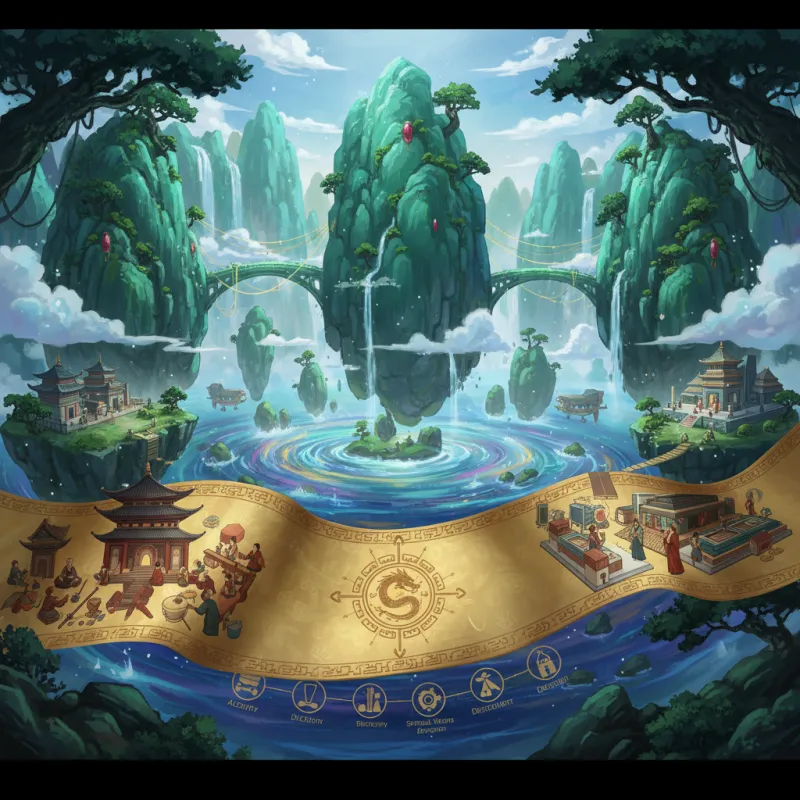
The Skyward Sword Sect's quarterly resource allocation meeting looks exactly like a board meeting at any Fortune 500 company. Elders sit in hierarchical order. Junior disciples present cultivation progress reports. Someone inevitably gets demoted for failing to meet their breakthrough quota. The only difference? Instead of PowerPoint slides, they use jade slips. And instead of quarterly earnings, they're tracking spirit stone reserves and pill production rates.
Welcome to the uncomfortable truth about cultivation sects: they're corporations wearing robes.
The C-Suite of Immortality
Every sect has a Sect Master (掌门, zhǎngmén) who functions as CEO. Below them sit the Grand Elders (太上长老, tàishàng zhǎnglǎo) — think board of directors, except they can actually kill you with a thought if you displease them. Then come the Peak Masters who run different divisions: Alchemy Peak (the R&D department), Sword Peak (security and enforcement), Administration Peak (HR and logistics).
In I Shall Seal the Heavens, the Violet Fate Sect's structure mirrors a pharmaceutical conglomerate. Their Alchemy Division controls pill production. Their Pill Auction Department handles distribution. They even have non-compete clauses — disciples who leave can't practice alchemy for rival sects. Meng Hao exploits this corporate structure brilliantly, playing different divisions against each other to maximize his own benefits.
The resemblance isn't coincidental. Er Gen wrote these sects during China's rapid corporate expansion in the 2000s. The organizational logic of modern business bleeds into his fictional cultivation world because that's the power structure his readers understand instinctively.
Vertical Integration and Market Dominance
Successful sects don't just control one resource — they control the entire supply chain. The Azure Cloud Sect in Renegade Immortal owns spirit stone mines, operates refineries that process raw stones, runs the trading posts that sell finished products, and maintains the Teleportation Arrays that move goods between locations. They've achieved what business schools call "vertical integration."
This creates massive barriers to entry. A new sect can't just appear and compete. They need mining rights (controlled by existing sects), refining knowledge (trade secrets), distribution networks (monopolized), and enough military power to defend their operations (requires resources they don't have yet). It's a closed loop that perpetuates the dominance of established players.
The most ruthless sects practice what economists call "predatory pricing." When a smaller sect discovers a new spirit vein, a major sect will flood the market with cheap spirit stones from their reserves, driving prices below the cost of extraction. The small sect goes bankrupt. The major sect then acquires their territory for pennies and adds another asset to their portfolio.
The Disciple Recruitment Pipeline
Sects don't take disciples out of altruism — they're recruiting talent. The entrance examinations test spiritual root quality the same way tech companies screen for coding ability. High-grade spiritual roots get fast-tracked into core disciple programs with better resources, personal mentoring, and clear advancement paths. Low-grade roots become outer disciples — the equivalent of contract workers who handle menial tasks and rarely advance.
Martial World makes this explicit. The Sky Fortune Kingdom's sects literally buy talented children from poor families, offering compensation packages of spirit stones and cultivation resources. It's a signing bonus. The children become assets on the sect's balance sheet, expected to generate returns through their future contributions.
The truly cynical part? Sects invest heavily in disciples during their Foundation Establishment and Core Formation stages, then extract maximum value once disciples reach higher realms. A Nascent Soul elder who wants to leave faces the same problem as an executive with unvested stock options — walking away means abandoning decades of accumulated benefits, sect-specific techniques, and access to restricted resources.
Mergers, Acquisitions, and Hostile Takeovers
When sects talk about "unifying the region" or "bringing order to the cultivation world," they mean consolidation. They're acquiring competitors and eliminating redundant operations. The language is spiritual, but the logic is pure business strategy.
The Heavenly Sword Sect's expansion in A Will Eternal follows a classic acquisition playbook. First, they identify a weaker sect with valuable resources. Second, they manufacture a conflict — perhaps a disciple gets "insulted" or a border dispute emerges. Third, they demand unreasonable compensation. When the weaker sect refuses, they have justification for military action. After conquest, they absorb useful disciples and techniques while eliminating leadership that might resist integration.
Sometimes sects merge voluntarily, usually when facing an existential threat. These mergers rarely work. Cultural integration fails. The former leadership of the absorbed sect resents their diminished status. Disciples from different traditions clash over technique superiority. Within a generation, the merged entity either fractures or one side completely dominates, making it a de facto acquisition anyway.
The most interesting corporate maneuver is the "friendly takeover" through marriage alliances. Two sects arrange marriages between talented disciples, creating interlinked interests. Over generations, this evolves into either a true merger or one sect gradually subsuming the other through strategic breeding programs that concentrate power in one lineage.
The Quarterly Earnings Report: Sect Tournaments
Inter-sect tournaments aren't about glory — they're investor presentations. Sects showcase their talent pipeline to attract potential allies, intimidate rivals, and signal market position. A strong showing at the Heavenly Dao Tournament means better terms on resource-sharing agreements, more talented disciples seeking admission, and increased leverage in territorial negotiations.
This explains why sects sometimes send weaker disciples to tournaments. They're managing expectations. If everyone knows your sect is in decline, you avoid painting a target on your back. Conversely, hiding your true strength (like the Profound Sky Continent's sects in Against the Gods) lets you surprise competitors when it matters.
The tournament structure itself mirrors corporate competition. There are weight classes (cultivation realms), rules that theoretically ensure fair play (but everyone cheats), and prizes that represent market share (access to secret realms, rare resources, Sect Reputation boosts). The sect that wins doesn't just get bragging rights — they get tangible economic advantages that compound over time.
The Hostile Work Environment
Sect politics are vicious because the stakes are existential. In a corporation, failure means getting fired. In a sect, failure means your rival poisons you, frames you for treason, or arranges an "accident" during a mission. The cultivation world has no HR department to file complaints with.
This creates a culture of paranoia and factionalism. Disciples align with powerful elders for protection. Elders form cabals to control sect resources. The Sect Master must constantly balance competing interests or risk a coup. Reverend Insanity portrays this brilliantly — Fang Yuan navigates sect politics by treating everyone as either an asset or a threat, never trusting anyone's stated motivations.
The most toxic element is the "up or out" culture. Disciples who fail to advance get pushed to the margins, given dangerous missions, or expelled entirely. There's no comfortable middle management position. You either climb toward the peak or you're discarded. This creates intense competition among disciples of the same generation, who should theoretically be allies but instead view each other as obstacles to limited resources.
When Corporations Become Monopolies
The endgame of sect politics is monopoly. One sect becomes so dominant that it can dictate terms to everyone else. They control resource prices, set cultivation standards, and eliminate any organization that challenges their authority. They become the cultivation world's equivalent of a government, except without democratic accountability.
Coiling Dragon shows this trajectory. The Four Divine Beasts Clan reaches such dominance that they essentially run the Infernal Realm's economy. Other factions exist only because the Clan allows it. This monopoly breeds complacency — the Clan stops innovating, assumes their position is unassailable, and eventually gets destroyed by a coalition of resentful competitors.
The cultivation world has a built-in check on monopolies: individual power. A single sufficiently powerful cultivator can destroy an entire sect. This is why sects obsess over preventing the rise of "demonic cultivators" or "unorthodox practitioners" — these individuals operate outside the corporate structure and threaten the entire system. They're the cultivation equivalent of disruptive startups that make established players obsolete.
The Illusion of Righteousness
The greatest trick sects pull is convincing everyone they're spiritual organizations pursuing the Dao, not corporations pursuing profit. They wrap resource extraction in the language of "maintaining order." They frame eliminating competitors as "purging evil." They call their monopolistic practices "upholding righteousness."
But watch what sects do, not what they say. When a "righteous" sect discovers a secret realm full of treasures, do they share it with the cultivation world? No. They seal it off, extract everything valuable, and kill anyone who stumbles upon it. When a "demonic" cultivator threatens their interests, they form a coalition — not because the cultivator is evil, but because he's disrupting their market position.
The protagonist of Renegade Immortal, Wang Lin, sees through this hypocrisy early. He treats sects as the self-interested organizations they are, negotiating from positions of strength and never trusting their stated principles. This pragmatism lets him survive in a world where everyone else is playing corporate politics while pretending they're pursuing enlightenment.
The cultivation world would be more honest if sects just admitted what they are: ancient, powerful corporations that control resources, exploit labor, eliminate competition, and pursue growth above all else. The robes and meditation halls are just branding. The real business happens in the resource allocation meetings, the territorial negotiations, and the hostile takeovers disguised as righteous crusades.
At least modern corporations don't pretend they're helping you achieve immortality while they're extracting value from your labor. Cultivation sects don't even give you that courtesy.
Related Reading
- The Rise of Sects in Chinese Cultivation Fiction: Paths to Immortality
- Cultivation Sects: The Corporations of the Immortal World
- Ancient Sects and Spiritual Realms in Chinese Cultivation and Xianxia Fiction
- Sect Hierarchy Explained: From Outer Disciple to Patriarch
- Secret Realms: Hidden Dimensions of Power
- Spiritual Roots: The Innate Talent System of Cultivation
- Auction House Economics: How Cultivation Markets Shape Power Dynamics
- Unveiling the Essence of Chinese Cultivation: A Journey Through Xianxia and Immortal Realms