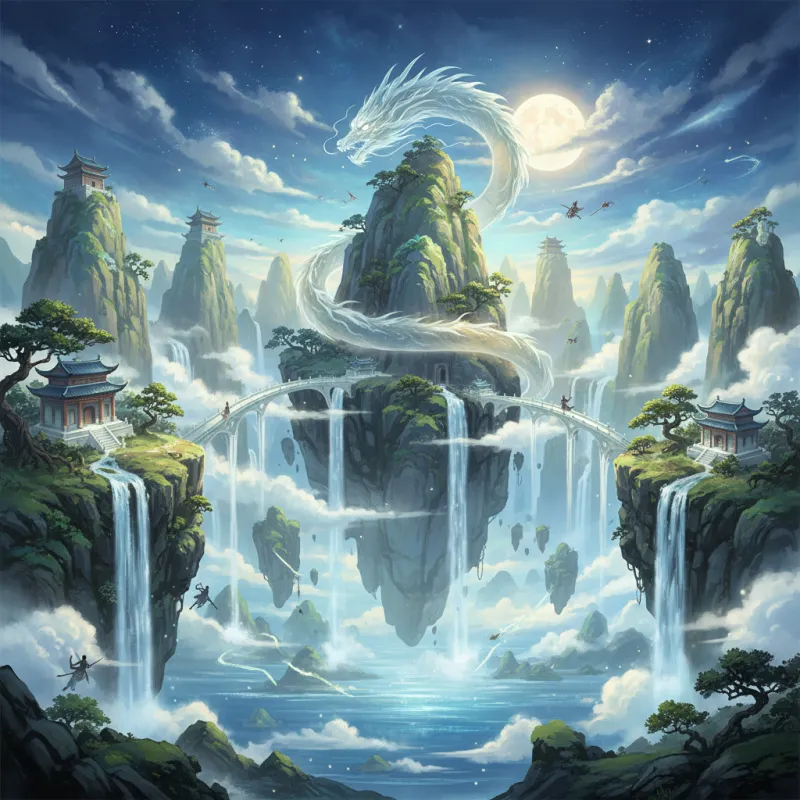
The old Daoist master sits cross-legged on a mountain peak, his breath synchronized with the pulse of heaven and earth. For three days and nights, he hasn't moved. Then, without warning, his eyes snap open—and the clouds above him part. This isn't fantasy. This is the cultivation ideal that has captivated Chinese imagination for over two millennia, now exploding across global fiction through xianxia novels.
The Philosophical Bedrock: Where Daoism Meets Ambition
Chinese cultivation fiction didn't emerge from nowhere. Its roots burrow deep into the Warring States period (475-221 BCE), when Laozi supposedly penned the Dao De Jing (道德经, Dàodé Jīng) and Zhuangzi dreamed of becoming a butterfly. These weren't just philosophical musings—they were instruction manuals for transcendence. The concept of xiūliàn (修炼, cultivation) literally means "to cultivate and refine," combining spiritual practice with alchemical transformation.
But here's what most people miss: cultivation fiction takes Daoist philosophy and weaponizes it. Where Laozi preached wu wei (无为, effortless action) and harmony with nature, xianxia protagonists pursue power with ruthless determination. They're not seeking enlightenment for peace—they want to punch holes through mountains and live forever. This tension between philosophical ideals and raw ambition is what makes the genre so compelling. It's Buddhism's quest for transcendence colliding head-on with Confucian hierarchy and Daoist immortality techniques, all wrapped in martial arts spectacle.
The historical fangshi (方士, method masters) of the Qin and Han dynasties actually attempted these practices. Emperor Qin Shi Huang sent expeditions to find the elixir of immortality. Alchemists consumed mercury and cinnabar, believing these substances would transform their mortal bodies. They died, obviously—but the dream persisted in literature.
The Immortal Hierarchy: Heaven's Bureaucracy
One of xianxia's most distinctive features is its meticulously structured cultivation realms. Unlike Western fantasy's vague "becoming more powerful," Chinese cultivation operates like a cosmic corporate ladder. You start as a Qi Condensation (凝气, Níng Qì) cultivator, barely able to sense spiritual energy, and climb through Foundation Establishment, Core Formation, Nascent Soul, and beyond—sometimes through dozens of realms.
This isn't arbitrary. The realm system reflects traditional Chinese cosmology, where heaven itself operates as a bureaucracy. The Jade Emperor has ministers, immortals have ranks, and even demons follow hierarchical structures. In novels like I Shall Seal the Heavens by Er Gen, the protagonist Meng Hao must navigate not just cultivation bottlenecks but also the political machinations of ancient sects and immortal factions.
Each realm represents a fundamental transformation. Breaking through from Foundation Establishment to Core Formation isn't like leveling up in a video game—it's reconstructing your entire existence. Your dantian (丹田, elixir field) becomes a miniature universe. Your lifespan extends by centuries. Your understanding of the Dao deepens. Failure means death, or worse, becoming a crippled cultivator, your meridians shattered, your potential destroyed forever.
The genius of this system is how it creates narrative tension. A protagonist might be invincible at their level but still an ant before higher-realm cultivators. It's a humility engine built into the power fantasy, forcing characters to scheme, hide, and occasionally grovel before returning for revenge. For more on how these power systems function, check out Understanding Cultivation Realms and Breakthroughs.
Xianxia vs. Xuanhuan: Know Your Subgenres
Here's where English-speaking fans often get confused. Xianxia (仙侠, Immortal Heroes) isn't the only cultivation genre—it's part of a larger ecosystem. Xuanhuan (玄幻, Mysterious Fantasy) is broader, incorporating Western fantasy elements, multiple magic systems, and sometimes completely invented cultivation paths. Xianxia specifically draws from Chinese mythology and Daoist practices.
Coiling Dragon by I Eat Tomatoes is xuanhuan—it features Western-style gods, dragons, and a cultivation system that owes more to creative invention than Daoist alchemy. Meanwhile, A Record of a Mortal's Journey to Immortality by Wang Yu is pure xianxia, grounded in traditional immortal cultivation with recognizable Daoist terminology and concepts.
Then there's wuxia (武侠, Martial Heroes), the grandfather of them all. Jin Yong's classics like The Legend of the Condor Heroes feature martial artists with superhuman abilities, but they remain fundamentally mortal. They can't fly on swords or live for millennia. Xianxia takes wuxia's martial arts foundation and asks: what if these warriors could actually become immortal?
The distinction matters because it shapes reader expectations. Xianxia promises a journey from mortal to god, with all the Daoist trappings that entails. Xuanhuan offers more creative freedom but less cultural specificity. Understanding this helps explain why some novels feel more "authentic" than others—they're drawing from different wells.
The Alchemy of Immortality: Pills, Treasures, and Heavenly Tribulations
No xianxia novel is complete without its alchemy system. The pursuit of the golden core (金丹, jīndān) isn't metaphorical—characters literally consume pills to advance their cultivation. This reflects historical Chinese alchemy, where Daoist practitioners believed they could create an immortal body through internal and external alchemy.
Internal alchemy (内丹, nèidān) involves circulating qi through meridians, refining it in the dantian, and eventually forming a spiritual core. External alchemy (外丹, wàidān) means consuming elixirs made from spiritual herbs, monster cores, and rare minerals. In novels, protagonists often combine both approaches, spending chapters describing pill refinement processes with the intensity of a cooking show.
The spiritual herb economy drives entire plot arcs. A thousand-year ginseng? Wars are fought over it. A Phoenix Blood Fruit? Entire sects will mobilize. These aren't just MacGuffins—they represent concentrated essence, shortcuts on the long road to immortality. The tension between natural cultivation (slow but stable) and pill-assisted advancement (fast but potentially unstable) creates moral and practical dilemmas.
Then there's the heavenly tribulation (天劫, tiānjié), cultivation fiction's most dramatic element. When you attempt to break through major realms, heaven itself tries to kill you with lightning. This isn't arbitrary cruelty—it's cosmic quality control. Heaven doesn't want too many immortals cluttering up the place. The tribulation tests your foundation, your willpower, and your worthiness to transcend mortality. Survive, and you're reborn stronger. Fail, and you're ash.
Modern Xianxia: From Web Novels to Global Phenomenon
The current xianxia boom began in the early 2000s with Chinese web novel platforms like Qidian. Authors like Er Gen, I Eat Tomatoes, and Wang Yu serialized massive novels—we're talking 2,000+ chapters—building devoted fanbases who followed daily updates. This serialization format shaped the genre's structure: cliffhangers, power escalation, and arc-based storytelling.
Stellar Transformations (2008) by I Eat Tomatoes revolutionized the genre by introducing a protagonist who couldn't follow the traditional cultivation path and had to forge his own. Renegade Immortal (2009) by Er Gen went darker, featuring a morally ambiguous protagonist willing to slaughter innocents for advancement. These novels proved xianxia could be more than power fantasy—it could explore philosophy, morality, and the cost of immortality.
The translation movement, spearheaded by sites like Wuxiaworld and Webnovel, brought xianxia to English-speaking audiences around 2014. Suddenly, readers worldwide were binge-reading about qi cultivation and heavenly tribulations. The genre's influence now extends beyond literature—Chinese donghua (animation) adaptations, manhua (comics), and even video games draw from xianxia conventions.
What makes modern xianxia resonate globally? Perhaps it's the meritocratic promise: anyone can cultivate, regardless of birth, if they have talent and determination. Or maybe it's the systematic progression, satisfying our love of measurable growth. The genre offers both escapism and structure, power fantasy grounded in philosophical tradition. For insights into specific cultivation techniques, explore Daoist Meditation and Qi Cultivation Practices.
The Dark Side: Moral Ambiguity in Cultivation
Let's address the elephant in the room: many xianxia protagonists are, by conventional standards, terrible people. They massacre entire clans for revenge. They steal treasures from weaker cultivators. They justify atrocities with "the law of the jungle" rhetoric. This isn't a bug—it's a feature.
Cultivation fiction often operates on a different moral framework than Western fantasy. The strong prey on the weak. Mercy is weakness. Face (面子, miànzi) and reputation matter more than abstract ethics. When someone offends you, you don't just defeat them—you exterminate their entire bloodline to prevent future revenge. It's brutal, and it reflects a worldview where power is the ultimate arbiter of right and wrong.
Some novels interrogate this morality. Reverend Insanity features a protagonist so ruthlessly pragmatic he becomes genuinely monstrous, forcing readers to question whether immortality is worth losing your humanity. Others embrace it uncritically, creating protagonists who are essentially serial killers with plot armor.
This moral ambiguity is part of xianxia's appeal and its controversy. It offers a space to explore what happens when the pursuit of transcendence overrides conventional morality. The cultivation path is lonely, the novels tell us, and those who cling to mortal ethics will never reach the peak. Whether you find this philosophy compelling or repellent shapes your relationship with the genre.
Cultivation's Future: Evolution and Innovation
Where does xianxia go from here? Recent novels experiment with the formula. Some add game-like systems, blending cultivation with LitRPG elements. Others deconstruct the genre, featuring protagonists who reject the traditional path or expose cultivation society's hypocrisies. Female-led cultivation novels are growing, challenging the genre's male-dominated perspective.
The internationalization of xianxia is creating hybrid forms. Korean and Japanese authors adapt cultivation concepts to their own cultural contexts. Western authors write cultivation-inspired fantasy, often softening the moral edges while keeping the progression systems. This cross-pollination enriches the genre while sometimes diluting its cultural specificity.
What remains constant is the core appeal: the promise of transcendence through effort, the satisfaction of systematic progression, and the dream of immortality. Whether you're reading about ancient Daoist immortals or futuristic cultivation in space, the fundamental fantasy persists—that through discipline, understanding, and perhaps a bit of ruthlessness, mortals can become gods.
The cultivation path is long, the novels remind us, and the peak is distant. But for millions of readers worldwide, the journey itself has become addictive. We've taken the first step on the immortal path, and there's no turning back.
Related Reading
- The Art of Immortal Cultivation: A Dive into Chinese Xianxia Fiction
- Unraveling the Mysteries of Formations in Chinese Cultivation and Xianxia Fiction
- Body Refinement: The Physical Path to Power
- Cauldrons: Essential Tools for Pill Refining