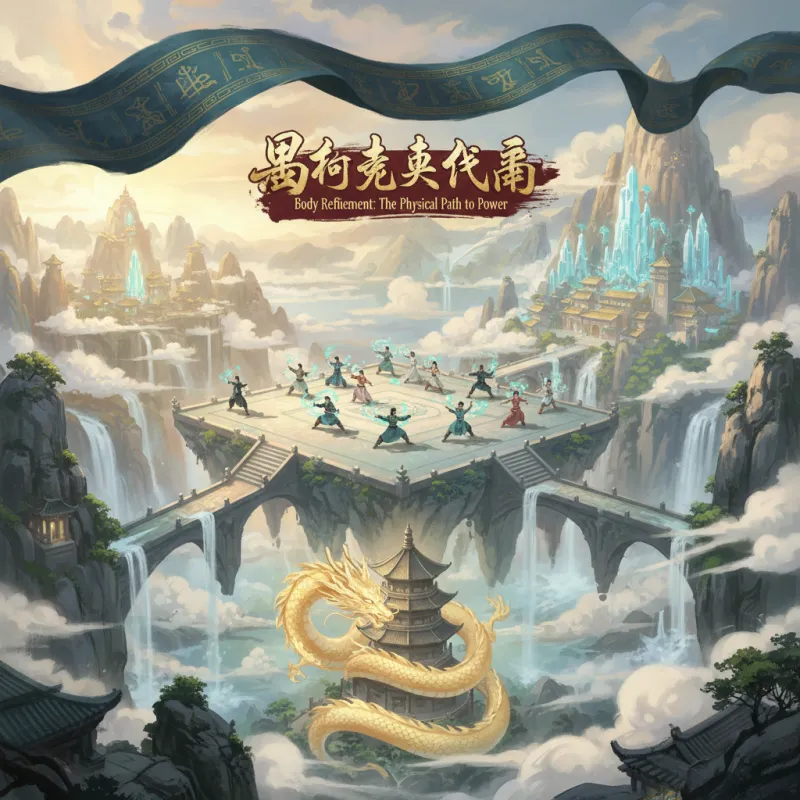
A young cultivator stands before a waterfall, fists bloodied from striking stone for twelve hours straight. His bones creak. His muscles scream. Yet he strikes again, because in the world of xianxia, spiritual enlightenment means nothing if your body shatters at the first tribulation lightning. This is body refinement (炼体, liàn tǐ) — the brutal, often overlooked foundation that separates those who ascend from those who become dust.
Why Body Refinement Gets No Respect
Here's the uncomfortable truth: most xianxia protagonists skip body refinement entirely. They stumble into a heaven-defying cultivation manual, absorb spiritual energy like a vacuum, and rocket through realms while their physical foundation remains as fragile as wet paper. Authors love this shortcut because it's fast, flashy, and gets readers to the good stuff — flying swords and spatial rings — within fifty chapters.
But the classics knew better. In Stellar Transformations (星辰变), Qin Yu spends years tempering his body through the meteor tears technique before even touching spiritual cultivation. In Coiling Dragon, Linley's body refinement through the Dragonblood Warrior lineage becomes his ultimate trump card. These aren't coincidences. Body refinement represents the difference between a glass cannon and an immortal foundation.
The concept draws from actual Daoist practices like neidan (内丹, internal alchemy) and traditional martial arts conditioning. Shaolin monks didn't achieve iron body techniques through wishful thinking — they conditioned bone, muscle, and fascia through years of progressive overload. Xianxia simply asks: what if you could take that principle to its logical extreme?
The Three Pillars of Physical Cultivation
Body refinement operates on three interconnected systems, each requiring different approaches and resources.
Bone Tempering (锻骨, duàn gǔ) comes first. Cultivators strengthen their skeletal structure through external pressure — striking iron trees, bathing in mineral-rich springs, or consuming beast bones ground into powder. The goal isn't just density but transformation. At higher levels, bones become jade-like, then crystalline, eventually transcending mortal material entirely. In I Shall Seal the Heavens, Meng Hao's Perfect Foundation includes bone refinement that makes his skeleton harder than magical treasures.
Muscle Forging (炼肉, liàn ròu) follows a different logic. Rather than bulk, cultivators pursue density and responsiveness. Each muscle fiber becomes a compressed spring of explosive power. The process often involves circulating qi through meridians while performing specific movements — think tai chi if each form could shatter boulders. Some techniques require cultivators to tear and rebuild muscle tissue repeatedly, a process as agonizing as it sounds.
Organ Refinement (炼脏, liàn zàng) represents the deepest level. Internal organs process spiritual energy, filter toxins, and house aspects of consciousness according to traditional Chinese medicine. The heart stores shen (神, spirit), the liver houses hun (魂, ethereal soul), the kidneys contain jing (精, essence). Refining these organs means transforming them into spiritual furnaces capable of processing increasingly pure energy. Mess this up, and you're coughing blood for the next hundred chapters.
Resources That Break the Bank
Body refinement is expensive, which explains why most cultivators can't afford it. Spiritual energy cultivation requires meditation and time — free resources. Physical cultivation demands materials.
Spirit beast blood ranks among the most common requirements. Not just any blood — it must come from creatures whose physical prowess matches or exceeds the cultivator's target realm. A Foundation Establishment cultivator needs Core Formation beast blood, which means either buying it at ruinous prices or hunting creatures that could tear them apart. The blood gets absorbed through the skin, drunk directly, or refined into pills. Each method has different efficiency rates and side effects.
Heavenly materials like thousand-year ginseng, jade marrow, or meteorite iron provide concentrated physical essence. These items appear in every xianxia economy, driving plot through scarcity. Protagonists steal them from young masters, find them in secret realms, or receive them from mysterious benefactors. The pattern repeats because body refinement creates constant resource pressure.
Extreme environments offer free alternatives for the desperate or clever. Cultivating under waterfalls, in volcanic caves, or during lightning storms subjects the body to natural tempering. It's slower and more dangerous than using pills, but it builds genuine foundation. This is why sect training grounds often include these features — they separate disciples willing to suffer from those seeking easy paths.
The Realm Problem
Here's where body refinement gets complicated: it doesn't map cleanly onto standard cultivation realms. A Qi Condensation cultivator might have a body refined to Foundation Establishment standards, creating a power mismatch that confuses both enemies and readers.
Some novels solve this with parallel systems. World of Cultivation uses separate tracks for sword cultivation, body cultivation, and spiritual cultivation. Others integrate body refinement into realm requirements — you can't advance to the next stage until your physical foundation meets minimum standards. The latter approach makes more sense from a worldbuilding perspective but creates pacing issues.
The most interesting novels treat body refinement as a multiplier. A cultivator with refined body at 50% of their spiritual realm fights like someone half a realm higher. At 100% parity, they punch above their weight class. At 150%+, they become the terrifying body cultivators who shrug off techniques and crush opponents through pure physical dominance.
When Body Cultivation Becomes the Path
Some cultivators abandon spiritual cultivation entirely, pursuing body cultivation (体修, tǐ xiū) as their primary path. These specialists appear as antagonists or side characters, demonstrating what happens when someone commits fully to the physical route.
Body cultivators develop different advantages. They're resistant to soul attacks, poison, and spatial techniques that target spiritual energy. Their recovery speed exceeds normal cultivators because their bodies function as self-contained healing systems. In prolonged battles, they outlast opponents who burn through spiritual energy reserves.
The tradeoffs are real. Body cultivators can't fly until much higher realms, lack ranged attack options, and struggle against formation arrays. They're also rarer because the resource requirements are even more demanding than hybrid approaches. But when a body cultivator reaches Nascent Soul equivalent? They become walking calamities that most spiritual cultivators can't handle.
Martial World and True Martial World by Cocooned Cow explore this path extensively, showing body cultivation as equally valid to spiritual cultivation. The protagonist Lin Ming balances both, but the novels make clear that pure body cultivators aren't inferior — just different.
The Foundation That Matters
Body refinement separates xianxia protagonists who feel earned from those who feel cheap. When a character survives tribulation lightning because they spent a hundred chapters tempering their body, it lands differently than plot armor. When they tank a sword strike that should have bisected them, we remember the training montages.
The best xianxia novels understand this. They make body refinement costly, time-consuming, and painful — then reward it proportionally. They show the protagonist's body as a cultivation project as important as their dantian or soul. Because in a genre where everyone can throw fireballs, the cultivator who can take a hit and keep fighting has something special.
Your body is your first treasure, your last defense, and the only thing you carry through every tribulation. Refine it accordingly.
Related Reading
- Dual Cultivation: Partnership in the Path to Immortality
- Pill Refining: The Alchemist's Art in Cultivation
- Spirit Beast Contracts: The Pokemon System of Cultivation Fiction
- Weapon Refining in Cultivation Fiction: Forging Swords That Think
- Mystical Beasts in Chinese Cultivation Fiction: Guardians of the Immortal Spiritual Realms