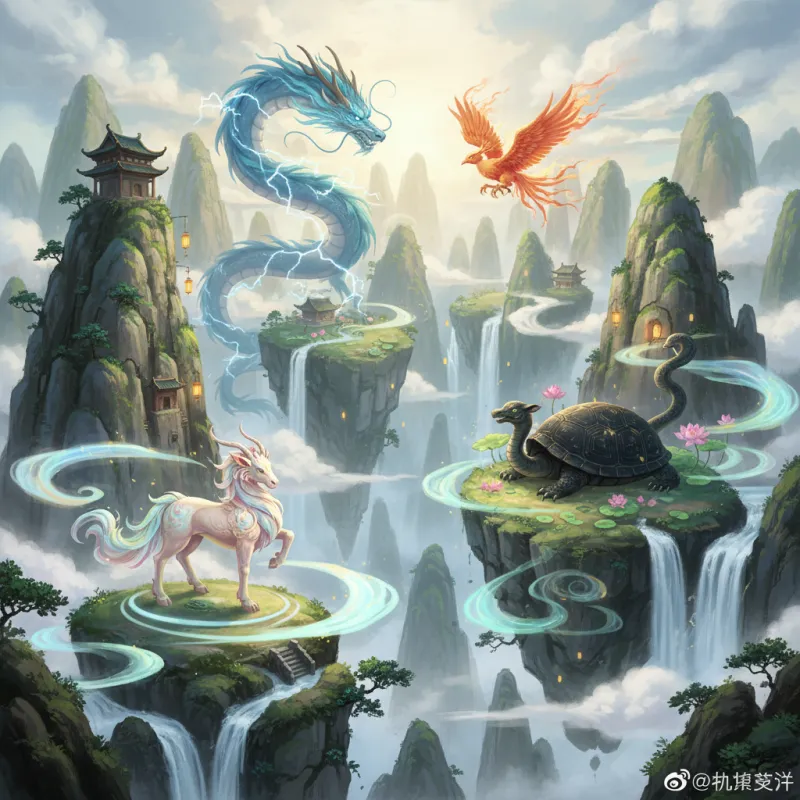
A dragon coils around a mountain peak, its scales shimmering with condensed spiritual energy that took ten thousand years to accumulate. Below, a young cultivator kneels, trembling—not from fear, but from the overwhelming pressure of facing a creature that has witnessed dynasties rise and fall. This scene, repeated across countless xianxia novels, captures something essential about mystical beasts in Chinese cultivation fiction: they're not just powerful monsters to defeat, but living embodiments of the Dao itself, teachers and obstacles on the path to immortality.
The Hierarchy of Spiritual Beasts: From Mortal to Divine
Unlike Western fantasy where dragons are simply powerful creatures, Chinese cultivation fiction operates on a strict hierarchy that mirrors the cultivation realms themselves. At the bottom, you have ordinary spirit beasts (灵兽, língshòu)—animals that have absorbed enough spiritual energy to gain intelligence and basic cultivation abilities. Think of the demonic wolves in I Shall Seal the Heavens that plague outer disciples, dangerous but ultimately fodder for anyone past the Qi Condensation stage.
Move up the ladder and you encounter demon beasts (妖兽, yāoshòu), creatures that have formed their own beast cores and can rival human cultivators in power. The White Tiger that serves as Meng Hao's companion in the same novel exemplifies this tier—intelligent, loyal, and capable of devastating attacks that would obliterate entire sects. These beasts often undergo tribulations just like human cultivators, facing heavenly lightning to advance their cultivation.
At the apex sit the divine beasts (神兽, shénshòu) and primordial beasts (太古凶兽, tàigǔ xiōngshòu). These aren't creatures you fight—they're forces of nature you negotiate with, flee from, or, if you're extraordinarily fortunate, form contracts with. The Azure Dragon, Vermillion Bird, White Tiger, and Black Tortoise—the Four Symbols (四象, Sìxiàng)—appear across countless novels as guardians of ancient inheritances or the mounts of long-dead immortal emperors. When Coiling Dragon introduces the Four Divine Beasts clans, it's not just worldbuilding; it's tapping into mythological archetypes that Chinese readers have internalized since childhood.
Blood Contracts and Beast Companions: The Symbiotic Path
The relationship between cultivator and beast in xianxia fiction goes far deeper than the typical fantasy "pet" dynamic. Blood contracts (血契, xuèqì) create genuine spiritual bonds that benefit both parties. When Lin Dong in Martial Universe forms a contract with the Ancient Dragon Ape, he doesn't just gain a powerful ally—he gains access to the beast's bloodline memories, cultivation insights accumulated over millennia, and a connection to primordial energies that would otherwise take centuries to comprehend.
This symbiosis reflects Taoist principles of harmony between humanity and nature. The cultivator provides protection, resources, and guidance through human cultivation techniques. The beast offers raw power, instinctual understanding of natural laws, and often access to secret realms or inheritances that only recognize their bloodline. It's a partnership, not ownership—and novels that forget this distinction usually feature beasts that eventually betray their "masters" in satisfying karmic justice.
The most compelling beast companions in cultivation fiction have their own character arcs. Little Flame in Tales of Demons and Gods starts as a weak spirit beast but grows alongside Nie Li, its evolution mirroring the protagonist's own journey. These aren't static power-ups; they're characters who struggle, make sacrifices, and sometimes die protecting their human partners in scenes that hit harder than many human character deaths.
Bloodlines and Inheritance: The Power in Ancient Veins
One of the most fascinating aspects of mystical beasts in cultivation fiction is the concept of bloodline inheritance (血脉传承, xuèmài chuánchéng). Unlike humans who must painstakingly comprehend cultivation techniques, beasts carry ancestral memories and abilities encoded in their very blood. A young phoenix doesn't need to learn how to manipulate fire—it's born understanding flames at a level that would take human cultivators centuries to achieve.
This creates interesting narrative dynamics. In Desolate Era, Ji Ning's encounters with ancient beasts often involve accessing their bloodline memories, glimpsing cultivation methods from the Primordial Era that have been lost to time. The blood of a true dragon can transform a mortal into a half-dragon cultivator, granting innate advantages but also attracting the attention of dragon clans who view such theft as blasphemy.
The bloodline concept also explains why certain beasts are hunted to near-extinction in these stories. A single drop of Qilin blood might contain insights into spatial laws. Phoenix feathers can be refined into pills that grant fire immunity. This creates a dark undercurrent in many novels—the systematic exploitation of spiritual beasts by human cultivators, a theme that Renegade Immortal explores with particular brutality. Wang Lin's journey includes witnessing entire beast populations slaughtered for cultivation resources, forcing readers to question whether the pursuit of immortality justifies such cruelty.
Sacred Beasts as Realm Guardians and Trial Masters
In the geography of cultivation fiction, mystical beasts serve as natural guardians of spiritual realms and secret dimensions. This isn't random—it's rooted in Chinese cosmology where certain creatures are intrinsically linked to specific locations and energies. The Azure Dragon guards the East, associated with wood element and spring. The Vermillion Bird protects the South, embodying fire and summer. These aren't just symbolic associations; they're fundamental laws of the cultivation universe.
When protagonists venture into ancient ruins or forbidden zones, they inevitably encounter beast guardians. These creatures serve multiple narrative functions: they test the protagonist's worthiness, protect inheritances from the undeserving, and maintain the balance of spiritual energy in their domains. The trials they present often require more than brute force—understanding the beast's nature, showing respect for ancient pacts, or demonstrating comprehension of the Dao principles the beast embodies.
A Record of a Mortal's Journey to Immortality handles this particularly well. Han Li's encounters with ancient beasts aren't just combat scenes; they're puzzles requiring knowledge of beast behavior, spiritual energy manipulation, and sometimes creative problem-solving. When he faces the Silvermoon Wolf King guarding a spatial node, victory comes not from overpowering it but from understanding its territorial instincts and offering a mutually beneficial arrangement.
The Dark Side: Demonic Cultivation and Beast Refinement
Not all interactions between cultivators and beasts are noble partnerships. Demonic cultivation (魔道, módào) often involves forcibly extracting beast cores, refining living creatures into puppets, or consuming their flesh to steal their power. This creates some of the most morally complex scenarios in cultivation fiction—is it acceptable to kill a spirit beast for its core if that power lets you protect your sect? Where's the line between necessary cultivation and wanton cruelty?
Reverend Insanity pushes this to extremes with its Gu cultivation system, where practitioners raise, refine, and consume spiritual insects and beasts as the primary cultivation method. Fang Yuan's ruthless efficiency in exploiting beast resources makes him a controversial protagonist, but it also forces readers to confront the logical endpoint of cultivation's "might makes right" philosophy.
The concept of beast refinement (炼兽, liànshòu) appears across the genre with varying moral implications. Some novels present it as a legitimate cultivation path—transforming beasts into loyal servants through careful nurturing and spiritual binding. Others depict it as a corrupting practice that degrades both beast and cultivator. The best novels use this ambiguity to explore questions about power, consent, and the cost of immortality.
Evolution and Tribulation: When Beasts Transcend Their Nature
Perhaps the most compelling narrative element involving mystical beasts is their potential for evolution and transcendence. Unlike static fantasy creatures, beasts in cultivation fiction can fundamentally transform their nature through cultivation, tribulation, and enlightenment. A common snake might cultivate for a thousand years, survive multiple heavenly tribulations, and eventually transform into a flood dragon (蛟龙, jiāolóng), then potentially into a true dragon (真龙, zhēnlóng).
These transformations aren't just power-ups—they represent genuine spiritual evolution. When a beast survives tribulation lightning, it's not merely getting stronger; it's being tested by the Heavens themselves, proving its worthiness to exist at a higher level of being. The tribulation clouds that gather when a beast attempts breakthrough are often more severe than those facing human cultivators, as if the universe itself resists creatures transcending their ordained nature.
Stellar Transformations explores this beautifully through Qin Yu's relationship with Hei Yu, a black eagle that evolves alongside him through multiple realms. Each transformation Hei Yu undergoes involves genuine risk—failure means death, success means rebirth into a higher form of existence. These aren't guaranteed progressions; they're desperate gambles that make each successful evolution feel earned and significant.
The Philosophical Foundation: Beasts as Dao Embodiments
At their core, mystical beasts in Chinese cultivation fiction represent something more profound than powerful allies or dangerous obstacles. They embody specific aspects of the Dao—the fundamental principles governing reality. A phoenix doesn't just use fire; it IS the principle of rebirth through destruction. A Qilin doesn't merely possess auspicious energy; it manifests the concept of harmony between all elements.
This philosophical grounding separates Chinese cultivation beasts from Western fantasy creatures. They're not random magical animals; they're living expressions of natural law. When a cultivator comprehends a beast's true nature, they're not just learning about that creature—they're gaining insight into the fundamental workings of the universe. This is why encounters with ancient beasts often trigger cultivation breakthroughs; the beast serves as a living scripture, demonstrating truths that would take lifetimes to comprehend through meditation alone.
The best cultivation novels understand this distinction. They don't just throw in dragons and phoenixes for cool factor—they use these creatures to explore deeper questions about existence, transformation, and the relationship between mortal and immortal realms. When done well, mystical beasts become some of the most memorable characters in the genre, their alien perspectives and ancient wisdom providing contrast to human ambition and mortality.
Related Reading
- The Enigmatic Beasts of Chinese Cultivation Fiction: A Journey Through the Spiritual Realms
- The Allure of Chinese Cultivation Fiction: A Journey Through Immortal Realms
- The Essence of Immortality: Understanding Chinese Cultivation and Xianxia Fiction
- Exploring the Intricate World of Chinese Cultivation and Xianxia Fiction