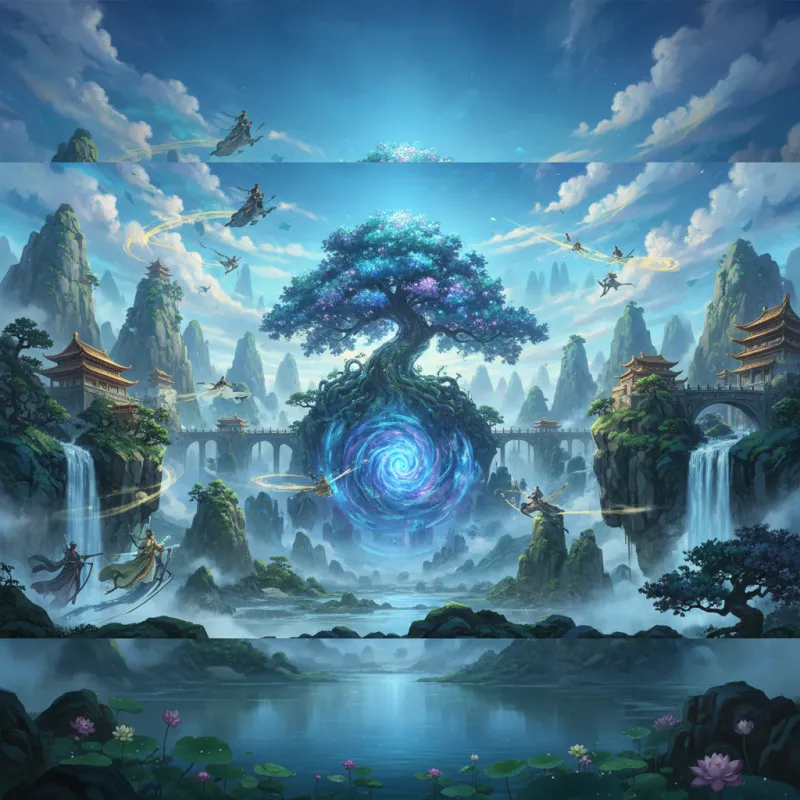
Picture this: a young orphan discovers a jade slip containing forbidden techniques, and within a decade, he's shattered the heavens themselves, leaving gods trembling in his wake. This isn't just fantasy—it's the beating heart of xianxia (仙侠, xiānxiá), a genre that's conquered Chinese webnovel platforms and now dominates international reading apps with billions of chapters consumed annually. What makes cultivation fiction so addictive that readers willingly dive into 2,000+ chapter epics?
The Daoist DNA of Cultivation Stories
Unlike Western fantasy's reliance on inherited bloodlines or chosen-one prophecies, cultivation fiction operates on a radically democratic premise: anyone can become a god through sheer determination and the right techniques. This concept springs directly from Daoist internal alchemy (内丹, nèidān), where historical practitioners like Ge Hong (283-343 CE) documented methods for refining qi (气, qì) and achieving transcendence. The Baopuzi (抱朴子), written in the 4th century, reads like a cultivation manual—complete with pill recipes, breathing techniques, and warnings about demonic tribulations.
Modern xianxia authors didn't invent these ideas; they gamified them. The Qi Condensation, Foundation Establishment, and Golden Core stages that structure novels like I Shall Seal the Heavens mirror the actual terminology from Daoist texts. Er Gen, the author, simply added numerical progression and flashy combat applications to concepts that Daoist monks spent lifetimes pursuing in mountain caves. The genius lies in making spiritual cultivation as tangible and measurable as leveling up in an RPG.
Why Cultivation Fiction Hits Different
The genre's explosive growth—from niche web serials in the early 2000s to a multi-billion dollar industry—reveals something profound about modern anxieties. In Coiling Dragon, the protagonist Li Linley spends 10,000 years in isolated cultivation to breakthrough a single realm. This resonates with readers grinding through education systems, corporate ladders, or skill development. The cultivation path validates delayed gratification in an age of instant everything.
But here's where it gets interesting: cultivation fiction is fundamentally optimistic in ways Western dark fantasy isn't. Yes, characters face betrayal, death, and cosmic injustice, but the universe operates on comprehensible laws. Master the Dao of the Sword, survive your tribulation lightning, and you will advance. Compare this to grimdark fantasy where heroes often fail despite doing everything right. Xianxia promises that effort compounds—a message that explains why it's particularly popular among students and young professionals in competitive Asian markets.
The Alchemy of Worldbuilding
What separates memorable cultivation novels from forgettable ones? Worldbuilding depth. Lord of the Mysteries by Cuttlefish That Loves Diving constructs 22 distinct beyonder pathways, each with nine sequences, complete with side effects, ritual requirements, and philosophical implications. The Fool pathway isn't just powerful—it embodies concepts of history, mystery, and the manipulation of fate itself. This level of systematic magic makes alchemy and pill refinement feel like actual sciences rather than plot devices.
The best authors understand that cultivation realms aren't just power levels—they're philosophical states. In Reverend Insanity, Fang Yuan's journey through the ranks reflects his evolution from human morality to something genuinely alien. By the time he reaches Venerable level, he's operating on timescales and value systems incomprehensible to mortals. The novel dares to ask: if you cultivate for 500 years, are you still the same person? Should you be?
The International Cultivation Craze
When Wuxiaworld launched in 2014, founder RWX (Ren Woxing) probably didn't anticipate creating a cultural phenomenon. Translating Coiling Dragon opened floodgates—suddenly, English readers discovered a fantasy tradition that didn't rely on Tolkien's tropes. The numbers tell the story: Webnovel reports over 200 million international users, with cultivation fiction dominating their top charts. Korean and Japanese authors now write cultivation-inspired works, creating fascinating hybrid genres.
This cross-pollination works both ways. Chinese authors increasingly incorporate Western fantasy elements—system notifications, dungeon mechanics, even isekai reincarnation plots. The Legendary Mechanic blends cultivation with sci-fi MMO mechanics. Lord of the Mysteries draws from Lovecraftian horror and Victorian aesthetics while maintaining cultivation's core progression structure. The genre's evolving faster than a protagonist breaking through realms during a life-or-death crisis.
The Dark Side of Immortality
Let's address the elephant in the cultivation cave: many xianxia novels feature morally questionable protagonists. Fang Yuan from Reverend Insanity massacres innocents for resources. Meng Hao in I Shall Seal the Heavens scams fellow cultivators without remorse. This isn't a bug—it's a feature exploring what happens when human ethics collide with immortal timescales and cosmic power scales.
The genre asks uncomfortable questions Western fantasy often avoids. If you need a rare herb to save your loved one, and harvesting it dooms a village, what do you do? If you've lived 10,000 years and everyone you knew is dust, do mortal lives still matter? These aren't hypotheticals—they're recurring dilemmas that force readers to examine their own ethical frameworks. The best cultivation novels don't glorify ruthlessness; they use it to explore the psychological cost of pursuing power across millennia.
Cultivation's Literary Future
The genre's maturation is evident in recent works that subvert classic tropes. Forty Millenniums of Cultivation reimagines cultivation in a socialist society where techniques are public goods, not hoarded secrets. Cradle by Will Wight (an American author) proves cultivation fiction works in Western settings when you understand its philosophical foundations. The realm progression systems that once seemed exotic now influence mainstream fantasy—Brandon Sanderson's magic systems show clear cultivation influence.
What's next? Expect more genre-blending experiments, deeper philosophical exploration, and perhaps a cultivation novel that finally breaks into mainstream Western literary circles. The core appeal—systematic progression, earned power, and the promise that dedication yields results—transcends cultural boundaries. In an uncertain world, cultivation fiction offers something increasingly rare: a universe where the rules are clear, effort matters, and transcendence is always possible for those willing to walk the path.
The jade slip is waiting. Will you begin your cultivation journey, or remain a mortal forever?
Related Reading
- Weapon Refining in Cultivation Fiction: Why Your Sword Has a Soul
- Unraveling the Essence of Tribulations in Chinese Cultivation Fiction
- Storage Rings: Spatial Magic in Cultivation