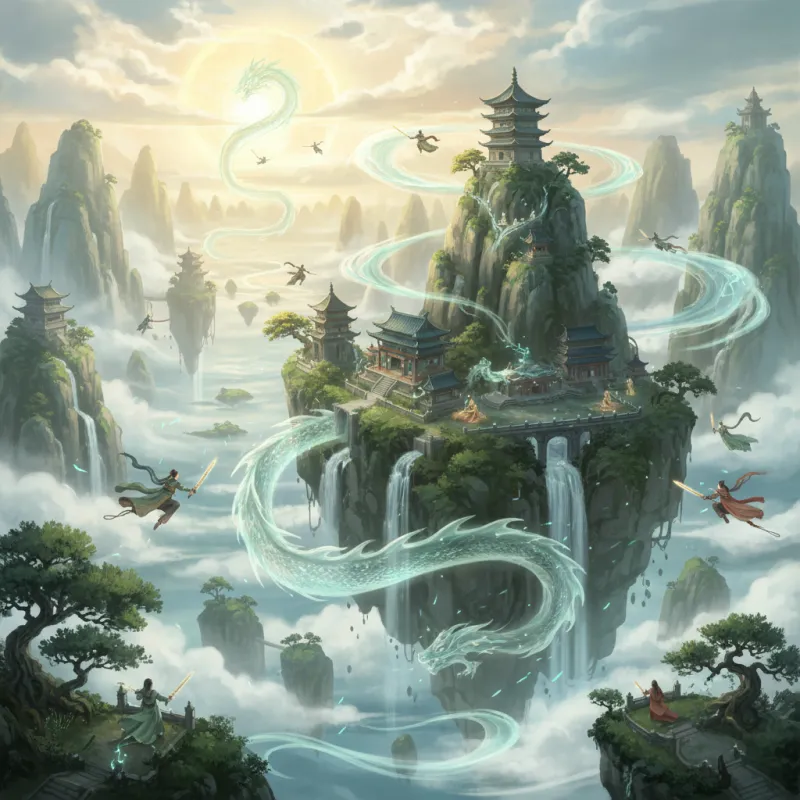
A young cultivator sits cross-legged on a mountain peak, drawing in the spiritual energy of heaven and earth with each breath. His meridians burn as qi flows through channels mapped by sages thousands of years before him. This scene—repeated in countless novels, web serials, and adaptations—captures the essence of xianxia (仙侠, xiānxiá), a genre that has transformed from obscure Daoist philosophy into a global literary phenomenon worth billions. But what makes these stories of immortal cultivation so compelling that millions refresh their browsers daily for the next chapter?
From Daoist Alchemy to Digital Pages
The roots of cultivation fiction stretch back to the Warring States period (475-221 BCE), when Daoist philosophers like Zhuangzi wrote of transcendent beings who "mounted the clouds and mist, rode the flying dragon, and wandered beyond the four seas." But the xianxia we recognize today didn't crystallize until the 1990s, when authors like Huang Yi began blending wuxia martial arts with explicit cultivation systems. His novel "Xun Qin Ji" (寻秦记, Seeking Qin) introduced structured power progression that would become genre standard. The real explosion came with the rise of web novel platforms like Qidian in the early 2000s, where serialized cultivation stories found their natural home. Writers could publish daily chapters, readers could comment in real-time, and the feedback loop created an evolutionary pressure that refined the genre's core elements into their current form.
The Cultivation System: More Than Power Levels
At the heart of every xianxia story lies the cultivation system—a structured path from mortal to immortal. The most common framework divides this journey into major realms: Qi Condensation (凝气, níng qì), Foundation Establishment (筑基, zhù jī), Core Formation (结丹, jié dān), Nascent Soul (元婴, yuán yīng), and beyond. Each realm represents not just increased power but fundamental transformation of the cultivator's existence. What distinguishes sophisticated xianxia from mere power fantasy is how these systems integrate with character development and worldbuilding. In "A Record of a Mortal's Journey to Immortality" (凡人修仙传), Han Li's methodical approach to cultivation—testing pills, mapping spirit veins, calculating resource efficiency—reflects the novel's core theme that immortality demands both talent and relentless pragmatism. The cultivation system becomes a lens for exploring questions about human nature, ambition, and the price of transcendence.
Heavenly Tribulations and Karmic Debt
The concept of heavenly tribulation (天劫, tiān jié) reveals xianxia's philosophical depth. When cultivators attempt to break through major realms, heaven itself strikes them with lightning, testing their worthiness to transcend mortal limits. This isn't arbitrary—it reflects the Daoist principle that defying natural order carries consequences. The tribulation system creates narrative tension while exploring themes of hubris and cosmic balance. Some novels like "Renegade Immortal" (仙逆) take this further, introducing karmic debt where every action—killing, stealing resources, even accepting help—accumulates spiritual weight that manifests during tribulation. Wang Lin's journey becomes a meditation on whether true transcendence is possible when built on others' suffering. These metaphysical mechanics aren't just plot devices; they're the genre's way of grappling with moral philosophy through fantastical frameworks.
Sects, Clans, and Cultivation Politics
The social structures of xianxia worlds mirror and exaggerate historical Chinese institutions. Cultivation sects function like martial arts schools, religious orders, and feudal states simultaneously. The Heavenly Sword Sect might control a region's spirit stone mines while the Profound Heaven Sect monopolizes pill refinement knowledge. This creates complex political landscapes where individual cultivation intersects with factional interests. "I Shall Seal the Heavens" (我欲封天) excels at depicting how sect politics shape cultivator psychology—Meng Hao's paranoid resourcefulness stems directly from growing up in a sect where disciples routinely poison each other for advancement opportunities. The genre's treatment of these institutions often critiques real-world power structures, showing how hierarchies based on strength inevitably breed corruption. For deeper exploration of these social dynamics, see Cultivation Sects and Their Hierarchies.
Alchemy, Artifacts, and the Dao of Crafting
Cultivation isn't just meditation and combat—it encompasses entire systems of mystical craftsmanship. Pill refinement (炼丹, liàn dān) draws from historical Chinese alchemy, where Daoist practitioners sought elixirs of immortality through mineral and herbal combinations. In xianxia, this becomes a sophisticated discipline with its own progression system. A Rank 1 alchemist might produce basic Qi Gathering Pills, while a Rank 9 grandmaster creates Heaven-Defying Pills that can resurrect the dead. Similarly, artifact refinement (炼器, liàn qì) and formation arrays (阵法, zhèn fǎ) provide alternative paths to power. What makes these systems narratively rich is how they create interdependencies—even the strongest cultivator needs pills to break through bottlenecks, creating economies and relationships that drive plot. "A Will Eternal" (一念永恒) uses its protagonist's incompetent alchemy attempts for comedy, but also explores how crafting disciplines require different mindsets than combat cultivation. For those interested in the technical aspects, check out The Art of Pill Refinement in Xianxia.
Realms Beyond: Ascending the Cosmic Hierarchy
The most ambitious xianxia novels don't stop at earthly immortality—they construct vast cosmological hierarchies. The mortal realm is merely the bottom rung, above which lie the Spirit Realm, Immortal Realm, Divine Realm, and beyond. Each higher plane operates under different laws, with denser spiritual energy and more powerful inhabitants. This vertical worldbuilding allows for endless escalation while maintaining narrative stakes. When the protagonist finally becomes the strongest in their realm, they discover they're merely a small fish in the next pond up. "Stellar Transformations" (星辰变) pioneered this approach, with Qin Yu's journey spanning from mortal world to the primordial chaos beyond all realms. The cosmological structure also enables philosophical exploration—what does it mean to be "immortal" if there are always higher powers? Is there a final realm, or does the hierarchy extend infinitely? These questions give the genre surprising metaphysical depth.
The Global Cultivation Phenomenon
Xianxia's international explosion began around 2014 when fan translators started rendering Chinese web novels into English. Websites like Wuxiaworld and Gravity Tales introduced Western readers to cultivation systems, and the response was overwhelming. The genre's appeal crosses cultural boundaries because it gamifies spiritual development in ways that resonate with global audiences raised on RPGs and progression fantasy. Korean and Japanese authors have created their own cultivation-inspired works, while Western writers increasingly incorporate xianxia elements into their fantasy novels. The genre has influenced game design, with cultivation mechanics appearing in everything from mobile games to major RPG releases. This cross-pollination is creating new hybrid forms—cultivation stories set in Western fantasy worlds, or xianxia that incorporates LitRPG system notifications. For more on how cultivation concepts translate across cultures, see Eastern and Western Cultivation Systems Compared.
Why We Keep Reading
The enduring appeal of xianxia lies in its fundamental promise: that dedicated effort can transcend all limitations. In a world where social mobility feels increasingly constrained, cultivation fiction offers a meritocratic fantasy where anyone with sufficient determination can become a god. But the best xianxia novels complicate this promise, showing how power corrupts, how the strong exploit the weak, and how the path to immortality is littered with moral compromises. They're power fantasies that question the value of power, progression stories that ask what we lose in our relentless pursuit of more. When that young cultivator on the mountain peak finally breaks through to the next realm, we celebrate not just his increased strength but his survival of another test in an endless journey. And then we click to the next chapter, because the Dao is long, and there are always higher peaks to climb.
Related Reading
- The Most Famous Pills and Elixirs in Cultivation Fiction
- Body Cultivation: The Path of Physical Transcendence
- Talisman Crafting in Cultivation Fiction: Writing Magic Into Reality