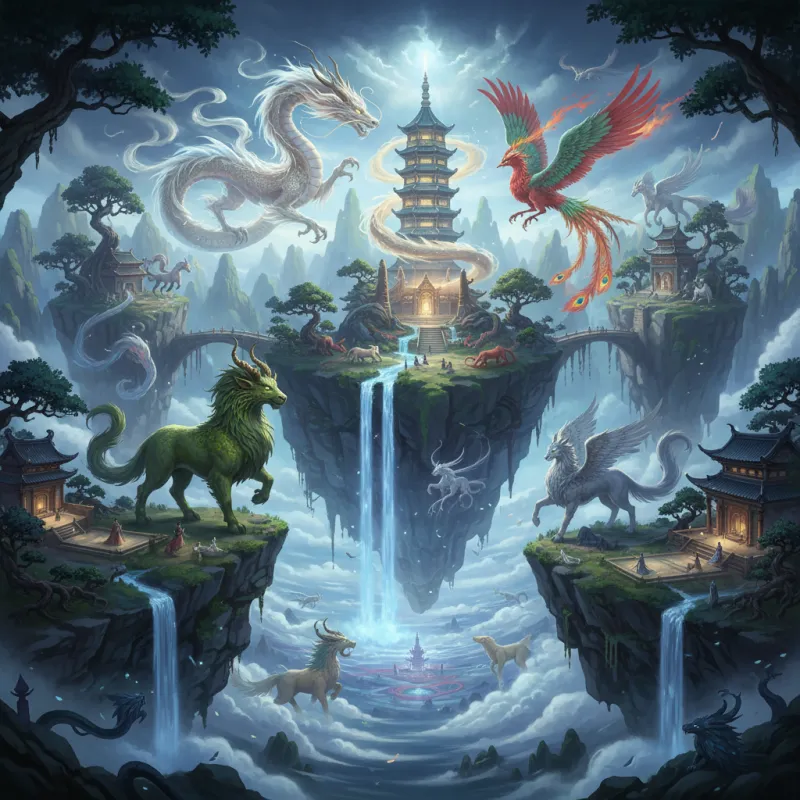
A white tiger materializes from morning mist atop Mount Kunlun, its fur rippling with patterns that spell out forgotten cultivation techniques. The beast's eyes hold the wisdom of ten thousand years, and a single roar can shatter a Golden Core cultivator's meridians. This isn't fantasy—it's Tuesday in a xianxia novel. But these enigmatic beasts represent far more than convenient plot devices or power-ups for protagonists. They're living repositories of Daoist cosmology, breathing manifestations of qi theory, and mirrors reflecting humanity's own cultivation journey.
The Taxonomy of Spiritual Beasts: More Than Just Monsters
Chinese cultivation fiction operates on a sophisticated hierarchy of beasts that would make Linnaeus weep with envy. At the foundation sit ordinary spirit beasts (灵兽, língshòu)—animals that have absorbed enough ambient qi to develop rudimentary intelligence and extended lifespans. Think of the spirit foxes in "A Record of Mortal's Journey to Immortality" that serve as scouts and companions, clever enough to understand commands but still bound by animal instincts.
Ascend one tier and you encounter demon beasts (妖兽, yāoshòu), creatures that have actively cultivated and formed beast cores (兽核, shòuhé) analogous to human cultivators' golden cores. These beings can rival Foundation Establishment or Core Formation cultivators in power. Er Gen's "I Shall Seal the Heavens" features the meat jelly—a seemingly absurd pink blob that's actually an ancient demon beast with cultivation surpassing most human characters. The meat jelly's transformation from comic relief to cosmic threat perfectly illustrates how demon beasts defy initial appearances.
Then come the true aristocrats: divine beasts (神兽, shénshòu) and sacred beasts (圣兽, shèngshòu). These creatures appear in classical texts like the "Classic of Mountains and Seas" (山海经, Shānhǎi Jīng) compiled during the Warring States period. The Azure Dragon, Vermillion Bird, White Tiger, and Black Tortoise—the Four Symbols (四象, Sì Xiàng)—represent cardinal directions and elemental forces. When "Coiling Dragon" introduces the Four Divine Beasts as actual characters with bloodlines and clan politics, it's drawing on two millennia of cultural mythology while adding xianxia's signature power-scaling absurdity.
Bloodlines and Inheritance: The Genetics of Transcendence
Modern xianxia has become obsessed with bloodline inheritance (血脉, xuèmài), and for good reason—it's a narrative goldmine. The concept allows authors to explain why some cultivators advance faster than others without resorting to pure talent or hard work. A protagonist with Azure Dragon bloodline doesn't just get cool powers; they inherit ancient memories, instinctive techniques, and a connection to primordial forces.
"Dragon-Marked War God" takes this to extremes, with its protagonist Jiang Chen possessing the bloodline of an ancient dragon that grants him innate understanding of dragon transformation techniques. But the most sophisticated treatment appears in "Renegade Immortal" where Wang Lin's encounters with various beast bloodlines—particularly the ancient Vermillion Bird—become catalysts for understanding the nature of cultivation itself. The bloodline isn't just power; it's a different lens for perceiving reality.
The bloodline awakening trope (血脉觉醒, xuèmài juéxǐng) has become so prevalent that it's spawned its own sub-genre. Characters discover they're descended from phoenixes, dragons, or qilins, usually at the most dramatically convenient moment. Critics dismiss this as lazy writing, but it reflects genuine Daoist concepts about inherited essence (精, jīng) and the transmission of spiritual qualities across generations. The cultivation realms themselves often require bloodline purification to advance beyond certain bottlenecks.
Beast Companions: More Than Pokémon with Chinese Characteristics
The beast companion (灵宠, língchǒng) relationship in xianxia transcends simple pet ownership. These bonds often involve soul contracts (灵魂契约, línghún qìyuē) that link cultivator and beast at fundamental levels. When done well, as in "Tales of Demons and Gods" with Nie Li's various spirit beast partnerships, these relationships explore themes of mutual growth, sacrifice, and the blurring of boundaries between human and animal consciousness.
The contracted beast typically grows alongside its master, advancing through beast cultivation stages that parallel human realms. A Qi Condensation cultivator might bond with a juvenile spirit fox, and both progress together through Foundation Establishment, Core Formation, and beyond. This creates narrative symmetry and allows for touching moments when beast and master protect each other—though cynics note it also conveniently provides protagonists with extra combat power.
But the most interesting beast companions subvert the loyal pet trope entirely. The aforementioned meat jelly from "I Shall Seal the Heavens" maintains its own agenda, occasionally abandoning the protagonist when better opportunities arise. The Lord Fifth parrot in the same novel speaks in third person, steals treasures, and treats its "master" Meng Hao with hilarious disdain. These characters work because they're not subordinates—they're partners with their own cultivation paths and personalities.
Transformation and Tribulation: When Beasts Become Human
The beast transformation (化形, huàxíng) represents one of xianxia's most philosophically rich concepts. After cultivating for centuries or millennia, powerful demon beasts can assume human form, usually after surviving a heavenly tribulation (天劫, tiānjié). This isn't mere shapeshifting—it's a fundamental transformation that allows beasts to cultivate human techniques and integrate into human society.
"Stellar Transformations" explores this brilliantly through its protagonist Qin Yu, who befriends numerous transformed beasts and eventually discovers the arbitrary nature of the human-beast distinction. If a ten-thousand-year-old demon beast in human form has cultivated longer and achieved higher realms than most humans, what makes them "beast" rather than "person"? The novel suggests that consciousness and cultivation achievement matter more than original form.
The transformation tribulation itself serves as narrative spectacle and philosophical examination. Heavenly tribulations in xianxia represent the universe's resistance to beings that defy natural order. A beast seeking human form challenges cosmic hierarchy, and the tribulation's severity reflects this transgression. Yet successful transformation proves the beast's worthiness—they've literally been tested by heaven and found acceptable. This mirrors Daoist concepts about transcending fixed categories and the fluidity of existence.
Sacred Beasts as Cosmic Forces and Plot Devices
At the apex of beast hierarchy sit creatures that transcend individual existence to become cosmic principles. The True Dragon (真龙, zhēn lóng) doesn't just breathe fire—it embodies the concept of imperial authority and celestial power. The Phoenix (凤凰, fènghuáng) represents rebirth and transformation itself. When "Desolate Era" introduces Chaos-level beasts that predate the current universe, it's not just power escalation; it's positioning these creatures as fundamental forces that shape reality.
These supreme beasts often serve as cultivation technique sources or inheritance opportunities. A protagonist who discovers an ancient phoenix's cave doesn't just find treasures—they access understanding of fire laws, rebirth cycles, and transformation principles that phoenixes embody. The beast becomes teacher, technique manual, and philosophical text simultaneously.
The danger lies in reducing these magnificent creatures to mere power-ups. Too many novels feature ancient divine beasts that exist solely to die dramatically and transfer their power to protagonists. "Against the Gods" occasionally falls into this trap, though it partially redeems itself by exploring the emotional weight of inheriting a dead beast's legacy. The best xianxia treats supreme beasts as characters with their own histories, motivations, and tragedies—beings whose power comes with the burden of cosmic responsibility.
The Philosophical Underpinning: Beasts as Mirrors
Ultimately, the enigmatic beasts of cultivation fiction serve as mirrors reflecting human nature and the cultivation journey itself. Beasts cultivate through instinct and natural absorption of qi, while humans use complex techniques and artificial methods. Yet both pursue the same goal: transcendence. This parallel suggests that the elaborate systems humans create—the sect hierarchies, the technique manuals, the pill refinement—might be unnecessary complications.
The beast who cultivates for ten thousand years in a mountain cave, slowly absorbing moonlight and spiritual energy, achieves the same realm as the human who frantically consumes pills, battles rivals, and schemes for resources. Which path is superior? Xianxia doesn't provide easy answers, but the question itself reveals the genre's philosophical depth.
When Wang Lin in "Renegade Immortal" finally understands that his cultivation has been too rigid, too human, and begins incorporating beast-like instinctive understanding, he breaks through bottlenecks that had stymied him for centuries. The beasts aren't obstacles or resources—they're alternative models of existence, different answers to the question of how to transcend mortality.
Beyond the Tropes: Where Beast Fiction Evolves
Contemporary xianxia increasingly subverts traditional beast tropes. "Reverend Insanity" features Gu worms—technically beasts but treated as tools, resources, and even philosophical concepts. "Lord of the Mysteries" incorporates Western monster mythology into its cultivation system, creating hybrid creatures that challenge pure Chinese beast taxonomy. These innovations suggest the genre's continued evolution.
The most exciting development involves beast protagonists. Novels like "Chrysalis" and "The Snake Report" (though Western, they're influenced by xianxia) place readers inside beast consciousness, experiencing cultivation from non-human perspectives. Chinese web novels are beginning to explore this space too, with stories following demon beast protagonists who view humans as the mysterious "other."
These enigmatic beasts—whether loyal companions, terrifying adversaries, or cosmic forces—remain central to cultivation fiction's appeal. They embody the genre's core promise: that through dedication and understanding, any being can transcend their original nature and touch the infinite. The white tiger on Mount Kunlun isn't just powerful; it's proof that enlightenment takes infinite forms, and the path to immortality winds through territories far stranger than human imagination alone could conjure.
Related Reading
- Mystical Beasts in Chinese Cultivation Fiction: Guardians of the Immortal Spiritual Realms
- From Mortal to Immortal: Every Stage Explained
- Body Cultivation: The Path of Physical Transcendence
- Pill Refining: The Alchemist's Art in Cultivation