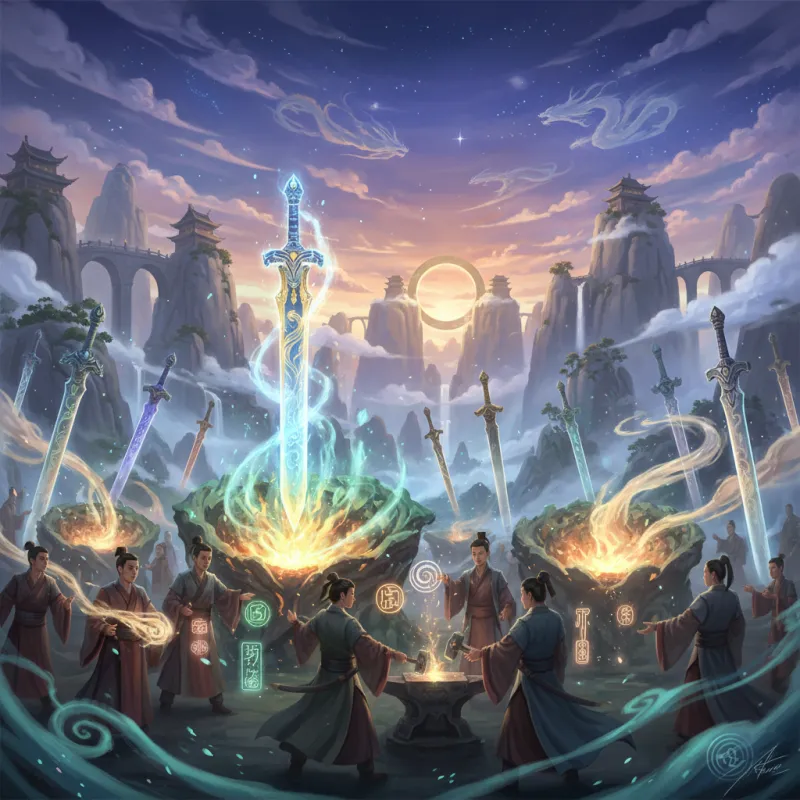
The sword screamed as it took its first breath. Not metaphorically — the blade actually shrieked, a sound like tearing silk and breaking glass, as spiritual energy flooded into the metal lattice and something that wasn't quite alive but definitely wasn't dead anymore opened what might generously be called eyes. The weapon refiner stumbled backward, bleeding from one ear, and thought: "I should have used less phoenix blood." This is weapon refining (炼器 liànqì) in cultivation fiction, where the line between crafting and creating life gets so blurry you need spiritual sense just to find it.
The Fundamental Difference: You're Not Making Tools
Here's what mortal blacksmithing is: applied metallurgy with excellent arm strength. Here's what weapon refining is: convincing the universe that this particular arrangement of matter deserves to break physics. A blacksmith heats metal until it's soft, then shapes it. A weapon refiner heats metal until it's spiritually receptive, then inscribes formation arrays (阵法 zhènfǎ) into its molecular structure while simultaneously binding it to elemental forces that don't technically exist in baseline reality.
The materials alone tell you everything. Mortal blacksmiths use iron, steel, maybe some bronze if they're feeling fancy. Weapon refiners use spirit iron (灵铁 língtiě) that hums when you touch it, ten-thousand-year cold jade (万年寒玉 wànnián hányù) that makes water freeze in a ten-meter radius, and the crystallized heartblood of spiritual beasts that died angry. One of these material lists produces farming implements. The other produces magical treasures (法宝 fǎbǎo) that can level mountains.
The end products aren't even in the same category. A mortal sword is a sharp piece of metal attached to a handle. A refined sword is a semi-autonomous entity with its own spiritual signature, combat instincts, and occasionally a personality disorder. In "Stellar Transformations," Qin Yu's weapon literally evolves alongside him, developing new abilities as he breaks through cultivation realms. Try getting that from your local blacksmith.
The Refining Process: Controlled Catastrophe
Every weapon refining session is essentially a small-scale apocalypse that you're trying to aim in a productive direction. The process has stages, and each one is an opportunity for spectacular failure.
Material preparation comes first. You're not just gathering ingredients — you're assembling a collection of spiritually active substances that would rather explode than cooperate. Spirit iron needs to be purified of mundane impurities while preserving its spiritual essence. Beast cores must be processed while they're still "fresh" (meaning the beast's resentment hasn't fully dissipated). Heavenly materials like star metal or thunder-struck wood require special handling because they're already halfway to being magical treasures on their own.
In "Martial World," Lin Ming spends three chapters just preparing materials for a single spear, because one of the components is a fire dragon's reverse scale that will incinerate anything it touches unless you suppress it with ice-attribute spiritual energy while simultaneously feeding it yang-attribute qi to keep it from going dormant. This is normal. Weapon refining is the art of juggling chainsaws while the chainsaws are on fire and also sentient.
Furnace heating is where things get interesting. You're not just making things hot — you're creating an environment where spiritual energy can flow freely enough to reshape matter at a fundamental level, but not so freely that everything explodes. The temperature isn't measured in degrees; it's measured in "how many formation arrays do I need to keep this contained." High-level refiners use specialized furnaces like the Nine Dragons Cauldron (九龙鼎 jiǔlóng dǐng) that can maintain different temperatures in different chambers simultaneously. Low-level refiners use whatever they can afford and pray a lot.
Array inscription is the step that separates weapon refining from very dangerous metalworking. While the materials are in their spiritually receptive state, you inscribe formation arrays directly into the weapon's structure. These aren't decorative engravings — they're functional programs written in the language of spiritual energy. A sharpness array makes the blade cut through things it physically shouldn't be able to cut. A lightness array reduces the weapon's effective weight without changing its mass. A spirit-gathering array lets the weapon absorb ambient spiritual energy and feed it to the wielder.
The complexity scales absurdly. A basic mortal-tier weapon might have one or two simple arrays. A heaven-tier treasure in "I Shall Seal the Heavens" has thousands of interlocking formations that create emergent properties nobody fully understands, including the person who made it. Meng Hao's copper mirror isn't just a weapon — it's a self-modifying system that rewrites its own arrays based on what it encounters.
Spirit binding is the final step and the most dangerous. You're taking all these materials and arrays and forcing them to become a unified entity with its own spiritual signature. This requires the refiner to pour their own spiritual energy into the weapon, creating a connection between maker and made. If you do it right, you get a magical treasure. If you do it wrong, you get a spiritual energy backlash that can cripple your cultivation or just kill you outright.
The really advanced refiners add one more step: spirit awakening. This is where you don't just create a magical treasure — you create a magical treasure with consciousness. A weapon spirit (器灵 qìlíng) is an artificial intelligence made of spiritual energy and crystallized intent, bound into the weapon during the refining process. It can communicate with its wielder, make tactical decisions in combat, and develop its own personality over time. In "Coiling Dragon," Linley's weapon Bloodviolet has a spirit that's been alive for millions of years and has opinions about everything.
Materials: The Weirder, The Better
The materials used in weapon refining read like a fantasy shopping list written by someone who's never heard of OSHA regulations. Spirit iron is the baseline — it's just iron that's been exposed to spiritual energy long enough to develop spiritual conductivity. From there, it gets progressively stranger.
Elemental materials are substances with strong affinities to specific elements. Sunfire gold (阳火金 yánghuǒ jīn) burns with perpetual flame. Deepwater silver (深水银 shēnshuǐ yín) is always cold and slightly damp. Galeforce copper conducts wind-attribute energy so efficiently that weapons made from it can cut from a distance. These materials don't just have elemental properties — they ARE elemental properties that happen to be solid.
Beast materials come from spiritual beasts and inherit their characteristics. A sword forged with dragon scales becomes supernaturally sharp and durable. A spear incorporating phoenix feathers gains fire attributes and regenerative properties. In "Desolate Era," Ji Ning uses materials from a Fiendgod's corpse to refine weapons that can harm other Fiendgods — the principle being that like affects like, and if you want to hurt something immortal, you need materials that remember what immortality feels like.
Heavenly materials are substances that formed under special circumstances and have properties that shouldn't exist. Star metal falls from the sky already refined by cosmic forces. Thunder-struck wood has been hit by tribulation lightning so many times it's developed lightning immunity and can store electrical energy. Void stone exists partially outside normal space and makes weapons that can cut through dimensional barriers. These materials are rare enough that finding one can be the plot of an entire novel arc.
The really exotic stuff defies categorization. In "A Record of a Mortal's Journey to Immortality," Han Li uses time-attribute materials that make his weapons age their targets, causing metal to rust and flesh to wither on contact. Other refiners use materials from the underworld, fragments of shattered immortal treasures, or crystallized karma. The rule is: if it's weird and spiritually active, someone has tried to make a sword out of it.
Grades and Classifications: The Power Ladder
Weapons in cultivation fiction are obsessively categorized because power levels are everything. The exact terminology varies by novel, but the general hierarchy is consistent.
Mortal-tier weapons are the bottom rung — they're refined using spiritual techniques but don't have enough spiritual energy to do anything truly supernatural. They're sharper and more durable than mundane weapons, but they won't fly or shoot energy blasts. These are what low-level cultivators use before they can afford anything better.
Spirit-tier weapons (灵器 língqì) are where things get interesting. They can store and channel spiritual energy, have basic formation arrays, and might have one or two special abilities. A spirit-tier sword might be able to extend its cutting edge with sword qi, or return to its owner's hand when thrown. These are the workhorses of the cultivation world — good enough to be useful, common enough to be affordable.
Treasure-tier weapons (法宝 fǎbǎo) are the real deal. They have complex formation arrays, can operate semi-autonomously, and have multiple special abilities. A treasure-tier sword can fly, fight independently, change size, and maybe transform into a dragon if you feed it enough spiritual energy. These are what serious cultivators use, and they're expensive enough that killing someone for their treasure is considered a legitimate career path in some novels.
Immortal-tier weapons (仙器 xiānqì) are for people who've transcended mortality and need weapons that can keep up. They're refined using immortal-grade materials and techniques that mortal refiners can't even comprehend. An immortal weapon might be able to cut through space, reverse time in a limited area, or contain an entire pocket dimension. In "Renegade Immortal," Wang Lin's weapon can seal souls and has enough spiritual energy to power a small sect for a century.
Beyond immortal-tier, the classifications get increasingly absurd. Chaos treasures, primordial weapons, universe-level artifacts — at a certain point, you're not talking about weapons anymore, you're talking about fundamental forces of reality that happen to be sword-shaped.
The Refiner's Cultivation: You Need Power to Make Power
Here's the catch: you can't refine weapons above your own cultivation level. A Foundation Establishment cultivator can't make Nascent Soul-tier treasures because they don't have enough spiritual energy to complete the binding process. This creates a direct correlation between a refiner's personal power and their professional capability.
Most weapon refiners are also combat cultivators because you need combat experience to understand what makes a weapon effective. The best refiners in cultivation fiction are usually people who've used weapons extensively and know exactly what they want. In "Tales of Demons and Gods," Nie Li is an exceptional refiner specifically because he's lived through countless battles and knows what features actually matter in combat versus what just looks impressive.
The refining process itself can be cultivation practice. Inscribing formation arrays requires precise spiritual energy control. Spirit binding demands massive energy reserves and fine manipulation. High-level refiners often break through to new cultivation realms during particularly difficult refining sessions because the process pushes their abilities to the limit.
Some cultivation methods are specifically designed for refiners. The "Myriad Refinements Body" technique in "World of Cultivation" lets practitioners absorb trace amounts of spiritual energy from materials they work with, gradually strengthening their bodies and expanding their energy reserves. Other methods focus on spiritual sense development because you need to perceive spiritual energy flows at a microscopic level to inscribe arrays properly.
Weapon Spirits: When Your Sword Has Opinions
The pinnacle of weapon refining is creating a weapon with its own consciousness — a weapon spirit (器灵 qìlíng). This isn't just making a smart weapon; it's creating artificial life that exists in a state of permanent symbiosis with its physical form.
Weapon spirits form during the spirit awakening process when the refiner intentionally leaves space in the weapon's spiritual structure for consciousness to develop. Some refiners use spirit beast souls as a foundation, binding a dying beast's consciousness into the weapon. Others use fragments of their own soul, creating a weapon that's literally part of themselves. The most advanced method is spontaneous awakening, where the weapon develops consciousness naturally from accumulated spiritual energy and combat experience — but this can take thousands of years.
A weapon spirit's personality depends on multiple factors: the materials used, the refiner's intent during creation, the weapon's combat history, and pure chance. Some spirits are loyal and helpful. Others are arrogant and demanding. In "Martial God Asura," Chu Feng's weapon spirit is a ancient expert who treats him like a disappointing student and constantly criticizes his technique.
The relationship between wielder and weapon spirit is complex. A cooperative spirit can dramatically enhance a weapon's effectiveness, providing tactical advice, managing the weapon's energy distribution, and even taking independent action in combat. A hostile spirit can refuse to activate the weapon's abilities or actively sabotage its wielder. Breaking in a new weapon spirit is like training a very powerful, very opinionated pet that can kill you if it gets annoyed.
Advanced weapon spirits can cultivate independently, growing stronger as they absorb spiritual energy and combat experience. In "Stellar Transformations," some ancient weapons have spirits more powerful than their current wielders, having survived multiple owners over millennia. These spirits are essentially immortal as long as their physical form remains intact, making them repositories of ancient knowledge and technique.
The Economics: Why Refiners Are Rich
Weapon refining is one of the most lucrative professions in cultivation fiction because everyone needs weapons and good ones are rare. A skilled refiner can name their price, especially for custom work. The economics work out because:
Materials are expensive. A single piece of ten-thousand-year cold jade might cost more than a mortal kingdom's annual tax revenue. High-level refiners need access to rare materials, which means they need either enormous wealth or connections to powerful organizations that can provide materials in exchange for refined weapons.
Failure rates are high. Even experienced refiners fail regularly, especially when working with new materials or attempting advanced techniques. Every failure destroys expensive materials and wastes time. Successful refiners charge enough to cover their failures and still make profit.
Demand exceeds supply. There are far more cultivators who need weapons than refiners who can make them. This is especially true at higher tiers — immortal-level refiners are so rare that they can essentially write their own contracts.
The really successful refiners don't just sell weapons; they sell services. Custom refinement, weapon repair, array inscription, spirit binding — each service commands premium prices. In "I Shall Seal the Heavens," Meng Hao makes more spirit stones from weapon refining than from most of his other schemes, and he's a professional schemer.
Some refiners work for sects or clans, receiving steady income and access to materials in exchange for producing weapons for the organization. Others are independent, traveling between cities and taking commissions. The most powerful refiners establish their own shops or auction houses, becoming wealthy enough to influence sect politics.
Modern Variations: When Authors Get Creative
Contemporary cultivation novels have started playing with weapon refining conventions in interesting ways. Some authors blend it with alchemy to create weapons that can be consumed for temporary power boosts. Others combine it with formation arrays to make weapons that are also defensive fortifications or transportation devices.
"Lord of the Mysteries" introduces the concept of sealed artifacts — weapons that contain dangerous entities or effects that must be carefully managed. The weapon isn't just a tool; it's a contained catastrophe that you're trying to aim at your enemies instead of yourself.
Some novels explore the idea of modular weapons that can be reconfigured for different situations. Instead of carrying multiple weapons, a cultivator has one weapon with interchangeable components, each providing different abilities. This requires incredibly sophisticated array work to maintain stability while allowing modification.
The most interesting innovation is probably living weapons — not weapons with spirits, but weapons made from living materials that grow and evolve. In "Reverend Insanity," Gu are living creatures used as weapons and tools, and cultivating them is a form of weapon refining that's more like animal husbandry than blacksmithing.
The Philosophy: What Does It Mean to Create Life?
At its highest levels, weapon refining raises uncomfortable questions about consciousness and creation. When you create a weapon spirit, have you created life? Does it have rights? Can you ethically destroy a weapon with a fully developed consciousness just because you want to harvest its materials for a better weapon?
Most cultivation novels ignore these questions because the protagonists are too busy fighting to worry about philosophy. But some authors engage with them directly. In "A Will Eternal," Bai Xiaochun accidentally creates a weapon spirit that's terrified of combat and has to figure out what to do with a sentient weapon that refuses to fight.
The relationship between refiner and creation mirrors the relationship between cultivator and the Dao. You're not just making things; you're imposing your will on reality and creating new patterns of existence. A weapon refiner who understands this can create treasures that transcend their apparent limitations because they're working with fundamental principles rather than just following techniques.
This is why the greatest refiners in cultivation fiction are often also philosophers or scholars. They understand that weapon refining isn't just a craft — it's a way of understanding how reality works and how consciousness emerges from matter and energy. When you can create a thinking sword, you've learned something profound about the nature of existence itself.
And sometimes that thinking sword screams when it wakes up, and you realize you've learned something profound about the nature of existence that you really wish you hadn't.
Related Reading
- Weapon Spirits: When Your Sword Has a Personality
- Weapon Grades in Cultivation Fiction: From Mortal Iron to Divine Artifacts
- Weapon Refining in Cultivation Fiction: Why Your Sword Has a Soul
- Weapon Spirits: When Your Sword Has Opinions
- Flying Swords: The Cultivator's Signature Weapon
- Cauldrons: Essential Tools for Pill Refining
- Mortal vs. Immortal Realm: The Two Worlds of Cultivation Fiction
- The Art of Immortal Cultivation: A Dive into Chinese Xianxia Fiction