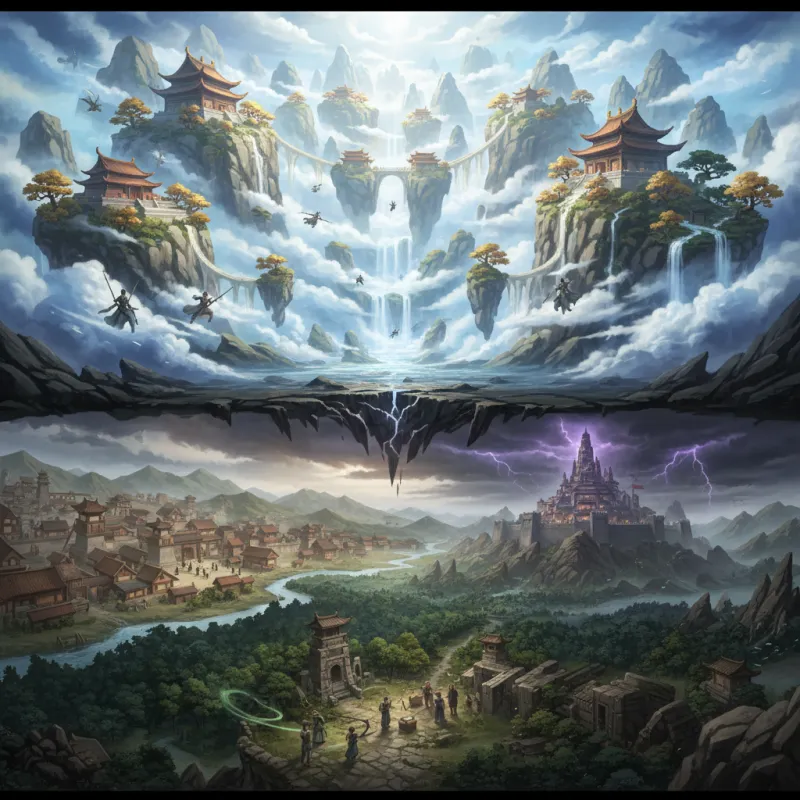
You've just become the strongest cultivator in existence. Emperors bow before you. Sects offer their sacred texts. Your name alone makes demons flee. Then you ascend to the immortal realm and get beaten up by a random guard at the city gate.
This is the mortal-to-immortal transition, and it's the most humbling moment in all of cultivation fiction. It's also one of the genre's most brilliant narrative devices—a complete power reset that forces protagonists to prove themselves all over again, except this time the stakes are cosmic and the competition is everyone who already survived the same journey.
The Mortal Realm: Where Legends Are Forged
The mortal realm (凡界 fánjiè) is where every cultivation story begins, and for good reason. It's the training ground, the tutorial level, the place where cultivators learn the fundamental truth of xianxia: strength is everything, and everything else is negotiable.
In novels like I Shall Seal the Heavens, Meng Hao spends hundreds of chapters in the mortal realm, progressing through stages like Qi Condensation (凝气 níngqì), Foundation Establishment (筑基 zhùjī), and Core Formation (结丹 jiédān). Each breakthrough feels monumental because within the mortal realm's context, it is. A Core Formation cultivator can flatten mountains. A Nascent Soul (元婴 yuányīng) expert can destroy cities. By the time you reach the Dao Seeking (问道 wèndào) stage, you're essentially a walking natural disaster.
But here's the thing about the mortal realm—it's not just weaker than the immortal realm. It's fundamentally limited. The spiritual energy (灵气 língqì) is thinner. The heavenly laws (天道 tiāndào) are less complete. Even the lifespan limits are brutal: most cultivators who don't ascend will eventually die of old age, no matter how powerful they become. The mortal realm has a ceiling, and that ceiling is absolute.
This creates the central tension of the first half of most cultivation novels: the race against time and tribulation to break through that ceiling before it crushes you.
Heavenly Tribulation: The Ultimate Entrance Exam
You can't just decide to ascend. The heavens have to try to kill you first.
Heavenly tribulation (天劫 tiānjié) is the universe's way of quality control. When a cultivator attempts to break through to the next major realm—especially when trying to ascend from mortal to immortal—the heavens themselves send down lightning tribulation (雷劫 léijié) to test whether they're worthy. Fail, and you die. Succeed, and you're reborn as something greater.
In Renegade Immortal, Wang Lin faces tribulations so severe they leave him half-dead even in victory. The novel makes it clear that tribulation isn't just a power check—it's the heavens' attempt to maintain balance by preventing too many mortals from ascending. The stronger your foundation, the more talented you are, the harder the tribulation tries to kill you. It's cosmic jealousy made manifest.
The tribulation clouds (劫云 jiéyún) that gather before ascension are typically described as world-ending phenomena. Nine-colored lightning. Tribulation fire that burns the soul. Sometimes even tribulation demons that take physical form. Other cultivators flee for hundreds of miles because being near someone else's tribulation can get you killed as collateral damage.
And if you survive? That's when the real shock begins.
The Immortal Realm: Starting Over at the Bottom
The moment you ascend (飞升 fēishēng) to the immortal realm (仙界 xiānjiè), everything changes. The spiritual energy is so dense it's almost solid. The space itself is more stable—techniques that could shatter continents in the mortal realm barely crack stone here. And every single person around you is someone who survived the same impossible journey you just completed.
In A Record of a Mortal's Journey to Immortality, Han Li ascends after dominating the mortal realm for centuries, only to discover he's now at the absolute bottom of the immortal realm's hierarchy. The cultivation stages start over: True Immortal (真仙 zhēnxiān), Golden Immortal (金仙 jīnxiān), and beyond. His mortal realm treasures? Mostly useless. His techniques? Crude and inefficient compared to immortal methods. His reputation? Nonexistent.
This is the genius of the two-realm system. It allows authors to do a complete narrative reset without actually resetting the character. Han Li is still Han Li—cautious, calculating, experienced. But his circumstances have changed so dramatically that he has to rebuild from scratch, and watching a clever, experienced cultivator navigate a new world with beginner-level power is infinitely more interesting than watching an overpowered protagonist steamroll everything.
The immortal realm also introduces new rules. Immortal stones (仙石 xiānshí) replace spirit stones as currency. Immortal qi (仙气 xiānqì) is qualitatively different from spiritual energy. Even the concept of lifespan and cultivation transforms—true immortals can live for millions of years, but they can still be killed, and the politics of beings who've been scheming for eons make mortal realm conflicts look like children's games.
The Power Scaling Problem (And How Two Realms Solve It)
Here's the dirty secret of cultivation fiction: power scaling is really hard to maintain across thousands of chapters. If your protagonist keeps getting stronger in a single continuous world, eventually they become so powerful that creating meaningful conflict becomes nearly impossible. How do you threaten someone who can destroy galaxies?
The mortal-immortal split elegantly solves this. It's essentially a soft reboot that preserves character development while resetting power dynamics. The protagonist keeps their personality, their techniques' foundations, and their hard-won wisdom, but they're once again in a world where they can be challenged, threatened, and forced to grow.
Martial World handles this particularly well. Lin Ming dominates the mortal realm, ascends, and immediately finds himself in a realm where his former peak strength is merely "acceptable." The novel can then spend another thousand chapters on his immortal realm journey without feeling repetitive because the context has completely changed.
Some novels even add a third realm—the divine realm (神界 shénjiè) or chaos realm (混沌界 hùndùnjiè)—for protagonists who outgrow even the immortal realm. It's the same trick applied again, and it works because the fundamental appeal remains: watching someone start from the bottom and claw their way to the top through intelligence, determination, and increasingly ridiculous power-ups.
The Psychological Reset: More Than Just Power Levels
The transition from mortal to immortal isn't just about power—it's about perspective. In the mortal realm, cultivators fight over sects, territories, and ancient grudges that might be a few thousand years old. In the immortal realm, those conflicts seem quaint.
Immortals think in terms of eons. They've seen mortal empires rise and fall like seasons. The "ancient" techniques that mortal cultivators kill each other over are often just simplified versions of immortal methods that were already outdated millions of years ago. This shift in temporal scale changes everything about how conflicts work.
In Desolate Era, Ji Ning's ascension forces him to confront the reality that his mortal realm achievements, while impressive, are footnotes in a much larger story. The enemies he defeated? Minor characters in the immortal realm's history. The treasures he collected? Interesting antiques at best. It's humbling in a way that pure power loss isn't, because it recontextualizes everything he thought he knew about cultivation itself.
This is also where the theme of dao comprehension becomes crucial. In the mortal realm, you can brute-force your way through many challenges with enough power. In the immortal realm, understanding the fundamental laws of reality becomes increasingly important. An immortal with deep dao comprehension can defeat opponents several stages above them, because they're not just using power—they're manipulating the rules of existence itself.
Why We Keep Reading After the Reset
The mortal-to-immortal transition could feel like a betrayal. You've invested hundreds of chapters watching the protagonist struggle to the peak, and now they're weak again? But when done well, it's actually the moment when cultivation novels prove their staying power.
Because here's what the reset preserves: competence. A protagonist who's reached the peak of the mortal realm has learned how to cultivate efficiently, how to fight smart, how to navigate dangerous politics, and how to survive against impossible odds. When they arrive in the immortal realm as a "weak" True Immortal, they're still carrying all that experience. They're not actually starting over—they're applying hard-won expertise to a new context.
Wang Lin from Renegade Immortal is terrifying in the immortal realm not because he's immediately powerful, but because he's already survived everything the mortal realm could throw at him. He knows how to hide, when to fight, and when to run. He's paranoid in the best possible way. The immortal realm's natives might be stronger, but they've never had to be as ruthlessly efficient as someone who clawed their way up from the absolute bottom.
This is why the two-realm structure works. It's not really a reset—it's an escalation. The challenges are harder, the stakes are higher, and the protagonist is more capable than ever, even if their raw power has been temporarily reduced. It's the cultivation fiction equivalent of New Game Plus: same character, harder difficulty, better rewards.
And honestly? Watching an experienced cultivator style on immortal realm natives who've never had to truly struggle is one of the genre's greatest pleasures.
Related Reading
- Mortal Realm to Immortal Realm: The Geography of Cultivation Worlds
- Cultivation World Geography: Understanding the Maps of Xianxia Fiction
- Cultivation Worlds: How Web Novels Build Entire Universes
- The Dao and Heavenly Laws: The Cosmic Rules of Cultivation
- The Enigmatic Beasts of Chinese Cultivation Fiction: A Journey Through the Spiritual Realms
- Heavenly Tribulation and Ascension: The Final Test of Cultivation
- Unlocking the Secrets of Chinese Cultivation and Xianxia Fiction