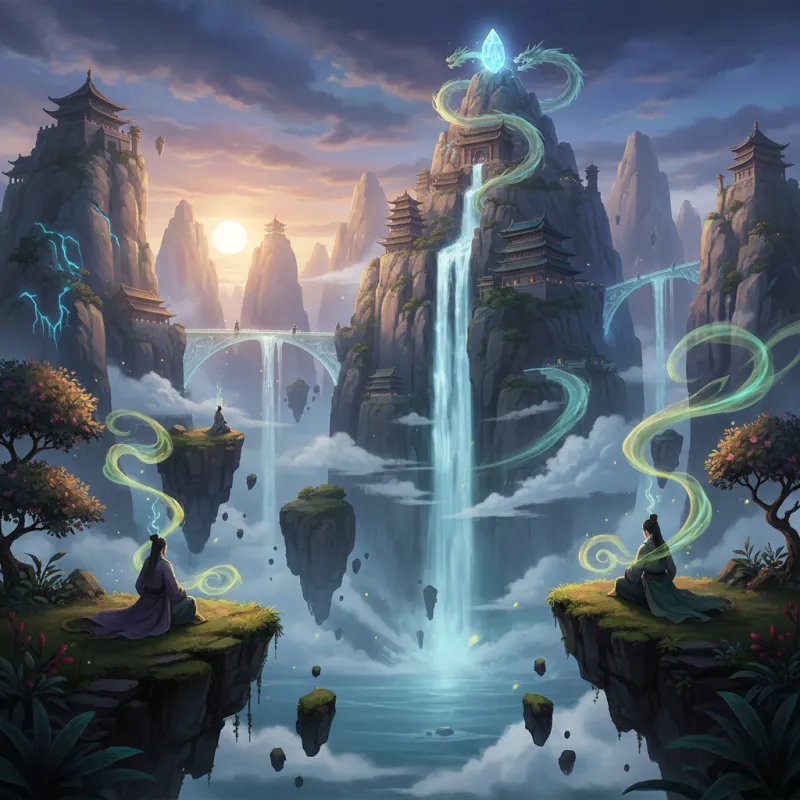
The first time you watch a cultivator shatter mountains with a gesture or split the heavens with a sword strike, you might think it's pure fantasy. But dig deeper into the philosophical bedrock of Chinese cultivation fiction, and you'll discover these "impossible" feats follow internal logic as rigorous as any physics textbook—just operating on different principles. The xianxia (仙侠, xiānxiá) genre isn't merely escapist fantasy; it's a literary tradition that transforms ancient Daoist alchemy, Buddhist cosmology, and Confucian ethics into narrative rocket fuel.
The Philosophical DNA: Where Immortals Are Made
Most Western readers stumble into cultivation novels expecting standard fantasy fare and get blindsided by the sheer systematization of power. This isn't accidental. The cultivation framework draws directly from neidan (内丹, nèidān)—internal alchemy—a legitimate Daoist practice dating back to the Tang Dynasty (618-907 CE). Historical figures like Lü Dongbin, one of the Eight Immortals, supposedly achieved transcendence through these very techniques, minus the face-slapping and jade beauties.
The core concept revolves around qi (气, qì), the vital energy permeating all existence. Unlike Western magic systems where power comes from external sources—wands, spells, gods—cultivation is fundamentally internal. You're not borrowing power; you're refining your own essence until you literally reconstruct your body at the molecular level. The Daodejing's famous line "the journey of a thousand miles begins with a single step" gets weaponized into a progression system where each realm represents a fundamental transformation of being.
What makes this brilliant for storytelling is the built-in conflict structure. Cultivation isn't just difficult—it's dangerous. Qi deviation (走火入魔, zǒuhuǒ rùmó) can shatter your meridians, cripple your cultivation base, or turn you into a demonic cultivator. The stakes are existential at every breakthrough, which is why cultivation realm systems create such compelling narrative tension.
The Realm Ladder: Why Everyone's Obsessed with Levels
If you've read any xianxia novel, you've encountered the realm system: Qi Condensation, Foundation Establishment, Core Formation, Nascent Soul, and so on. Critics dismiss this as video game logic, but they're missing the metaphysical point. Each realm represents a qualitative transformation, not just quantitative power increase.
Take the jump from Core Formation to Nascent Soul—you're not just getting stronger, you're birthing a second self, a spiritual infant that can survive your body's destruction. This mirrors Daoist concepts of the yang shen (阳神, yángshén), the immortal spirit body cultivated through meditation. When Meng Hao in I Shall Seal the Heavens forms his Nascent Soul, it's not a power-up cutscene; it's achieving what Daoist practitioners spent lifetimes attempting.
The genius of this system is how it gamifies enlightenment. Buddhist concepts like breaking through delusion become literal tribulation lightning (天劫, tiānjié) that you must survive. The Confucian emphasis on self-cultivation through study and discipline transforms into grinding techniques and comprehending dao insights. It's philosophy you can feel, which is why readers get genuinely invested in whether the protagonist reaches the next realm.
Modern novels have evolved increasingly complex variations. Reverend Insanity introduces a completely different system with Gu worms, while Lord of the Mysteries blends Western occultism with cultivation mechanics. But they all maintain that core principle: power through self-transformation, not external gifts.
Daoist Alchemy Meets Narrative Structure
Here's where it gets interesting for writers: the cultivation journey naturally creates a three-act structure on steroids. The early realms (Qi Condensation through Foundation Establishment) function as Act One—learning the rules, establishing stakes, building the foundation. Middle realms (Core Formation through Nascent Soul) are Act Two—complications, setbacks, the dark night of the soul made literal through tribulations. Upper realms (Soul Formation and beyond) become Act Three—confronting ultimate antagonists, resolving cosmic conflicts.
But unlike Western three-act structure, cultivation novels can nest these structures recursively. Each realm breakthrough is its own mini-arc with setup, conflict, and resolution. This is why cultivation novels can run for thousands of chapters without feeling padded—the structure is fractal. Alchemy and pill refinement follows similar patterns, with each successful concoction representing a micro-victory within the larger progression.
The historical precedent for this comes from Daoist texts like the Cantong Qi (周易参同契, Zhōuyì Cāntóng Qì), written around 142 CE, which describes alchemical transformation in stages. The text uses the I Ching's hexagrams to map spiritual development—essentially an ancient cultivation manual. Modern xianxia authors are, whether they realize it or not, working in a 2,000-year-old literary tradition.
The Tribulation Motif: Suffering as Transformation
Western fantasy often treats suffering as something to overcome and leave behind. Cultivation fiction makes suffering productive. Heavenly tribulations aren't just obstacles—they're the universe's quality control system. Survive, and you've proven your dao heart is solid. Fail, and you weren't worthy of the next realm anyway.
This reflects Buddhist concepts of dukkha (suffering) as inherent to existence, but with a Daoist twist: suffering can be refined into strength. When Wang Lin in Renegade Immortal endures tribulation after tribulation, each one tempering his resolve, it's not masochism—it's the narrative embodiment of the Buddhist/Daoist principle that enlightenment requires confronting and transcending suffering.
The tribulation clouds (劫云, jiéyún) that gather before breakthroughs have become iconic imagery in the genre. They're visually dramatic, sure, but they also represent the cultivator's karma manifesting as literal cosmic judgment. Your past actions, your dao comprehension, your very worthiness—all tested by lightning that can erase you from existence. It's high stakes made visceral.
Immortality's Price: The Dark Side Nobody Mentions
Here's what cultivation novels understand that most Western fantasy doesn't: immortality is terrifying. Not the achievement itself, but what it costs. To reach the upper realms, cultivators routinely sacrifice their humanity—sometimes literally. They watch mortal friends and family age and die. They make ruthless decisions that would horrify their younger selves. The phrase "the dao is heartless" (天道无情, tiāndào wúqíng) isn't just edgy philosophy; it's a warning label.
Reverend Insanity's Fang Yuan embodies this perfectly. He's not evil for evil's sake—he's what happens when someone pursues cultivation with absolute logical consistency, stripping away every human attachment that might slow his progress. It's uncomfortable to read because it asks: if you could live forever, what would you sacrifice? Your morality? Your relationships? Your very identity?
This connects to the Daoist concept of wuwei (无为, wúwéi)—effortless action through alignment with the dao. But taken to extremes, it becomes amorality. The universe doesn't care about human ethics, so why should an immortal? This tension between human values and cosmic indifference drives the best cultivation stories, creating protagonists who must navigate between becoming monsters and remaining fatally weak.
Why This Genre Conquered the Internet
Cultivation fiction exploded online because it's perfectly optimized for serial publication. The realm system provides clear progress markers. Each breakthrough is a natural climax. The power scaling can extend infinitely—there's always a higher realm, a stronger opponent, a deeper mystery. It's addictive by design, which is why novels like Coiling Dragon and Martial God Asura accumulated billions of views.
But beyond the addictive structure, cultivation fiction taps into something universal: the fantasy of self-improvement taken to its logical extreme. In a world where we're told to optimize ourselves—better bodies, sharper minds, higher productivity—cultivation novels ask "what if you could optimize everything?" What if discipline and effort could literally remake reality? It's the ultimate power fantasy for the self-help generation.
The genre's global spread also reveals something interesting about cultural exchange. Western readers initially struggled with concepts like face (面子, miànzi) and filial piety driving plot conflicts. But as the genre matured, these cultural elements became features, not bugs. Readers learned to appreciate the Confucian ethics underlying sect hierarchies and the Buddhist karma systems explaining why antagonists keep returning for revenge. Understanding cultivation techniques requires understanding the philosophy that birthed them.
The Future: Where Cultivation Fiction Goes Next
The genre is evolving rapidly. Authors are deconstructing tropes, blending cultivation with other systems, and exploring darker philosophical territory. Lord of the Mysteries proved you could marry cultivation mechanics to Lovecraftian horror. Forty Millenniums of Cultivation transplanted the genre into science fiction. The boundaries are dissolving.
What remains constant is that core appeal: the promise that through effort, discipline, and understanding, you can transcend your limitations. It's an optimistic message wrapped in a genre that regularly features genocide, betrayal, and cosmic horror. That contradiction—hope through ruthlessness, transcendence through suffering—is what makes cultivation fiction endlessly fascinating.
The ancient Daoist alchemists sought to transform lead into gold, base matter into immortal essence. Modern cultivation authors have achieved their own transmutation: turning philosophical treatises into addictive serial fiction that's conquered global readership. That's its own kind of immortality.
Related Reading
- Formation Arrays: The Strategic Art of Cultivation Warfare
- Dual Cultivation Explained: Beyond the Misconceptions
- Divine Sense: The Sixth Sense of Cultivators
- Cultivation Techniques: The Methods of Becoming Immortal
- Body Cultivation: The Path of Physical Transcendence
- Unraveling the Essence of Tribulations in Chinese Cultivation Fiction
- Talisman Crafting: The Art of Writing Magic
- Exploring the Intricate World of Chinese Cultivation and Xianxia Fiction