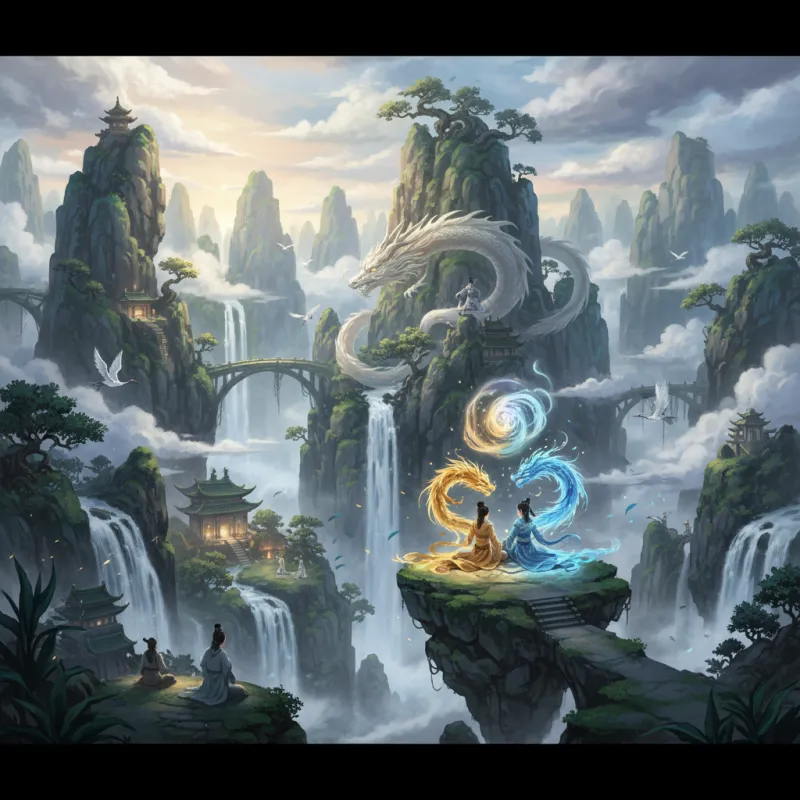
The first time you see "dual cultivation" mentioned in a xianxia novel, you probably know exactly where it's heading. Your suspicions are correct—but also incomplete. Yes, dual cultivation (双修 shuāngxiū) involves intimate partnership between cultivators. Yes, it's often used as narrative justification for romance scenes. But beneath the surface-level understanding lies a cultivation technique with genuine philosophical roots and surprisingly complex mechanics that most readers (and many authors) completely miss.
The Philosophical Foundation That Actually Matters
Dual cultivation isn't something web novelists invented to spice up their stories—it's rooted in centuries-old Daoist internal alchemy (内丹 nèidān) practices. The core concept draws from yin-yang (阴阳 yīnyáng) theory, but not in the simplistic "men are yang, women are yin" way that most cultivation fiction presents it. Historical Daoist texts like the Wuzhen Pian (悟真篇, "Awakening to Reality") from the Song Dynasty describe dual cultivation as the harmonization of complementary energies within a single practitioner's body—the "inner woman" and "inner man" that exist regardless of physical gender.
When this concept migrated into cultivation fiction, it got flattened. Modern xianxia typically treats dual cultivation as energy exchange between partners of opposite genders, where yang qi (阳气 yángqì) and yin qi (阴气 yīnqì) balance each other through physical union. This isn't entirely wrong—it's just a dramatically simplified version that prioritizes plot convenience over the nuanced energy work described in actual Daoist texts. The original practice involved meditation, breath control, and internal visualization, with physical partnership being one possible method among many.
How It Actually Works (In Fiction)
In cultivation novels, dual cultivation typically operates through one of three mechanical frameworks. The first and most common is the complementary energy model: two cultivators with opposing energy types exchange qi during intimate cultivation, allowing both to progress faster than solo practice. Think of it like Qi Condensation breakthroughs—you're still doing the fundamental work of refining energy, just with an external catalyst.
The second framework is the parasitic model, where one cultivator (usually male, usually villainous) drains their partner's cultivation to boost their own. This shows up constantly in stories as a way to establish that a character is irredeemably evil. The Against the Gods novel uses this extensively with the "Profound Handle" technique, where male cultivators steal female cultivators' pure yin energy. It's dual cultivation's dark mirror—all the mechanics, none of the mutual benefit.
The third and rarest framework is the resonance model, where partners don't exchange energy but synchronize their cultivation, allowing them to punch above their weight class when working together. Martial World explores this with Lin Ming and his companions, where their combined techniques become exponentially more powerful through cultivation resonance. This version actually comes closest to historical Daoist concepts of harmonizing internal energies.
The Consent Problem Nobody Talks About
Here's where cultivation fiction gets uncomfortable: dual cultivation creates a power dynamic nightmare. When your cultivation progress—your literal survival in a world where strength determines everything—depends on intimate partnership, how free is anyone's choice really? Novels rarely address this. Female characters "need" dual cultivation to break through bottlenecks. Male protagonists "happen" to be the only suitable partner. The narrative treats this as romantic destiny rather than the coercive situation it obviously is.
Some novels do better. A Record of a Mortal's Journey to Immortality treats dual cultivation as a legitimate but optional technique, no more inherently necessary than pill refinement or formation arrays. Han Li encounters dual cultivation practitioners but never needs the technique himself, which reinforces that it's one path among many. Contrast this with novels where the female lead's cultivation will literally stagnate forever without the male protagonist's "help"—that's not romance, that's manufactured dependency.
The better-written stories establish clear rules: both partners must consent, both must benefit equally, and alternative cultivation paths must exist. When these conditions aren't met, you're not reading about dual cultivation—you're reading about exploitation with cultivation terminology painted over it.
Yin-Yang Beyond Gender Essentialism
Most cultivation fiction treats yin and yang as synonymous with female and male, which is both historically inaccurate and narratively limiting. Classical Daoist texts describe yin and yang as qualities that exist in everything, regardless of gender. Yang represents activity, expansion, heat, and light. Yin represents receptivity, contraction, coolness, and darkness. Every person contains both; cultivation involves balancing them internally.
This opens narrative possibilities that most authors ignore. What about dual cultivation between same-gender partners with different elemental affinities? A fire cultivator (yang-dominant) and water cultivator (yin-dominant) could theoretically practice dual cultivation regardless of gender. Grandmaster of Demonic Cultivation hints at this with Wei Wuxian and Lan Wangji's cultivation compatibility, though it never explicitly frames their relationship as dual cultivation.
The gender essentialism also creates weird logical problems. If women are inherently yin and men inherently yang, why do female cultivators practice yang-attributed fire techniques? Why do male cultivators use yin-attributed water methods? The novels want to have it both ways—gender-locked dual cultivation but gender-neutral technique compatibility. It's philosophically inconsistent, even by xianxia standards.
When Authors Actually Do Their Homework
Occasionally, you encounter a cultivation novel where the author clearly researched historical Daoist practices. Forty Millenniums of Cultivation treats dual cultivation as advanced energy manipulation requiring precise control and mutual understanding—closer to performing surgery together than the typical portrayal. The novel emphasizes that dual cultivation's effectiveness comes from perfect synchronization of cultivation techniques, not from gender-based energy exchange.
Lord of the Mysteries takes a different approach, incorporating Western esoteric traditions alongside Chinese cultivation concepts. Its version of dual cultivation (though not called that) involves partners anchoring each other during dangerous advancement rituals, providing spiritual stability rather than energy exchange. This reflects actual historical practices from both Daoist and Western alchemical traditions, where partnership served protective rather than exploitative functions.
These examples prove that dual cultivation can be more than narrative convenience or fan service. When authors treat it as a complex technique with specific requirements, risks, and alternatives, it becomes genuinely interesting worldbuilding. When they treat it as "protagonist needs romantic subplot," it becomes exactly the shallow trope everyone assumes it is.
The Cultivation Stage Question
Here's a practical consideration most novels gloss over: at what cultivation stage does dual cultivation even become possible? If you're still in Qi Condensation, you barely have enough qi to maintain your own cultivation—sharing it seems counterproductive. Foundation Establishment (筑基 zhùjī) makes more sense, as your qi reserves are stable enough to circulate externally. But most novels have characters attempting dual cultivation at absurdly low levels, which should theoretically cripple both partners.
The stage-appropriate approach would treat dual cultivation like Core Formation techniques—something you attempt only after establishing a solid foundation. Early-stage dual cultivation should be dangerous, potentially fatal, and definitely not something you try because you're romantically interested in someone. The novels that enforce this restriction (rare as they are) create much more interesting tension. Characters must choose between accelerating their cultivation through risky dual cultivation or taking the slower, safer solo path.
Beyond the Bedroom: Dual Cultivation's Unexplored Potential
The fixation on intimate dual cultivation means authors ignore other partnership-based cultivation methods. Battle formation cultivation, where multiple cultivators synchronize their techniques in combat, is essentially dual cultivation without the romance subplot. Sect-wide cultivation arrays that pool disciples' qi for breakthrough assistance? Also dual cultivation, just scaled up. The core concept—harmonizing complementary energies for mutual benefit—applies far beyond romantic partnerships.
Imagine a cultivation novel where dual cultivation referred primarily to master-disciple energy transmission, or sibling cultivators who developed synchronized techniques from childhood. These relationships could explore the same themes of trust, compatibility, and mutual growth without the problematic power dynamics that plague romantic dual cultivation. Some novels touch on this—Coiling Dragon has Linley and Bebe's soul contract creating cultivation resonance—but rarely frame it as dual cultivation proper.
The term itself has become so associated with romance that authors avoid using it for non-romantic partnerships, even when the mechanics are identical. This is a missed opportunity. Dual cultivation as a broader category of cooperative cultivation techniques could enrich worldbuilding significantly.
The Verdict: Technique or Trope?
So is dual cultivation a legitimate cultivation technique or just an excuse for spicy scenes? The honest answer: it depends entirely on the author's intent and execution. The philosophical foundation exists. The mechanical possibilities are genuinely interesting. But the way most cultivation fiction deploys dual cultivation—as inevitable romantic destiny that conveniently requires intimate partnership—undermines its potential as serious worldbuilding.
The best cultivation novels treat dual cultivation like any other advanced technique: optional, risky, requiring specific conditions and compatibility, with clear alternatives available. The worst treat it as mandatory for female characters' progression while male protagonists somehow advance just fine solo. If you're reading a novel where dual cultivation only ever benefits the male lead, you're not reading about cultivation—you're reading poorly disguised wish fulfillment.
Dual cultivation could be fascinating. It usually isn't. But when authors actually engage with the concept's philosophical roots and mechanical implications, it becomes one of the more interesting aspects of cultivation fiction. The potential is there. Most authors just choose not to explore it.
Related Reading
- Body Cultivation: The Path of Physical Transcendence
- Sword Cultivation: Becoming One with the Blade
- Formation Arrays: The Strategic Art of Cultivation Warfare
- Cultivation Techniques: The Methods of Becoming Immortal
- Divine Sense: The Sixth Sense of Cultivators
- Exploring the Fascinating Characters of Chinese Cultivation and Xianxia Fiction
- Ancient Sects and Spiritual Realms in Chinese Cultivation and Xianxia Fiction
- Exploring the Intricate World of Chinese Cultivation and Xianxia Fiction