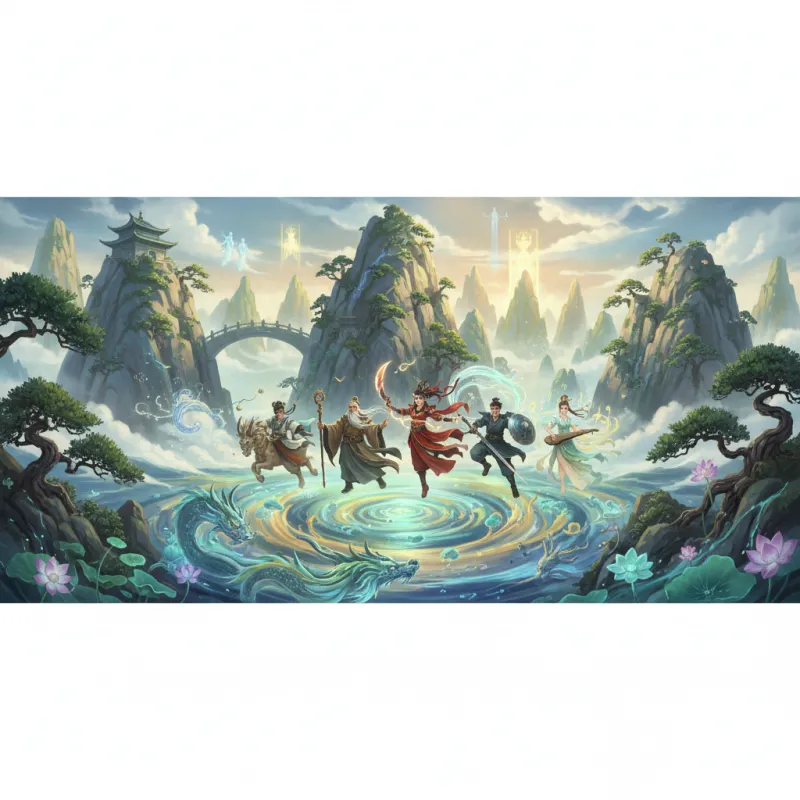
When Wei Wuxian plummets from a cliff in Mo Dao Zu Shi (魔道祖师, Módào Zǔshī), only to awaken thirteen years later in another man's body, he embodies something essential about xianxia characters: they refuse to stay dead, refuse to accept limits, and refuse to play by the rules everyone else follows. This defiance—whether against heaven, fate, or the cultivation world's rigid hierarchies—defines the most memorable figures in Chinese cultivation fiction. But what makes these characters so compelling isn't just their supernatural abilities or their quest for immortality. It's how they navigate the brutal contradiction at the heart of xianxia: the path to transcendence requires both ruthless ambition and unwavering moral conviction.
The Protagonist Paradox: Genius or Underdog?
Xianxia protagonists typically fall into two camps, though the best ones blur the line between them. There's the heaven-defying genius like Meng Hao from I Shall Seal the Heavens (我欲封天, Wǒ Yù Fēng Tiān), who possesses innate talent that makes elders weep and rivals gnash their teeth. Then there's the scrappy underdog like Linley Baruch from Coiling Dragon (盘龙, Pánlóng), who starts with mediocre spiritual roots but compensates through sheer determination and fortuitous encounters.
What's fascinating is how these archetypes reflect Daoist and Buddhist philosophies about potential and enlightenment. The genius represents sudden enlightenment (顿悟, dùnwù)—the idea that some souls are simply closer to the Dao. The underdog embodies gradual cultivation (渐修, jiànxiū)—the belief that persistent effort can overcome any limitation. Er Gen, one of the most influential xianxia authors, deliberately plays with this in A Will Eternal (一念永恒, Yī Niàn Yǒng Héng), where protagonist Bai Xiaochun is simultaneously a coward and a genius, terrified of death yet somehow stumbling into breakthrough after breakthrough.
The protagonist's relationship with their cultivation realm progression reveals character in ways Western fantasy rarely explores. When a character breaks through from Foundation Establishment (筑基, Zhùjī) to Core Formation (金丹, Jīndān), it's not just a power-up—it's a fundamental transformation of their existence, their perception, even their lifespan. The best xianxia writers use these breakthroughs as character development milestones, moments when protagonists must confront who they've become in their pursuit of power.
Mentors and Masters: The Weight of Inheritance
The master-disciple relationship (师徒关系, shītú guānxì) in xianxia carries weight that Western mentor figures rarely achieve. When Yun Che in Against the Gods (逆天邪神, Nì Tiān Xié Shén) inherits techniques from his deceased master, he's not just learning skills—he's carrying forward a lineage, avenging grudges, and fulfilling oaths that span generations. This reflects the Confucian emphasis on filial piety and the transmission of knowledge through proper channels.
But xianxia fiction also loves subverting this dynamic. The "evil master" trope, where a demonic cultivator raises a disciple with ulterior motives, appears repeatedly because it creates delicious moral complexity. In Grandmaster of Demonic Cultivation, Wen Ruohan's treatment of his subordinates contrasts sharply with Lan Qiren's rigid but protective approach to his nephews, showing how cultivation sects function as extended families with all the dysfunction that implies.
The most memorable masters aren't the all-powerful immortals who solve every problem. They're figures like Qing Shui's grandfather in Ancient Strengthening Technique, who dies early but whose teachings echo through hundreds of chapters. Or the eccentric hermits who appear for three chapters, drop cryptic wisdom, and vanish—leaving protagonists to figure out whether that advice was profound insight or the ramblings of someone who's lived too long.
Antagonists: More Than Stepping Stones
Weak xianxia reduces villains to "young masters" (少爷, shàoyé) who exist solely to be face-slapped and killed. Strong xianxia creates antagonists with their own cultivation paths, their own justifications, their own tragic backstories. The difference matters enormously.
Consider Leylin Farlier from Warlock of the Magus World—technically the protagonist, but so ruthlessly pragmatic that he functions as his own antagonist, constantly wrestling with the cost of his choices. Or Meng Hao's various rivals in I Shall Seal the Heavens, many of whom start as enemies but evolve into complex figures with their own arcs. The best antagonists in xianxia aren't evil—they're cultivators who made different choices at crucial junctures, who prioritized power over compassion or vice versa.
The "demonic cultivator" (魔修, móxiū) archetype deserves special attention because it exposes xianxia's moral ambiguity. These characters practice forbidden techniques, often involving blood sacrifice or soul manipulation, yet the line between righteous and demonic cultivation is frequently arbitrary. Reverend Insanity (蛊真人, Gǔ Zhēnrén) takes this to its logical extreme with Fang Yuan, a protagonist who embraces demonic methods without pretense of righteousness. His character asks uncomfortable questions: if the goal is immortality and transcendence, why should cultivators limit themselves with mortal morality?
Female Characters: Beyond the Jade Beauty
Let's address the elephant in the cultivation cave: xianxia has a well-deserved reputation for reducing female characters to "jade beauties" who exist primarily as romantic interests or motivation for male protagonists. The genre's roots in male-oriented web fiction show clearly here.
But dismissing all xianxia female characters as flat would ignore significant exceptions and recent evolution. Ning Que's relationship with Sang Sang in The Way of Choices (择天记, Zé Tiān Jì) subverts expectations by making her the actual reincarnation of a deity while he's the ordinary one. Meng Hao's wife Xu Qing in I Shall Seal the Heavens starts as a typical love interest but develops into a cultivator with her own path and agency.
Female-authored xianxia and the related genre of cultivation romance (修真言情, xiūzhēn yánqíng) offer different perspectives entirely. Works like The Husky and His White Cat Shizun (二哈和他的白猫师尊, Èr Hā Hé Tā De Bái Māo Shīzūn) center emotional complexity and relationship dynamics in ways male-authored xianxia typically doesn't. The characters in these works pursue immortality not just for power but for the chance to spend eternity with loved ones—a fundamentally different motivation that reshapes the entire narrative.
The matriarch archetype—powerful female cultivators who lead sects or families—appears frequently but often remains underdeveloped. When done well, like the Ice Phoenix Palace Master in various works, these characters demonstrate that female cultivators can achieve the same heights as male ones without sacrificing their femininity or becoming masculine stereotypes.
Side Characters: The Cultivation World's Ecosystem
Xianxia's scope allows for sprawling casts that populate entire cultivation worlds. The best series treat side characters as protagonists of their own stories who happen to intersect with the main narrative. Wang Lin's journey in Renegade Immortal (仙逆, Xiān Nì) features dozens of memorable side characters, each with distinct personalities, cultivation paths, and fates. Some become allies, some enemies, some simply pass through—but all feel like real cultivators pursuing their own immortality.
The "comic relief" companion appears in almost every xianxia, often as a rotund, gluttonous cultivator or a lecherous old man with surprising depths. These characters serve important functions beyond humor—they humanize the protagonist, provide perspective on the cultivation world's absurdities, and often deliver the story's most poignant moments. When Bei Xiaobei in A Will Eternal reveals his tragic past, it recontextualizes hundreds of chapters of his buffoonish behavior.
Sect brothers and sisters (师兄弟, shīxiōngdì) create found families that contrast with blood relations. The bonds formed through shared cultivation, surviving tribulations together, and protecting each other from rival sects often prove stronger than biological ties. This reflects both Buddhist concepts of chosen spiritual family and the historical reality of martial arts schools in China, where disciples lived together for years under a master's tutelage.
Character Growth Through Tribulation
What distinguishes xianxia character development from Western fantasy is the concept of heavenly tribulation (天劫, tiānjié). When cultivators attempt to break through major realms, heaven itself tests them with lightning, inner demons, or karmic retribution. These aren't just action sequences—they're externalized character arcs where protagonists must confront their flaws, regrets, and attachments.
The inner demon tribulation (心魔劫, xīnmó jié) particularly fascinates because it forces characters to face psychological truths they've been avoiding. A cultivator who murdered innocents for resources might face their victims' ghosts. Someone who abandoned their family for power might relive those moments of choice. The tribulation doesn't care about justifications or rationalizations—it exposes the truth of who the character has become.
This creates a built-in mechanism for character development that Western fantasy lacks. A xianxia protagonist can't simply accumulate power without consequence. Each realm breakthrough requires not just resources and talent but genuine self-examination and growth. The cultivators who fail tribulations aren't necessarily weaker—they're the ones who couldn't face themselves honestly.
The Immortal's Dilemma: Humanity vs. Transcendence
The ultimate character question in xianxia is whether cultivators remain human as they approach immortality. After living for thousands of years, watching generations of mortals live and die, accumulating power that can shatter mountains—what's left of the person who started the journey?
Some protagonists like Fang Yuan embrace inhumanity as necessary for true transcendence. Others like Meng Hao cling to their humanity through relationships, memories, and moral principles even as they ascend to godhood. This tension between mortal concerns and immortal perspective drives the best character work in the genre.
The most profound xianxia suggests that true immortality isn't about living forever—it's about maintaining your essential self while everything around you changes. When a character can destroy worlds with a thought but still remembers the taste of their mother's cooking, still feels genuine friendship, still experiences wonder at the Dao's mysteries—that's when xianxia transcends power fantasy and becomes something deeper.
These characters captivate readers not because they're perfect or even particularly likable, but because they embody a fundamentally human question: if you could live forever and gain unlimited power, what would you be willing to sacrifice to get there? And more importantly, would the person who finally achieves immortality still be you?
Related Reading
- The Inscription Arts: Talismans, Runes, and the Written Word as Weapon
- The Enigmatic Beasts of Chinese Cultivation Fiction: A Journey Through the Spiritual Realms
- Unlocking the Secrets of Chinese Cultivation and Xianxia Fiction