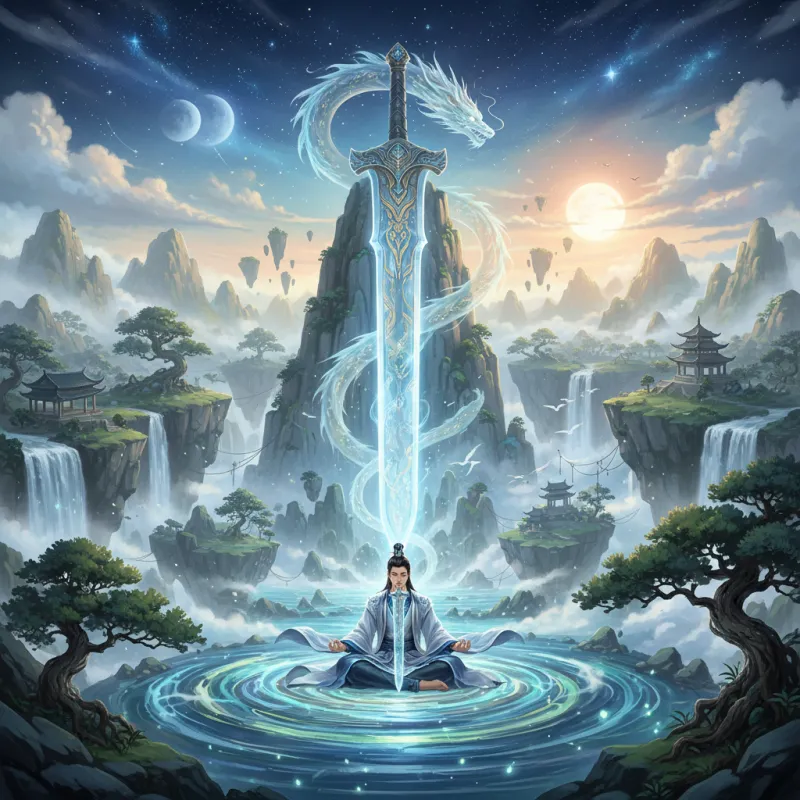
The blade doesn't care about your cultivation level. It doesn't care about your spiritual roots, your sect backing, or how many heavenly treasures you've consumed. When you pick up a sword for the first time, you're making a promise: I will become sharp enough to cut through anything, or I will break trying. That's the fundamental difference between sword cultivation (剑修 jiànxiū) and every other path in the cultivation world — it's not about accumulating power, it's about refining yourself into a single, perfect edge.
The Sword Cultivator's Paradox
Here's what makes sword cultivation genuinely interesting: it's simultaneously the most accessible and most demanding path in cultivation fiction. Any cultivator can pick up a sword. Most do, at least initially. But true sword cultivation — the kind where you achieve sword heart (剑心 jiànxīn) and eventually sword intent (剑意 jiànyì) — requires something that can't be taught or inherited. You need obsession that borders on madness.
Look at the classic sword cultivators in xianxia literature. Li Qiye from Emperor's Domination spent millions of years perfecting a single sword technique. Meng Hao from I Shall Seal the Heavens literally carved his Dao into his sword. These aren't people who chose sword cultivation because it seemed powerful — they're people who couldn't imagine cultivating any other way. The sword isn't their tool; it's their identity.
This creates a fascinating selection bias. Sword cultivation attracts two types of people: geniuses who see the path's potential, and maniacs who don't care about potential at all. The geniuses usually plateau at sword intent. The maniacs become sword immortals (剑仙 jiànxiān). There's a reason for this. Genius can take you to technical mastery, but only obsession can take you to unity with the blade.
The Three Stages Nobody Talks About
Most cultivation novels gloss over the actual progression of sword cultivation, jumping straight from "beginner with sword" to "flying sword go brrr." But the real path has distinct stages that fundamentally change how you interact with your weapon.
Sword Qi (剑气 jiànqì) is where everyone starts. You're projecting your spiritual energy through the sword, using it as a conduit. This is barely sword cultivation at all — you're just a regular cultivator who happens to prefer swords over talismans or formations. Your sword could be replaced with any decent spiritual weapon and you'd perform roughly the same. Most cultivators never progress beyond this stage, and honestly, that's fine. Sword qi is perfectly serviceable for 90% of cultivation scenarios.
Sword Intent (剑意 jiànyì) is where things get interesting. This is when your understanding of the sword becomes conceptual rather than technical. You're not just swinging a blade anymore — you're manifesting the idea of cutting, of sharpness, of the sword itself. A cultivator with sword intent can make a rusty iron sword more dangerous than a heaven-grade spiritual weapon in the hands of someone without it. This is the stage where sword arrays become truly devastating, because you're not just controlling multiple swords, you're orchestrating multiple expressions of your sword concept.
Sword Heart (剑心 jiànxīn) is the stage that separates sword cultivators from sword immortals. At this level, there's no distinction between you and your sword. Your heartbeat is the rhythm of your blade. Your thoughts are cutting intent. You don't need to draw your sword to kill someone — your presence itself is a blade. This sounds like mystical nonsense until you realize what it means practically: a sword heart cultivator can manifest sword qi without a physical sword, can cut through conceptual barriers like formations and illusions, and most importantly, cannot be disarmed. Ever. Because they are the sword.
Why Sword Cultivation Dominates Fiction (And It's Not Just Cool Factor)
Yes, sword cultivation looks incredible. Flying swords, sword rain techniques, that moment when the protagonist unsheathes their blade and reality itself seems to hold its breath — it's all visually spectacular. But that's not why sword cultivation has maintained its dominance in xianxia fiction for decades.
The real reason is narrative efficiency. A sword cultivator's power level is immediately legible to readers. When someone draws their sword, you know a fight is about to happen. When they don't need to draw their sword to win, you know they've reached a terrifying level. When their sword intent manifests as a physical phenomenon — sword light (剑光 jiànguāng) filling the sky, sword domains (剑域 jiànyù) suppressing enemies — the power scaling is viscerally clear.
Compare this to pill refinement or formation mastery. Those paths are intellectually interesting, but they're harder to make cinematically compelling. A sword cultivator's progression from "can cut through iron" to "can cut through space itself" is intuitive. An alchemist's progression from "can refine Foundation Establishment pills" to "can refine pills that contain complete Daos" requires more explanation.
There's also the historical weight. Sword cultivation draws on centuries of Chinese martial arts tradition and Daoist sword immortal legends. The flying sword isn't just a cool xianxia invention — it's rooted in actual Daoist mythology about immortals who could command swords with talismans. When a xianxia novel features sword cultivation, it's tapping into a cultural resonance that Western fantasy's "guy with magic sword" simply doesn't have.
The Sword Cultivator's Weakness (Yes, There Is One)
Here's what sword cultivation novels often ignore: sword cultivators are specialists, and specialists have blind spots. A sword is fundamentally an offensive weapon. It cuts, it pierces, it destroys. What it doesn't do is defend, heal, or create. A pure sword cultivator facing a formation master is at a disadvantage until they reach sword intent strong enough to simply cut through formations. Against a body cultivator who can tank their attacks? That's a bad matchup until their sword qi becomes sharp enough to pierce invulnerable flesh.
This is why most successful sword cultivators in fiction aren't pure specialists. They supplement their sword path with defensive techniques, movement arts, or auxiliary skills. The protagonist of Stellar Transformations combines sword cultivation with body refinement. Many sword cultivators learn basic formation knowledge to understand what they're cutting through. The sword is their primary path, but they're pragmatic enough to shore up their weaknesses.
The exception is sword cultivators who reach such absurd levels that their single specialty transcends all limitations. When your sword intent is strong enough to cut through karma itself, who needs defense? When you can manifest ten thousand sword projections simultaneously, who needs versatility? But reaching that level requires the kind of single-minded dedication that most cultivators — even talented ones — simply don't possess.
The Aesthetic Completeness Problem
This is going to sound pretentious, but bear with me: sword cultivation is aesthetically complete in a way other paths aren't. There's a reason every major xianxia protagonist either is a sword cultivator or has a sword cultivator as their primary rival. The sword represents a complete philosophical package.
The sword is both weapon and tool. It's associated with righteousness (the upright blade) but also with slaughter (the killing sword). It requires technical skill but transcends technique at the highest levels. It's elegant but brutal, simple but infinitely complex. A sword cultivator's journey from novice to immortal mirrors the sword itself — starting as a crude tool, refined through endless tempering, eventually transcending its physical form to become pure concept.
Other cultivation paths don't have this same symbolic weight. Body cultivation is about the self, which is philosophically interesting but narratively limiting. Alchemy is about transformation and creation, which is profound but less viscerally compelling. Formation mastery is about control and understanding, which is intellectually satisfying but harder to make emotionally resonant. The sword, though? The sword works on every level simultaneously.
What Modern Xianxia Gets Wrong
Contemporary xianxia novels have a bad habit of treating sword cultivation as "regular cultivation but with a sword." The protagonist learns sword techniques the same way they'd learn any other skill — through manuals, inheritance, or sudden enlightenment. This misses the point entirely.
Real sword cultivation, as depicted in the better classics, is about relationship. Your sword isn't interchangeable. The blade you carry through Foundation Establishment shouldn't be the same blade you carry at Nascent Soul, not because you need a stronger weapon, but because you and your sword grow together. The sword absorbs your blood, your qi, your intent. You absorb the sword's nature — its balance, its edge, its purpose.
This is why the best sword cultivation arcs involve the protagonist forging or finding their "true" sword — not just a powerful weapon, but the weapon that resonates with their Dao. In Coiling Dragon, Linley's Bloodviolet sword isn't just strong; it's fundamentally aligned with his path. When he eventually transcends it, it's not because he found something better, but because he himself became the sword.
Modern novels often skip this development, giving protagonists heaven-grade swords early and treating them as stat sticks. It's efficient for power scaling, but it loses the emotional core of what makes sword cultivation compelling. The sword should be a character in its own right, not just equipment.
The Ultimate Question: Why Choose the Sword?
In a world where you could cultivate any path — where you could refine your body to invulnerability, master formations that reshape reality, or create pills that grant immortality — why choose the sword? Why commit to a path that demands obsession, offers no shortcuts, and requires you to risk your life in direct combat?
Because the sword is honest. It doesn't hide behind arrays or proxies. It doesn't rely on resources or preparation. When you draw your sword, you're making a statement: I am sharp enough to cut through whatever stands before me, or I'm not. There's no ambiguity, no excuses. The sword reveals truth — about your enemies, about the world, and most importantly, about yourself.
That's the real appeal of sword cultivation. Not the flying swords or the mountain-cutting techniques or the cool factor. It's the clarity. In a cultivation world full of schemes, hidden masters, and complex power systems, the sword cultivator's path is refreshingly direct: become sharper, cut deeper, never stop refining your edge. Everything else is just details.
Related Reading
- Cultivation Techniques: The Methods of Becoming Immortal
- Body Cultivation: The Path of Physical Transcendence
- Formation Arrays: The Strategic Art of Cultivation Warfare
- Divine Sense: The Sixth Sense of Cultivators
- Sword Intent: Understanding the Dao of the Blade
- The Pill Refining Hierarchy: From Mortal Medicine to Heaven-Defying Elixirs
- Pill Refining: The Alchemist's Art in Cultivation
- Spirit Stones: The Currency and Fuel of the Cultivation World