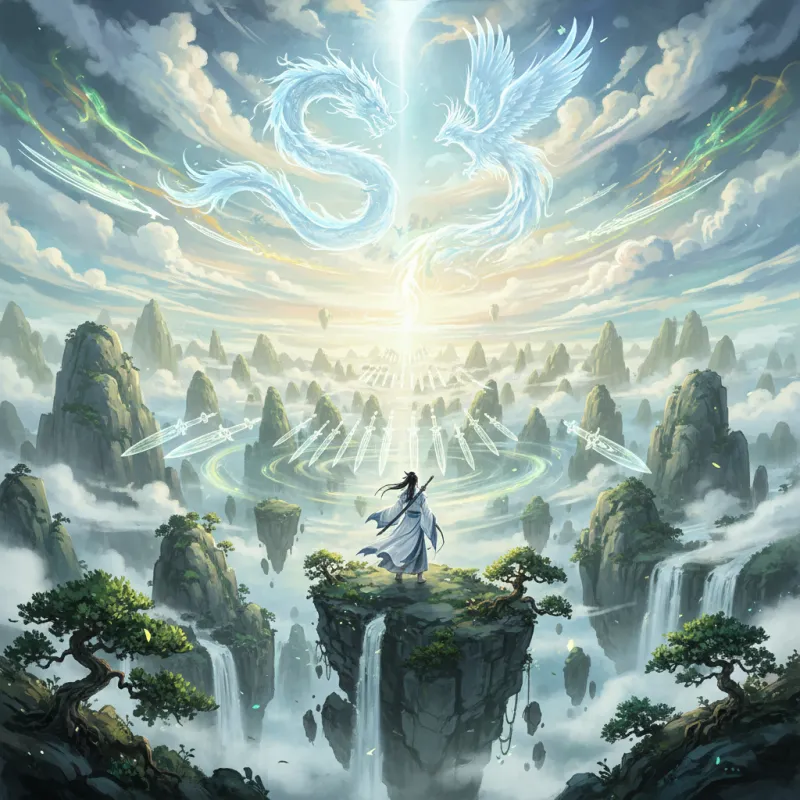
A single sword stroke splits the heavens, yet the blade never moves. The cultivator stands motionless, eyes closed, while mountains crumble in the distance. This isn't fantasy hyperbole—it's the logical endpoint of Sword Intent (剑意, jiàn yì), perhaps the most misunderstood concept in xianxia cultivation. Most readers think it's just "fighting with your mind" or "sword energy," but they're missing the profound philosophical framework that separates a sword cultivator from someone who merely swings sharp metal around.
What Sword Intent Actually Means
Let's cut through the mysticism. Sword Intent is the manifestation of your understanding of the Dao (道, dào) through the medium of the sword. It's not a technique you learn from a manual—it's a state of comprehension where your will, your blade, and the fundamental laws of reality align. When Ye Qingyu in "Sword of Coming" finally grasps his Sword Intent, he doesn't learn a new move. He stops seeing the sword as separate from himself.
The Chinese character 意 (yì) means "intent," "meaning," or "significance"—not just "intention" in the casual sense. It carries weight. It's the difference between wanting to cut something and understanding the nature of severance itself. Ancient Daoist texts describe 意 as the bridge between 心 (xīn, heart-mind) and 气 (qì, vital energy). Sword Intent is what happens when this bridge becomes a highway, and your consciousness flows through your weapon without obstruction.
Think of it this way: a beginner uses Sword Qi (剑气, jiàn qì) to extend their blade's reach. An expert uses Sword Qi to cut from a distance. But someone who's comprehended Sword Intent doesn't need to extend anything—their understanding of "cutting" manifests wherever they direct their will. The sword becomes optional.
The Three Stages of Comprehension
Most xianxia novels break Sword Intent into stages, though the names vary wildly. The framework from "I Shall Seal the Heavens" offers the clearest progression I've encountered:
Sword Awareness (剑识, jiàn shí): You begin to perceive the sword as more than metal. Every blade has a "personality"—the way it wants to move, the angles it prefers, the rhythm of its balance. Cultivators at this stage can pick up any sword and immediately understand its nature. They're not imposing their will yet; they're listening.
Sword Resonance (剑鸣, jiàn míng): Your intent and the blade's nature harmonize. This is where most cultivation novels place their "breakthrough" moments. The sword hums when you hold it, responds to your thoughts, maybe even flies to your hand when summoned. You're having a conversation with your weapon, and it's talking back. Characters like Li Qiye from "Emperor's Domination" spend centuries at this stage, refining the dialogue until it becomes instinctive.
Sword Unity (剑合, jiàn hé): The conversation ends because there's no distinction left between speaker and listener. Your Sword Intent doesn't flow through the blade—it IS the blade, and the blade is you, and both are expressions of the Dao you've comprehended. At this level, the physical sword becomes a formality. You could manifest your Sword Intent through a stick, a finger, or nothing at all.
Historical and Philosophical Roots
The concept didn't spawn from nowhere. Tang Dynasty sword manuals like the "Sword Classic" (剑经, Jiàn Jīng) attributed to Pei Min describe 剑意 as the "spirit of the blade"—the intangible quality that separates a master from a skilled fighter. But they were talking about reading an opponent's intent and responding with perfect timing, not shooting energy beams.
Xianxia authors took this kernel and cross-pollinated it with Buddhist concepts of 意识 (yì shí, consciousness) and Daoist internal alchemy. The result is something that would make historical swordsmen scratch their heads but feels philosophically consistent within cultivation logic. If you can refine your body with Qi Condensation, why couldn't you refine your understanding until it affects reality?
The Song Dynasty philosopher Zhu Xi wrote extensively about 格物致知 (gé wù zhì zhī)—investigating things to extend knowledge. Sword Intent is essentially this principle weaponized. You investigate the nature of the sword, of cutting, of separation and unity, until your knowledge becomes so complete it manifests as power.
Sword Intent vs. Other Weapon Intents
Here's where it gets interesting: why is Sword Intent so dominant in xianxia? You rarely see "Spear Intent" or "Hammer Intent" getting the same treatment, even though those weapons have equally rich martial traditions.
The answer lies in Chinese cultural symbolism. The sword (剑, jiàn) represents the scholar-warrior ideal—elegant, refined, associated with Daoist immortals and righteous heroes. The 剑 is a gentleman's weapon, while the 刀 (dāo, saber) is for soldiers. This class distinction permeates cultivation fiction. Sword cultivators are pursuing enlightenment; everyone else is just fighting.
Practically speaking, the sword's double edge makes it philosophically richer. A saber cuts in one direction—it's decisive, aggressive, straightforward. A sword can cut coming or going, thrust or slash, defend or attack with the same motion. This duality mirrors Daoist concepts of yin and yang, making it the perfect vehicle for exploring the Dao through combat.
That said, novels like "Lord of the Mysteries" and "Renegade Immortal" do explore other weapon Intents, and they're fascinating precisely because they break the mold. Spear Intent emphasizes penetration and directness—a single point of absolute focus. Saber Intent embodies overwhelming momentum. Each weapon Intent reflects a different understanding of the Dao, a different answer to the question "What is combat?"
Cultivating Your Own Sword Intent
In fiction, characters usually comprehend Sword Intent through one of three paths:
Enlightenment through combat: You fight someone so far above your level that you either break through or die. The pressure forces your understanding to crystallize. This is the shonen anime approach—dramatic, exciting, and statistically likely to get you killed. Wang Lin from "Renegade Immortal" nearly dies a dozen times before his Sword Intent awakens, and he's considered lucky.
Meditation and comprehension: You sit under a waterfall for three years contemplating the nature of sharpness. Boring to read about, but probably safer. The problem is that intellectual understanding doesn't always translate to combat application. You might comprehend the Dao of the Blade philosophically but freeze up when someone's actually trying to kill you.
Inheritance and guidance: A master directly transmits their understanding, giving you a foundation to build on. This is the fastest path but also the most limiting—you're starting with someone else's Dao, which might not align with your nature. The best inheritances, like in "A Record of a Mortal's Journey to Immortality," provide the framework but force you to fill in the details yourself.
The commonality across all three paths? Sword Intent emerges when your understanding of the sword aligns with your understanding of yourself and the world. It's not a technique you practice; it's a realization you achieve. You can't force it, which is why so many cultivation novels feature characters stuck at the threshold for decades.
The Dark Side of Sword Intent
Here's what most articles won't tell you: Sword Intent can absolutely destroy your cultivation if you comprehend the wrong Dao. Your Sword Intent reflects your understanding of reality, and if that understanding is flawed or incomplete, you're building your foundation on sand.
In "Coiling Dragon," we see cultivators whose Sword Intent becomes too narrow—they understand "cutting" so completely that they can't conceive of any other solution. Their Dao becomes a prison. Others comprehend a Sword Intent based on slaughter and bloodlust, which works great until they try to advance to higher realms and discover their foundation is incompatible with heavenly laws.
The most tragic cases are cultivators who comprehend someone else's Sword Intent through inheritance and mistake it for their own. They advance quickly at first, then hit an insurmountable wall when they try to deepen their understanding. You can't fake comprehension—the Dao knows when you're lying to yourself.
Why Sword Intent Matters Beyond Combat
The real genius of Sword Intent as a narrative device is that it's a perfect metaphor for mastery itself. Replace "sword" with "medicine," "formation arrays," or "alchemy," and the principle remains: true mastery comes when your understanding becomes so complete that technique becomes unnecessary. You don't follow the rules anymore—you understand why the rules exist, which means you know when to break them.
This is why Sword Intent often marks the transition from "talented cultivator" to "true powerhouse" in xianxia novels. It's proof that you've stopped memorizing and started understanding. You're not just strong; you're wise. You've touched the Dao, even if only in one narrow domain.
And that's the beautiful irony: Sword Intent is simultaneously the most specific and most universal concept in cultivation fiction. It's about swords, yes, but it's really about the moment when practice becomes principle, when technique becomes truth, when you stop wielding the Dao and start embodying it.
The blade that cuts without moving. The strike that lands before it's thrown. The sword that exists in intent alone. That's not mysticism—that's what happens when understanding becomes absolute. Whether you're reading about it in a web novel or contemplating it as philosophy, Sword Intent represents the same fundamental truth: mastery is when the tool and the wielder become indistinguishable, when your will shapes reality because you've finally understood what reality is.
Related Reading
- Body Cultivation: The Path of Physical Transcendence
- Formation Arrays: The Strategic Art of Cultivation Warfare
- Divine Sense: The Sixth Sense of Cultivators
- Dual Cultivation Explained: Beyond the Misconceptions
- Cultivation Techniques: The Methods of Becoming Immortal
- Discovering the Fascinating Artifacts of Chinese Cultivation and Xianxia Fiction
- The Allure of Chinese Cultivation Fiction: A Journey Through Immortal Realms
- Unraveling the Mysteries of Chinese Cultivation and Xianxia Fiction