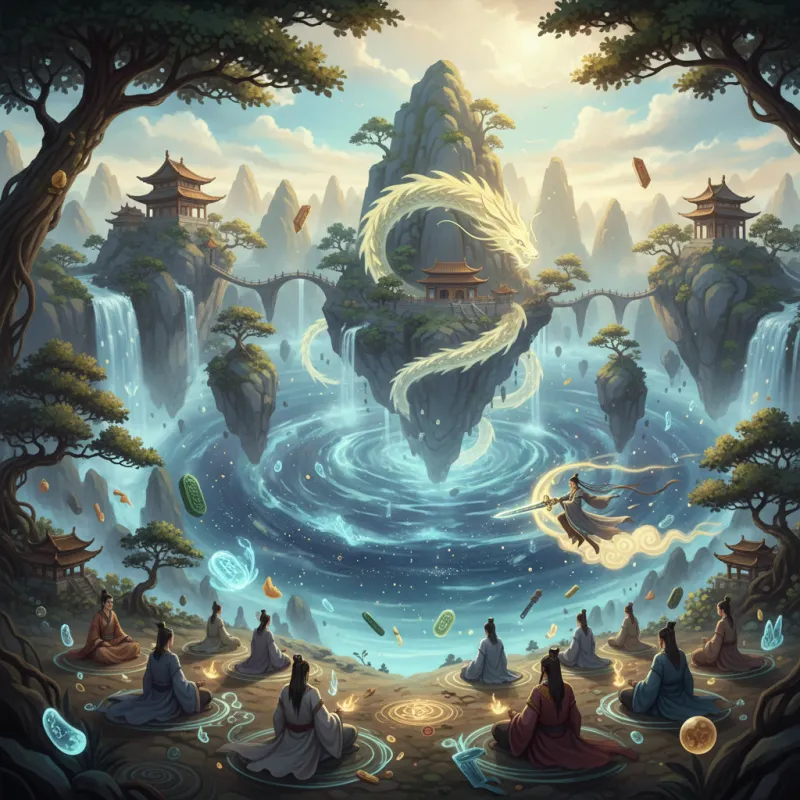
When Zhang Sanfeng first ascended to immortality in the 14th century, legend says he carried only three items: a jade slip containing the Taiji principles, a gourd of immortal wine, and a sword that could cut through karma itself. Whether you believe the tale or not, this image—of a cultivator defined by their treasured artifacts—has shaped Chinese xianxia fiction for centuries. These aren't just magical items in the Western fantasy sense. They're extensions of the cultivator's dao, physical manifestations of their understanding, and often the difference between ascending to the heavens or scattering into dust.
The Spiritual Weapons That Choose Their Masters
The concept of 灵器 (língqì, spiritual weapons) operates on a principle that would frustrate any Western RPG player: you can't just pick up the best sword and swing it around. In cultivation fiction, weapons possess their own spiritual consciousness, and the relationship between cultivator and artifact is closer to a marriage than ownership. Take the Immortal Slaying Sword Formation from Investiture of the Gods (封神演义, Fēngshén Yǎnyì)—four swords that required four cultivators of equal power to wield simultaneously, each sword resonating with a different elemental principle.
Modern xianxia novels like I Shall Seal the Heavens by Er Gen have expanded this concept brilliantly. The protagonist Meng Hao's relationship with his copper mirror isn't just about power—it's about understanding the artifact's history, its previous owners, and the dao principles embedded within it. This mirrors the Daoist concept of 器道合一 (qì dào héyī, unity of tool and dao), where mastery comes not from domination but from harmonious understanding.
The ranking system for spiritual weapons typically follows the cultivation realm hierarchy: Mortal, Spirit, Treasure, Dao, and Immortal grade. But here's what most casual readers miss—a lower-grade weapon in the hands of someone who truly understands it will always outperform a higher-grade weapon wielded by someone chasing power alone. This philosophical underpinning separates cultivation fiction from simple power fantasy.
Storage Rings and the Portable Cave Heaven
If you've read any xianxia novel, you've encountered the 储物戒 (chǔwù jiè, storage ring). On the surface, it's a convenient plot device—how else would cultivators carry around mountains of spirit stones, medicinal pills, and the occasional captured enemy? But the concept draws from genuine Daoist spatial theories about 洞天福地 (dòngtiān fúdì, grotto-heavens and blessed lands), pocket dimensions where immortals supposedly dwelled.
The Zhuangzi describes these spaces philosophically, but Tang Dynasty Daoist texts like the Records of the Assembled Transcendents of the Fortified Walled City catalog them geographically. Early cultivation novels simply miniaturized this concept. What's fascinating is how modern authors have evolved the trope—in World of Cultivation, storage rings become plot points about economic systems and resource management. In Forty Millenniums of Cultivation, they're explained through pseudo-scientific spatial folding technology.
The best authors use storage artifacts to explore themes of greed and attachment. A cultivator hoarding treasures in their storage ring is literally carrying their karmic baggage. Some novels feature 须弥戒 (xūmí jiè, Sumeru rings) named after Mount Sumeru from Buddhist cosmology, capable of containing entire worlds—a metaphor for how desire can become infinite if left unchecked. For more on how spatial concepts influence cultivation systems, see Understanding Cultivation Realms and Their Cosmic Significance.
Pill Furnaces and the Alchemy of Transformation
The 丹炉 (dānlú, pill furnace) deserves its own discussion because it represents something deeper than a crafting station. Historical Daoist alchemists like Ge Hong (283-343 CE) literally died trying to create immortality pills—the external alchemy (外丹, wàidān) tradition involved mercury, lead, and other toxic substances. The shift to internal alchemy (内丹, nèidān), where the body itself becomes the furnace, happened around the Tang Dynasty, but cultivation fiction brilliantly maintains both traditions.
In Coiling Dragon, the protagonist's understanding of fire laws directly impacts his ability to forge artifacts. In A Record of a Mortal's Journey to Immortality, Han Li's success in pill refinement comes from his meticulous, almost scientific approach—tracking temperatures, timing, and ingredient ratios with obsessive detail. This reflects the actual historical practice of Daoist alchemy, which kept detailed laboratory records that modern historians study.
The furnace itself often becomes a character. The Eight Trigrams Furnace (八卦炉, bāguà lú) from Journey to the West didn't just fail to kill Sun Wukong—it refined him, giving him his golden eyes that see through illusions. Modern xianxia authors love this motif: the artifact that seems to destroy the protagonist actually tempers them into something stronger. The furnace represents transformation through controlled destruction, the Daoist principle of 涅槃重生 (nièpán chóngshēng, rebirth through nirvana).
Jade Slips and the Transmission of Knowledge
Before paper, before printing, Daoist texts were carved on jade tablets. The 玉简 (yùjiǎn, jade slip) in cultivation fiction isn't just a flash drive for kung fu techniques—it's a meditation on how knowledge transfers across generations. Real jade slips from the Han Dynasty have been excavated, containing everything from administrative records to medical texts. The material itself matters: jade was believed to preserve not just information but the spiritual essence of the writer.
In cultivation novels, jade slips often contain the final insights of dying masters, their dao understanding crystallized in a format that only those with sufficient cultivation can comprehend. This creates a beautiful narrative tension—the protagonist might possess a jade slip containing world-shaking techniques but lack the realm to understand it. It's the Daoist version of "when the student is ready, the teacher appears," except the teacher is a piece of jade that's been waiting for centuries.
Renegade Immortal by Er Gen uses jade slips particularly well, with the protagonist Wang Lin discovering that some slips contain not just techniques but fragments of their creator's personality and memories. This touches on the Daoist concept of 神识 (shénshí, divine sense)—the idea that consciousness can be imprinted on objects. For deeper exploration of how consciousness and cultivation intertwine, check out The Role of Divine Sense in Cultivation Advancement.
Formation Flags and Arrays That Reshape Reality
The 阵旗 (zhènqí, formation flag) and the arrays they create represent perhaps the most intellectually demanding artifacts in cultivation fiction. Based on historical Chinese military strategy, feng shui principles, and the I Ching hexagram system, formations (阵法, zhènfǎ) are essentially programmable reality hacks. The Zhuge Liang's Eight Arrays from the Three Kingdoms period inspired countless fictional formations that trap enemies in spatial loops, invert the five elements, or create pocket dimensions.
What makes formations fascinating is their democratic nature—a weaker cultivator with superior formation knowledge can trap a stronger opponent. This appeals to the underdog narrative that drives most xianxia plots. In Stellar Transformations, the protagonist Qin Yu uses formations to punch above his weight class repeatedly, turning his disadvantages into strategic advantages.
The best formation scenes in cultivation fiction read like puzzle boxes. The protagonist must understand the underlying principles—usually based on 五行 (wǔxíng, five elements) theory or 八卦 (bāguà, eight trigrams)—to break or manipulate the array. This isn't just about power; it's about comprehension. A formation master is essentially a reality programmer, and their flags are the code they write. Modern novels like Forty Millenniums of Cultivation even blend formation theory with actual computer programming concepts, creating a fascinating fusion of ancient and modern.
The Artifacts We Carry Forward
The enduring appeal of cultivation artifacts lies in their metaphorical weight. Every storage ring represents what we choose to carry through life. Every spiritual weapon reflects how we've shaped ourselves through practice. Every jade slip is knowledge waiting for us to be ready to receive it. Chinese cultivation fiction, at its best, uses these artifacts not as power-ups but as mirrors—showing us that the real treasure isn't the object itself but what we become in pursuit of understanding it.
The genre continues evolving, with authors finding new ways to explore these ancient concepts. Some novels deconstruct the tropes, questioning whether the pursuit of artifacts leads to enlightenment or just endless accumulation. Others double down on the power fantasy, creating increasingly elaborate artifact hierarchies. But the core remains: these objects matter because they represent the cultivator's journey, their dao, their understanding of the universe. In the end, the most powerful artifact in any cultivation novel is the one that teaches the protagonist—and the reader—something true about the nature of existence itself.
Related Reading
- Cauldrons: Essential Tools for Pill Refining
- Storage Rings and Spatial Equipment: Pocket Dimensions on Your Finger
- Flying Swords: The Cultivator's Signature Weapon
- Storage Rings: Spatial Magic in Cultivation
- Exploring Artifacts and Their Role in Chinese Cultivation and Xianxia Fiction
- Exploring the Intricate World of Chinese Cultivation and Xianxia Fiction
- Dual Cultivation Explained: Beyond the Misconceptions
- The Glossary Problem: Why Cultivation Fiction Is Hard to Translate