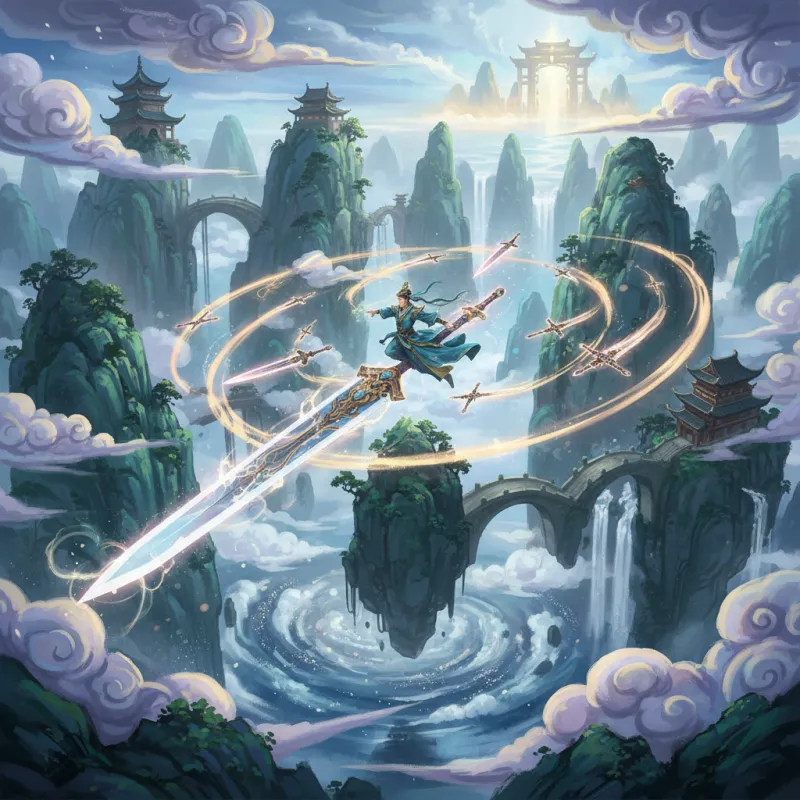
A blade streaks across the sky like a silver comet, responding to its master's will from a thousand li away. The cultivator stands motionless on a mountain peak, eyes closed, yet the sword dances through the air as if guided by invisible threads—slicing through demon beasts, parrying enemy attacks, and returning to hover obediently at his side. This is the flying sword, or fēijiàn (飞剑), the ultimate symbol of a cultivator's mastery and the weapon that separates true immortals from mere martial artists.
More Than Just a Weapon
The flying sword represents a fundamental shift in how cultivation novels approach combat. Unlike the grounded martial arts of wuxia, where heroes leap across rooftops and exchange blows in close quarters, xianxia introduces a weapon that transcends physical limitations entirely. The flying sword isn't wielded—it's commanded. It doesn't require the cultivator to be present at all. In I Shall Seal the Heavens, Meng Hao's wooden sword becomes an extension of his very soul, capable of executing techniques while he focuses on other aspects of battle. This is cultivation warfare: multitasking on a cosmic scale.
What makes flying swords particularly fascinating is their progression system. A cultivator doesn't simply pick up a sword and start flying it around. The process typically begins during the Foundation Establishment realm, when a cultivator first learns to externalize their spiritual energy. Early attempts are clumsy—the sword wobbles, moves slowly, and can barely maintain altitude. By Golden Core, the sword becomes a true extension of the cultivator's will. Nascent Soul cultivators can split their consciousness to control multiple swords simultaneously, creating sword formations that can level mountains. This progression mirrors the cultivator's own journey, making the flying sword both a tool and a measuring stick for advancement.
The Sword Cultivation Path
Some cultivators dedicate their entire existence to the sword, following what's known as jiànxiū (剑修), or sword cultivation. These specialists forsake the balanced approach of traditional cultivation to pour everything into their blade. The results are devastating. In Renegade Immortal, Wang Lin encounters sword cultivators whose single-minded focus allows them to punch above their weight class, defeating opponents an entire realm higher through pure sword mastery alone.
The sword cultivation path demands sacrifice. These cultivators often progress more slowly through the realms because they're not developing other aspects of their power—no elaborate formations, no diverse spell repertoire, no body refinement techniques. Just the sword. But what they lose in versatility, they gain in lethality. A true sword cultivator's flying sword isn't just fast; it's inevitable. Their sword intent, or jiànyì (剑意), becomes so refined that reality itself seems to bend around their blade. Enemies report feeling the sword's approach before it arrives, as if the universe is warning them of their impending doom.
The legendary Sword Saint archetype appears across countless novels, always with similar characteristics: minimal words, maximum efficiency, and an almost religious devotion to the blade. These characters often carry a single sword their entire lives, nurturing it with their blood essence and spiritual energy until weapon and wielder become inseparable. When such a cultivator finally falls, their sword typically shatters or loses its luster, unable to accept another master.
Sword Spirits and Sentient Blades
The relationship between cultivator and flying sword deepens when the blade develops consciousness. A sword spirit, or jiànlíng (剑灵), emerges when a weapon has been nurtured for centuries or forged from materials of exceptional quality. These spirits range from simple awareness to full personalities that can argue with their masters, offer advice, or even refuse commands if they disagree with the wielder's choices.
In Coiling Dragon, Linley's Bloodviolet sword contains a spirit that communicates through emotional impressions, guiding him toward techniques that complement the blade's inherent properties. Other novels feature more talkative sword spirits—some wise and ancient, others childish and playful, reflecting the sword's creation circumstances or the personality of its first master. The best sword spirit relationships feel like genuine partnerships, where both parties grow stronger through their connection.
The process of awakening a sword spirit varies by novel, but common elements include: feeding the sword with spiritual energy over decades, bathing it in the blood of powerful enemies, or exposing it to heavenly tribulation lightning. Some cultivators deliberately seek out sword embryos—unfinished blades with the potential for consciousness—and raise them like children. The investment is enormous, but a sword with a compatible spirit can mean the difference between life and death when facing enemies who've lived for millennia.
Sword Formations and Arrays
Individual flying swords are impressive, but sword formations, or jiànzhèn (剑阵), represent the pinnacle of sword-based combat. These arrays combine multiple swords into geometric patterns that amplify their collective power exponentially. The classic example is the Immortal Slaying Sword Formation from Investiture of the Gods, which required four supreme swords and could only be broken by four saints working together. Modern xianxia novels have run wild with this concept.
The mathematics of sword formations matter. A simple three-sword formation might triple the attack power, but a properly configured nine-sword formation could increase it by a factor of eighty-one. The swords don't just attack together—they create a domain where the cultivator's sword intent becomes law. Inside a mature sword formation, gravity might reverse, space could fold, or time itself might slow for everyone except the formation's master. Breaking such a formation requires either overwhelming power or identifying the formation's eye—the critical sword whose removal causes the entire structure to collapse.
Advanced cultivators develop signature formations that become their calling cards. These aren't just random sword arrangements but carefully designed systems that reflect the cultivator's understanding of the Dao. A cultivator who comprehends the Dao of Water might create a flowing formation where swords move like a river, impossible to predict or block. Someone following the Dao of Lightning would favor formations that strike from multiple angles simultaneously, each sword carrying the speed and power of a thunderbolt. The variety is endless, limited only by the cultivator's imagination and realm.
The Economics of Flying Swords
Let's talk about something most cultivation novels gloss over: flying swords are expensive. A decent quality sword suitable for Foundation Establishment might cost hundreds of spirit stones—more than most cultivators earn in years. Golden Core level swords run into the thousands, and Nascent Soul grade weapons often require rare materials that can only be found in forbidden zones or ancient ruins.
This economic reality shapes cultivation society in interesting ways. Many cultivators inherit their flying swords from masters or family members, creating lineages where the same blade serves multiple generations. Others join sects specifically for access to the sect's armory, trading freedom for equipment. The truly desperate might venture into ancient battlefields, hoping to find a masterless sword among the ruins—though such weapons often carry curses or residual sword intent from their previous owners that can drive new wielders insane.
The materials matter enormously. A sword forged from common steel, even if refined with spiritual energy, will never match one made from Meteoric Iron or Profound Ice Jade. The best swords incorporate materials that resonate with specific elements or Daos, amplifying the cultivator's techniques. Some novels feature cultivators who spend centuries searching for that one perfect material to reforge their sword, treating the quest like a cultivation breakthrough in itself. The relationship between artifact refinement and sword quality cannot be overstated—a master refiner can transform mediocre materials into a legendary blade through skill alone.
Flying Swords in Modern Xianxia
Contemporary cultivation novels have evolved the flying sword concept in creative directions. Some authors introduce technological elements, creating swords that incorporate formation arrays directly into the blade. Others explore the idea of sword cultivation in modern settings, where cultivators hide their flying swords as ordinary objects—a pen, a ruler, even a smartphone—that transform when needed.
The power scaling has also intensified. Early wuxia novels featured swords that could cut through stone. Modern xianxia casually describes swords that slice through dimensions, sever karma, or erase concepts from existence. At the highest levels, a cultivator's sword becomes less a physical object and more a manifestation of their will—capable of existing and not existing simultaneously, striking from the past and future at once, or dividing into infinite copies that each carry the full power of the original.
Yet the core appeal remains unchanged: the image of a cultivator standing calm while their sword handles the dirty work, the ultimate expression of power through control rather than brute force. The flying sword represents what cultivation is really about—transcending mortal limitations, achieving the impossible, and looking incredibly cool while doing it. Whether you're reading about ancient sword immortals or modern cultivation prodigies, that moment when the sword takes flight never gets old.
Related Reading
- Formation Arrays: The Magical Engineering of the Cultivation World
- Flying Swords: The Iconic Vehicles of Cultivation Fiction
- Discovering the Fascinating Artifacts of Chinese Cultivation and Xianxia Fiction
- Cauldrons: Essential Tools for Pill Refining
- Cultivation Artifacts: Swords That Think, Rings That Store, and Robes That Protect
- Jade Slips: The USB Drives of the Cultivation World
- Unraveling the Essence of Tribulations in Chinese Cultivation Fiction
- Heavenly Tribulation: When the Heavens Strike Back