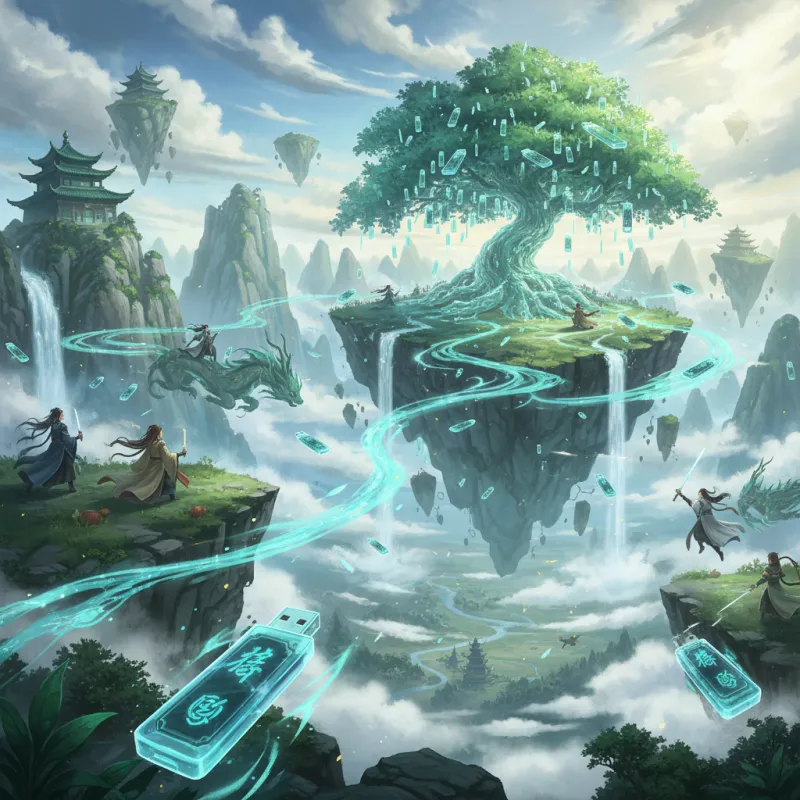
A Nascent Soul elder spends three centuries perfecting a sword technique that can split mountains. How does he pass it on? He could take disciples, sure, but what if they're idiots? What if they misremember the third form? What if — heaven forbid — they die before passing it along? No, the smart cultivator carves it into a jade slip, and that knowledge survives until the heat death of the universe. Or at least until some junior accidentally shatters it while showing off.
What Makes Jade Slips Special
A jade slip (玉简 yùjiǎn) isn't just any piece of jade you picked up at the spiritual materials market. It's specifically refined spiritual jade, processed to hold divine sense (神识 shénshí) imprints without degrading. The quality matters enormously — low-grade jade might hold a basic Qi Condensation (凝气 níngqì) technique, but if you want to store something like the complete Nine Heavens Thunder Scripture, you need jade that's been soaking in spiritual veins for ten thousand years.
The size is deceptive. Most jade slips are finger-length, maybe thumb-width if they're fancy. But the information density? Absurd. A single high-quality slip can contain entire libraries. In I Shall Seal the Heavens, Meng Hao encounters jade slips containing complete historical records of fallen sects, cultivation techniques with thousands of variations, and even the life experiences of ancient cultivators. The limiting factor isn't storage space — it's whether your divine sense is strong enough to parse all that data without your brain leaking out your ears.
The creation process requires a cultivator to imprint their divine sense directly into the jade's crystalline structure. This isn't like writing — it's more like burning a neural pathway into the stone itself. The information exists as a kind of spiritual hologram, complete with the original cultivator's understanding and insights. This is why jade slips from powerful cultivators are so valuable: you're not just getting the technique, you're getting their comprehension of it.
The Divine Sense Interface
Here's where jade slips get interesting from a technical standpoint. You don't read them with your eyes — you read them with your divine sense, that projection of consciousness that cultivators develop around Foundation Establishment (筑基 zhùjī). Press the slip to your forehead, extend your divine sense into it, and the information flows directly into your mind. No translation needed, no misunderstanding possible. The knowledge transfer is instantaneous and complete.
But there's a catch, and it's a big one: your cultivation level determines what you can access. Try to read a jade slip meant for Soul Formation (化神 huàshén) cultivators when you're still in Qi Condensation? Best case scenario, you get a splitting headache. Worst case, your sea of consciousness (识海 shíhǎi) cracks like an egg and you spend the next decade drooling in a corner. This built-in security feature means sects can leave their most precious techniques lying around in libraries, knowing that only disciples who've reached the appropriate level can actually use them.
The reading experience varies by author and content. Simple techniques might feel like watching an instructional video in your head. Complex ones — especially those involving profound dao insights — can trigger enlightenment experiences where you lose track of time entirely. In Coiling Dragon, Linley spends what feels like moments reading a jade slip, only to discover days have passed in the outside world. This time dilation effect is common with high-level slips containing deep philosophical content.
Jade Slips vs. Other Storage Methods
Why jade slips instead of books? Several reasons, and they're all practical. First, durability. Paper rots, bamboo strips crack, stone tablets are heavy as hell. Jade slips can survive being buried for millions of years and still work perfectly. Second, security. You can't casually flip through a jade slip — you need cultivation to access it at all, and the right level of cultivation to access specific content. Try that with a book.
Third, and this is the big one: information fidelity. When you copy a book by hand, errors creep in. When you pass down a technique through oral tradition, it degrades like a game of telephone played across centuries. But jade slips? The information is exactly as the creator imprinted it, down to the subtle nuances of their understanding. This is why ancient inheritances (传承 chuánchéng) are so valuable — they're not corrupted versions passed down through generations, they're the original master's direct teaching, preserved perfectly.
That said, jade slips aren't perfect. They're vulnerable to spiritual energy fluctuations — a powerful cultivator's aura can accidentally wipe nearby slips clean. They can be intentionally destroyed by divine sense attacks. And unlike formation plates, they're read-only after creation. You can't edit a jade slip; you can only make a new one. This has led to some hilarious situations in novels where cultivators discover "updated" versions of techniques they learned from "definitive" jade slips.
The Economics of Knowledge
In most cultivation worlds, jade slips create a fascinating information economy. Low-level techniques are cheap and widely available — every sect has libraries full of basic Qi Condensation methods. But high-level techniques? Those are worth more than spirit stones (灵石 língshí). A complete Nascent Soul technique on a jade slip might be worth an entire mortal kingdom.
This creates interesting power dynamics. Sects hoard their best techniques on jade slips locked in forbidden vaults. Rogue cultivators spend lifetimes hunting for ancient jade slips in ruins. Entire plot arcs revolve around stealing, copying, or trading jade slips. In Renegade Immortal, Wang Lin's rise to power is directly tied to the jade slips he acquires from ancient cultivators' caves — each one representing knowledge that contemporary sects have lost or never possessed.
The copying problem is real. Theoretically, a powerful cultivator could read a jade slip and create a duplicate by imprinting the same information into new jade. But this requires perfect comprehension of the original content, which is rare. Most copies are degraded versions, missing subtle insights or containing the copier's misunderstandings. This is why original jade slips from ancient masters command such absurd prices — they're the source code, not a compiled binary.
Some sects have developed jade slip DRM, essentially. They imprint techniques with restrictions: read it once and it self-destructs, or it only works for cultivators with specific spiritual roots (灵根 línggēn), or it requires a password phrase spoken in ancient language. These protected slips are both more valuable and more frustrating, especially when the protection method has been lost to time and nobody can figure out how to access the damn thing.
Jade Slips in Specific Novels
A Record of a Mortal's Journey to Immortality treats jade slips with unusual realism. Han Li encounters countless jade slips throughout his journey, but many are damaged, incomplete, or contain techniques incompatible with his cultivation method. He can't just absorb every technique he finds — he has to carefully evaluate whether the knowledge is worth the time investment to learn. This practical approach makes jade slips feel like actual tools rather than plot devices.
Martial World takes jade slips in a different direction, emphasizing their role in preserving martial intent (武意 wǔyì). The jade slips Lin Ming discovers don't just contain techniques — they contain the fighting spirit and comprehension of ancient martial artists. Reading them is less like downloading a file and more like sparring with a ghost. The emotional and spiritual content matters as much as the technical information.
In Desolate Era, jade slips are treated almost casually at higher levels. Immortals and World Gods create jade slips the way we might write sticky notes, leaving them scattered across the Three Realms as casual gifts or teaching aids. But even there, truly profound jade slips — those containing complete Dao insights — are treasured beyond measure. Ji Ning's entire cultivation path is shaped by a handful of jade slips from beings who transcended the universe itself.
The Cultural Logic
Jade slips make sense in Chinese cultivation fiction because they're extrapolations of real historical practices. Ancient China used bamboo and wooden slips (简 jiǎn) for writing before paper became common. These were literally thin strips of bamboo or wood bound together with cord, used for everything from government records to philosophical texts. The Bamboo Annals, discovered in a tomb from 281 CE, were written on bamboo strips and survived for centuries underground.
Jade itself has profound significance in Chinese culture — it represents purity, immortality, and connection to heaven. Jade burial suits were created for Han Dynasty royalty, based on the belief that jade could preserve the body and spirit. Jade tablets were used in imperial courts as symbols of authority. So when cultivation fiction needed a storage medium that felt both ancient and eternal, jade was the obvious choice.
The divine sense reading mechanism also has cultural roots. Chinese philosophy has long emphasized direct transmission of understanding beyond words — the concept of "mind-to-mind transmission" (以心传心 yǐxīn chuánxīn) in Chan Buddhism, where enlightenment passes directly from master to student without verbal teaching. Jade slips are the technological implementation of this ideal: pure knowledge transfer without the corruption of language.
Modern Variations and Innovations
Contemporary cultivation novels have started playing with the jade slip concept. Some introduce jade slip networks, where multiple slips are linked and can share information in real-time — basically spiritual internet. Others have jade slips that can record experiences directly, creating something like cultivation world VR recordings. My Senior Brother is Too Steady features jade slips with built-in commentary systems, where readers can leave notes that future readers will see.
The most interesting innovation might be jade slip cultivation techniques themselves. Some novels feature methods specifically designed to enhance divine sense reading speed, increase information retention from jade slips, or even allow cultivators to create jade slips at lower cultivation levels than normally possible. These inscription techniques treat jade slip creation as its own specialized path, with masters who can imprint information with unprecedented clarity or compress vast libraries into single slips.
There's also been exploration of jade slip failure modes. What happens when a jade slip degrades over millions of years? Usually, the information becomes fragmented or corrupted, leading to incomplete techniques that might be dangerous to practice. Some plots revolve around reconstructing ancient techniques from damaged jade slips, piecing together fragments like archaeological puzzles. Others feature jade slips that were deliberately sabotaged, containing techniques that seem legitimate but actually lead practitioners astray.
The jade slip remains one of cultivation fiction's most elegant solutions to the knowledge transfer problem. It's technologically consistent, culturally grounded, and flexible enough to support countless plot developments. Whether it's a priceless ancient inheritance or a basic technique manual, the humble jade slip keeps the cultivation world's information flowing across the ages — no Wi-Fi required.
Related Reading
- Talisman Crafting: The Art of Writing Magic
- Talisman Crafting in Cultivation Fiction: Writing Magic Into Reality
- The Inscription Arts: Talismans, Runes, and the Written Word as Weapon
- Rune and Inscription Systems in Cultivation Fiction
- How to Write Cultivation Fiction: A Beginner's Guide for Western Authors
- Mortal Realm to Immortal Realm: The Geography of Cultivation Worlds
- The Art of Immortal Cultivation: A Dive into Chinese Xianxia Fiction