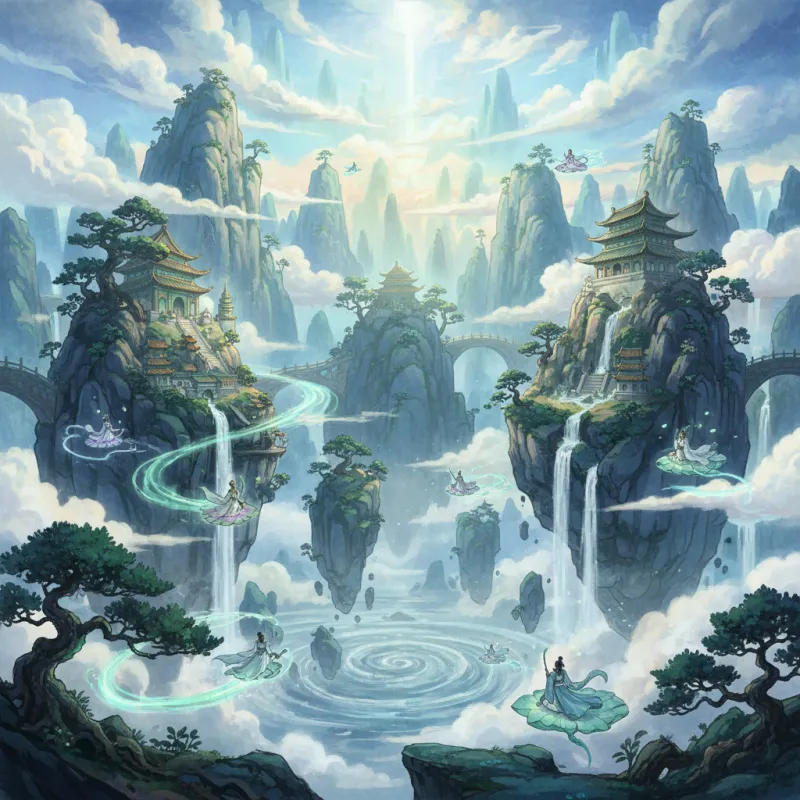
The young cultivator's meridians shattered like porcelain under the weight of heavenly tribulation lightning. Yet three chapters later, he's breaking through to Core Formation realm, his dantian blazing with spiritual energy that would make ancient immortals weep with envy. This is xianxia (仙侠, xiānxiá) — where death is negotiable, power is everything, and the path to immortality is paved with enough plot armor to withstand a nuclear blast. But beneath the power fantasies and cultivation speed-runs lies a literary tradition that's been obsessing over immortality since before the Tang Dynasty poets were getting drunk and writing about it.
The Daoist Roots: When Philosophy Became Power Levels
Xianxia didn't spawn from a vacuum in some 1990s Chinese internet café. Its DNA traces directly to Daoist alchemical texts like the Baopuzi (抱朴子) written by Ge Hong in 320 CE, where he meticulously documented methods for achieving physical immortality through external alchemy (waidan, 外丹) and internal cultivation (neidan, 内丹). The difference? Ge Hong was deadly serious about his mercury pills and breathing techniques, while modern xianxia authors turned these esoteric practices into gamified progression systems.
The concept of qi (气, qì) — that vital energy flowing through all living things — became the universal currency of power. What was once a philosophical principle about harmonizing with the Dao transformed into something you could measure, compress into your dantian (丹田, dāntián), and weaponize against your enemies. The foundation establishment process that takes decades in classical Daoist texts? Xianxia protagonists speed-run it in months, usually with the help of a fortuitous encounter or a mysterious old master who's definitely not going to die tragically to motivate the hero.
The Cultivation Hierarchy: Buddhism Meets RPG Mechanics
Here's where xianxia gets brilliantly absurd. The genre took Buddhist concepts of spiritual advancement through multiple lifetimes and said, "What if we made this into a ranked ladder system?" The result is the cultivation realm hierarchy that's become so standardized you could mistake it for an MMORPG skill tree.
Qi Condensation, Foundation Establishment, Golden Core, Nascent Soul, Spirit Severing — these aren't just arbitrary power levels. Each realm theoretically represents a philosophical breakthrough, a fundamental transformation of one's existence. The Golden Core (jindan, 金丹) realm, for instance, directly references Daoist internal alchemy where practitioners would "forge" a golden elixir within their dantian. In texts like the Zhong-Lü Chuandao Ji (钟吕传道集) from the Tang Dynasty, this was a metaphor for spiritual refinement. In I Shall Seal the Heavens by Er Gen, it's the stage where Meng Hao starts casually destroying mountains.
The genius of this system is how it creates narrative tension through quantifiable progress. Unlike Western fantasy where power levels remain frustratingly vague (looking at you, Gandalf), xianxia readers always know exactly where their protagonist stands in the cosmic pecking order. It's deeply satisfying in the same way that watching a progress bar fill up is satisfying — which probably explains why cultivation novels are so addictive.
The Tribulation Trope: Heaven Really Hates Overachievers
Nothing says "you've made it" in xianxia quite like having the heavens themselves try to murder you with lightning. Heavenly tribulation (tianjie, 天劫) is the genre's most dramatic power-up mechanism, and it's rooted in the Buddhist concept of karmic obstacles and the Daoist idea that achieving immortality defies the natural order.
In classical Chinese mythology, figures like the Eight Immortals faced tests and transformations, but they didn't have to dodge lightning bolts every time they wanted a promotion. Modern xianxia cranked this up to eleven. The tribulation clouds gather, the protagonist stands alone on a mountain peak (always a mountain peak), and then the universe throws everything it has at them. Survive, and you break through to the next realm. Fail, and you're a scorch mark with a sad backstory.
What makes this compelling isn't just the spectacle — it's the philosophical weight. The heavens in xianxia aren't benevolent. They're actively hostile to those who seek to transcend mortality, which flips the traditional Chinese concept of tianming (天命, tiānmìng, the Mandate of Heaven) on its head. Instead of accepting one's fate, xianxia protagonists spit in fate's face and dare it to strike them down. It's rebellion dressed up as cultivation, and it resonates with readers who've felt crushed by systems beyond their control.
Alchemy and Artifacts: The Material Culture of Immortality
While protagonists are busy absorbing spiritual energy and comprehending profound truths, they're also hoarding pills like a doomsday prepper stocks canned goods. Pill refinement in xianxia draws from centuries of Chinese alchemical tradition, where Daoist practitioners actually did consume mineral compounds (often with fatal results) in pursuit of immortality.
The Bencao Gangmu (本草纲目), Li Shizhen's 1578 compendium of materia medica, catalogs hundreds of substances believed to have medicinal or spiritual properties. Xianxia authors took this pharmaceutical tradition and added spirit herbs that only bloom once every thousand years, phoenix blood that can resurrect the dead, and dragon bones that boost your cultivation by three minor realms. It's traditional Chinese medicine meets fantasy capitalism.
Then there are the artifacts — flying swords, spatial rings, formation flags, and jade slips containing ancient techniques. These items create an entire economy within xianxia worlds, complete with auction houses, treasure pavilions, and the inevitable young master who gets offended when the protagonist outbids him. The spatial ring (kongjian jie, 空间戒) deserves special mention as perhaps the most practical magical item ever conceived: infinite inventory space that solves every adventurer's carrying capacity problem.
The Sect System: Feudalism With Extra Steps
Xianxia's organizational structure — the cultivation sect (zongmen, 宗门) — mirrors both historical Chinese martial arts schools and Buddhist monastic orders, but with more political intrigue and significantly more murder. The hierarchical system of outer disciples, inner disciples, core disciples, and elders creates a rigid social structure where your cultivation level determines your worth.
This isn't just worldbuilding flavor. The sect system allows authors to explore themes of meritocracy versus nepotism, individual achievement versus institutional power, and the corruption that comes with immortality. When people can live for thousands of years, political grudges become multi-generational vendettas, and that elder who seems benevolent might be nursing a slight from three dynasties ago.
The best xianxia novels use sects to examine how power perpetuates itself. In Reverend Insanity by Gu Zhen Ren, the protagonist Fang Yuan explicitly rejects the sect system's hypocrisy, becoming a demonic cultivator who acknowledges that cultivation is fundamentally about seizing resources and power from others. It's a darker, more honest take on what the pursuit of immortality actually means when you strip away the philosophical pretensions.
The Modern Evolution: From Web Novels to Cultural Export
Xianxia exploded in the early 2000s with the rise of Chinese web novel platforms like Qidian. Authors like I Eat Tomatoes (我吃西红柿), Er Gen (耳根), and Mao Ni (猫腻) serialized massive epics that ran for millions of characters, updating daily and responding to reader feedback in real-time. This created a unique literary ecosystem where cultivation techniques and power systems evolved through collective iteration.
The genre's influence has spread far beyond China. English translations introduced Western readers to cultivation novels, spawning a whole subgenre of "progression fantasy" that borrows xianxia's systematic approach to power advancement. Korean and Japanese authors have created their own spins on cultivation, blending it with their local mythologies and storytelling traditions.
What makes xianxia endure isn't just the power fantasy — though let's be honest, watching someone go from trash to treasure is eternally satisfying. It's the way the genre takes ancient philosophical traditions about transcendence and self-cultivation and makes them visceral, immediate, and dramatic. Every breakthrough is a victory against cosmic forces that want to keep you mortal. Every technique mastered is proof that human will can overcome heaven's decree.
The young cultivator's meridians might shatter, but they'll rebuild them stronger. That's not just plot convenience — it's the core promise of xianxia. No matter how many times the universe tries to grind you down, you can always take one more step on the path to immortality. Even if that path is littered with the corpses of young masters who really should have known better than to provoke the protagonist.
Related Reading
- Unveiling the Essence of Chinese Cultivation: A Journey Through Xianxia and Immortal Realms
- Flying Swords: The Cultivator's Signature Weapon
- Exploring the Intricate World of Chinese Cultivation and Xianxia Fiction
- The Philosophical Underpinnings of Chinese Cultivation Fiction and Immortal Realms