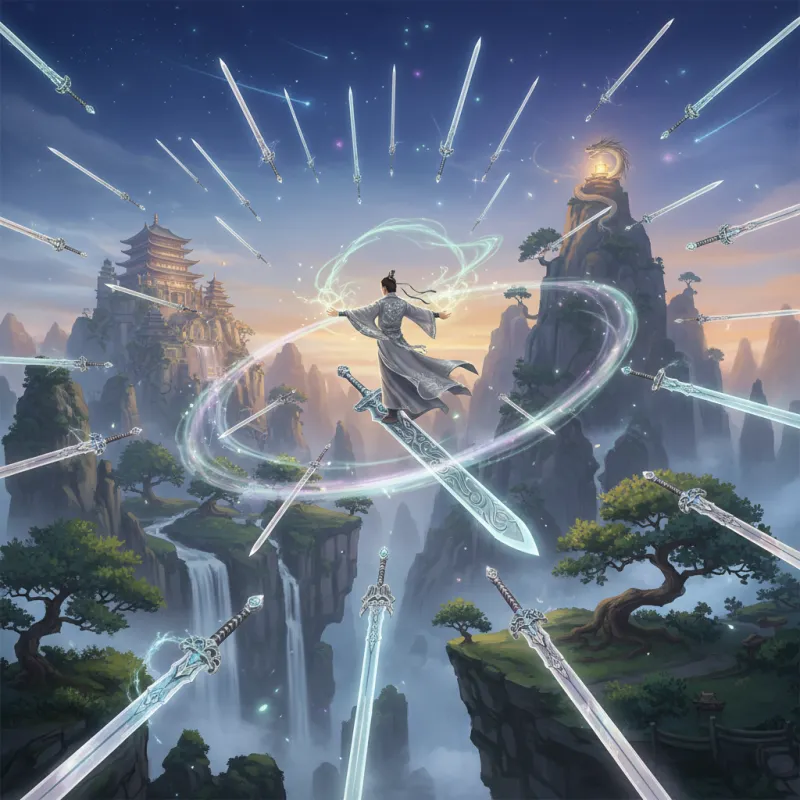
Ask any cultivator what separates a mortal swordsman from an immortal, and they'll point to the sky. The moment a sword leaves your hand and obeys your will across a hundred li, you've crossed a threshold that no amount of martial training can reach. Flying swords (飞剑 fēijiàn) aren't just weapons — they're the dividing line between those who walk the earth and those who command it.
The Shu Mountain Legacy
Flying swords entered Chinese popular imagination through Huanzhulouzhu's Legend of the Swordsmen of the Mountains of Shu (蜀山剑侠传 Shǔshān Jiànxiá Zhuàn), serialized from 1932 to 1948. This wasn't some minor work — at over five million characters, it defined what sword cultivation meant for generations. Huanzhulouzhu described swords that could split into thousands of rays of light, pierce through mountains, and return to their master's hand across impossible distances. Every modern cultivation novel owes him a debt, whether the authors know it or not.
But here's what most readers miss: Huanzhulouzhu was synthesizing older traditions. Daoist immortal tales from the Tang and Song dynasties already featured immortals riding swords or transforming them into dragons. The Investiture of the Gods (封神演义 Fēngshén Yǎnyì) from the Ming dynasty had Jiang Ziya's disciples wielding supernatural blades. What Huanzhulouzhu did was systematize it — he created rules, hierarchies, and a progression system that web novelists would later refine into the cultivation realms we know today.
Sword Cultivation vs. Sword Wielding
Here's where new readers get confused: not every cultivator with a sword is a sword cultivator (剑修 jiànxiū). A body cultivator might carry a blade. A formation master might use swords as array anchors. But a true sword cultivator stakes everything on the sword itself — their cultivation method, their combat style, their very dao (道 dào).
The difference shows in how they refine their weapons. Most cultivators treat weapons as tools, upgraded when they find better materials or reach higher realms. Sword cultivators bond with a single blade, feeding it their spiritual energy (灵气 língqì) and blood essence (精血 jīngxuè) over decades. The sword becomes an extension of their consciousness. In A Record of a Mortal's Journey to Immortality, Han Li encounters sword cultivators whose blades respond to killing intent before their masters even form the thought. That's not technique — that's symbiosis.
The cultivation method matters too. Sword cultivators typically practice sword intent (剑意 jiànyì), a mental state where the sword becomes an expression of will rather than a physical object. Lower realms focus on sword qi (剑气 jiànqì) — projecting cutting force through the blade. Middle realms develop sword light (剑光 jiànguāng), where the sword moves independently. Upper realms achieve sword domain (剑域 jiànyù), where the cultivator's will transforms space itself into cutting edges. Each stage requires the cultivator to fundamentally reconceptualize what a sword is.
The Refining Process
Creating a flying sword isn't like forging a mortal blade. The process combines weapon refining with spiritual cultivation in ways that would horrify a traditional blacksmith. Most sword cultivators start with a base material — meteoric iron, ten-thousand-year cold jade, phoenix bone — something that can channel spiritual energy without shattering.
Then comes the blood binding (血祭 xuèjì). The cultivator feeds the sword their blood essence, creating a connection that transcends normal master-weapon relationships. This isn't symbolic — the sword literally becomes part of their cultivation base. Damage the sword, damage the cultivator. Destroy the sword, and you might cripple their foundation permanently. It's why sword cultivators are simultaneously the most dangerous and most vulnerable specialists in any sect.
The refinement continues throughout the cultivator's life. Each breakthrough in cultivation realm requires re-tempering the sword with higher-grade materials and more refined spiritual energy. A Foundation Establishment sword won't survive Core Formation energies. A Nascent Soul cultivator needs a blade that can withstand their soul's pressure. This is why ancient swords passed down through generations are so valuable — they've been refined through multiple realms and carry the accumulated insights of previous masters.
Some sects practice sword nurturing (养剑 yǎngjiàn), where disciples keep their swords in specialized formations that feed them spiritual energy constantly. Others prefer the harsh method — exposing swords to tribulation lightning, demon beast cores, or even other cultivators' sword intent. The Shu Mountain Sword Sect in countless novels favors the latter, believing that swords, like cultivators, grow strongest through adversity.
Sword Flight Mechanics
Every cultivation novel handles sword flight differently, but certain principles recur. At the most basic level, flying on a sword requires three things: a blade refined to accept spiritual energy, enough cultivation to maintain the energy flow, and the mental discipline to control movement while standing on something the width of your foot.
Most novels place sword flight around Foundation Establishment realm, though some allow it earlier with specialized techniques or treasures. The logic makes sense — you need enough spiritual energy to both levitate the sword and maintain a protective barrier against wind resistance. Try flying at a thousand li per hour without a barrier, and you'll understand why Golden Core cultivators can cross continents while Foundation Establishment disciples stick to short hops.
The actual mechanics vary wildly. Some novels have cultivators standing on the flat of the blade, others on the spine, still others somehow balanced on the edge without bisecting themselves. The most common explanation involves a thin layer of spiritual energy between foot and sword, which also explains how cultivators don't slip off during aerial combat. Though honestly, if you're the type to worry about friction coefficients during a sword duel at ten thousand feet, cultivation novels might not be for you.
Speed increases with realm, naturally. A Foundation Establishment cultivator might manage a few hundred li per hour. Core Formation pushes into thousands. Nascent Soul cultivators can cross provinces in a day. And Deity Transformation or higher? They're essentially teleporting with extra steps. I Shall Seal the Heavens has Meng Hao eventually moving so fast on his sword that he arrives before he leaves, which is either profound dao insight or the author having fun with relativity.
Combat Applications
Here's what makes sword cultivators terrifying in combat: their weapon is already airborne. While a body cultivator needs to close distance and a spell cultivator needs casting time, a sword cultivator's blade is already moving, already cutting, already everywhere their intent directs it.
The basic technique is sword control (御剑 yùjiàn) — directing the blade through spiritual sense. Novices manage crude movements, like throwing a knife with your mind. Masters achieve what the novels call "sword following intent" (剑随意动 jiàn suí yì dòng), where the sword moves the instant they conceive of the movement. No delay, no telegraphing, just thought becoming cutting edge.
Then there's sword multiplication (剑化万千 jiàn huà wànqiān), where one sword becomes ten, becomes a hundred, becomes a storm of blades. Most of these are illusions or qi projections, but even illusions can kill if they're sharp enough and backed by sufficient spiritual energy. The trick is identifying the real sword among the copies — which is why experienced cultivators learn to sense the blood binding connection rather than trust their eyes.
Advanced techniques get esoteric. Sword arrays (剑阵 jiànzhèn) use multiple swords as formation anchors, creating spaces where the cultivator's sword intent becomes environmental law. Formation masters spend lifetimes perfecting these, but sword cultivators can improvise crude versions in combat. Sword domains, mentioned earlier, take this further — the cultivator doesn't need physical swords at all, just the concept of cutting imposed on reality itself.
The ultimate technique, referenced in countless novels but rarely achieved, is the sword transforming into a dragon (剑化龙 jiàn huà lóng). The sword gains semi-sentience, moving with its own intelligence while remaining bound to the master's will. At this level, the distinction between cultivator and sword becomes philosophical rather than practical.
Famous Swords and Their Cultivators
Coiling Dragon's Linley doesn't use traditional flying swords, but his Bloodviolet Godsword demonstrates the principle — a weapon that grows with the wielder and eventually transcends physical limitations. Desolate Era's Ji Ning practices sword dao to such extremes that his sword intent can cut through fate itself, which is either the pinnacle of cultivation or the author running out of things for swords to slice.
The most iconic might be A Will Eternal's Bai Xiaochun, who somehow turns sword cultivation into comedy without diminishing its power. His swords are terrifying precisely because he treats them like mischievous pets rather than sacred weapons, which says something about the flexibility of sword dao.
But for pure sword cultivation philosophy, Renegade Immortal's Wang Lin stands apart. His sword isn't the strongest or fastest, but it carries the weight of his experiences — every betrayal, every loss, every moment of despair refined into cutting intent. That's what separates memorable sword cultivators from forgettable ones: the sword reflects the person wielding it.
Why Swords Specifically?
You might wonder why swords dominate when sabers, spears, and axes exist in cultivation fiction. Part of it is cultural — the jian (剑 straight double-edged sword) holds special status in Chinese culture as the "gentleman of weapons," associated with scholars and nobility rather than common soldiers. Confucian scholars wore swords as status symbols. Daoist immortals carried swords as ritual implements.
But there's a practical reason too: swords have two edges and a point, offering more cutting surfaces for spiritual energy to flow through. The straight blade allows for cleaner energy channeling than a curved saber. The balance point makes them easier to control remotely than top-heavy axes or flexible whips. When you're manipulating a weapon through thought alone, these details matter.
That said, plenty of novels feature saber cultivators, spear immortals, and even the occasional halberd master. They're just rarer, which makes them memorable when done well. The principles remain similar — bond with the weapon, refine it through realms, develop intent and domain. The sword just has a few thousand years of cultural momentum behind it.
The Modern Evolution
Web novels have taken flying swords in directions Huanzhulouzhu never imagined. Some novels treat swords as programmable artifacts, loaded with formations and restrictions like spiritual computers. Others go biological, with swords that eat demon cores and evolve like spirit beasts. Forty Millenniums of Cultivation even has technological flying swords powered by crystalline engines rather than spiritual energy, which is either heresy or innovation depending on your perspective.
The core fantasy remains unchanged: mastery over a weapon so complete that it becomes an extension of self, and the freedom to soar above the world on a blade of your own making. Every cultivator's journey is different, but the moment they first stand on a sword and rise into the sky? That's universal.
Related Reading
- Weapon Spirits: When Your Sword Has a Personality
- Weapon Spirits: When Your Sword Has Opinions
- Weapon Grades in Cultivation Fiction: From Mortal Iron to Divine Artifacts
- Weapon Refining in Cultivation Fiction: Forging Swords That Think
- Weapon Refining in Cultivation Fiction: Why Your Sword Has a Soul
- Pill Refining in Cultivation Fiction: Chemistry Meets Mysticism
- Unraveling the Essence of Tribulations in Chinese Cultivation Fiction
- Auction Houses in Cultivation Fiction: Where Power Is Bought and Sold