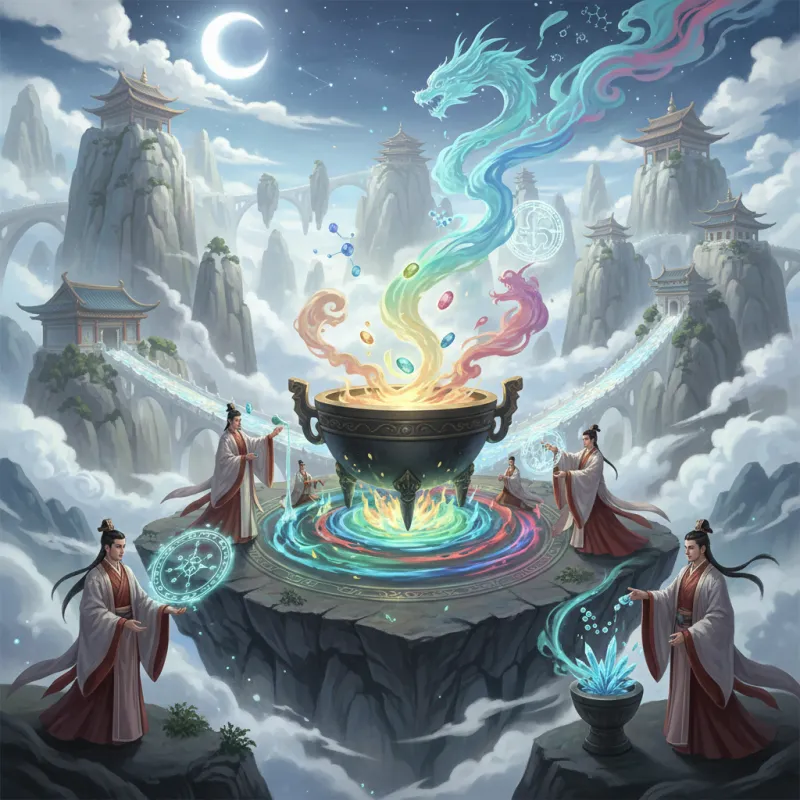
The cauldron explodes. Again. The young alchemist staggers back, face blackened with soot, another month's worth of spirit herbs reduced to acrid smoke. In Coiling Dragon, I Shall Seal the Heavens, and countless other cultivation novels, this scene repeats with almost ritualistic frequency—because pill refining (炼丹, liàndān) isn't just cooking with magic ingredients. It's a delicate dance between chemistry, spiritual energy manipulation, and split-second timing where a single mistake can waste resources worth more than a mortal kingdom.
The Alchemical Foundation
Western readers often miss this, but Chinese pill refining has deep roots in actual Daoist alchemy (外丹术, wàidān shù—external alchemy). Historical figures like Ge Hong (葛洪, 283-343 CE) wrote detailed treatises on creating elixirs of immortality using mercury, lead, and cinnabar. These weren't fantasy—they were serious scientific attempts that, ironically, probably poisoned more people than they saved. When Er Gen writes about Meng Hao's pill concoctions in I Shall Seal the Heavens, he's drawing on a tradition where emperors literally died from consuming "immortality pills" loaded with heavy metals.
The fictional version keeps the procedural complexity while adding spiritual energy as the crucial variable. In A Record of a Mortal's Journey to Immortality, Han Li's success as a pill refiner stems from his meticulous attention to both the chemical properties of herbs and the flow of spiritual energy through his cauldron. It's not enough to know that Goldflame Grass (金焰草, jīnyàn cǎo) contains fire-attribute essence—you need to understand how heat breaks down its cellular structure, when to add complementary ingredients, and how to infuse your own spiritual sense to guide the reaction.
The Three Stages of Refinement
Every pill refining session follows a predictable arc, though the details vary wildly by the cultivator's skill level and the pill's grade.
Purification (提纯, tíchún) comes first. Raw spirit herbs contain impurities—mundane plant matter, conflicting energies, environmental contamination. The refiner must burn away the dross while preserving the essential medicinal properties. In Martial World, Lin Ming discovers that his Phoenix flames allow him to purify ingredients to 99% purity, far beyond what most refiners achieve. This isn't just showing off—higher purity means stronger pills with fewer side effects. A poorly purified Foundation Establishment Pill might help you break through, but it'll also saddle you with erratic qi flow for decades.
Fusion (融合, rónghé) is where most failures occur. Different ingredients have different melting points, reaction speeds, and spiritual affinities. Add the Yin-attribute herb too early, and it'll be destroyed by the Yang-attribute flame. Wait too long, and the primary ingredient loses potency. In Tales of Demons and Gods, Nie Li's advantage comes partly from his knowledge of precise timing—he knows that Scarlet Flame Dragon Grass must be added exactly three breaths after the cauldron reaches 800 degrees, not before, not after.
The real chemistry happens here. Ingredients don't just mix—they transform. Spiritual energy acts as both catalyst and reagent, breaking molecular bonds and forming new compounds that couldn't exist in the mundane world. When done correctly, the separate ingredients lose their individual properties and become something greater. When done incorrectly, you get an explosion.
Condensation (凝丹, níngdān) is the final test. The refiner must compress the liquid medicinal essence into solid pill form while sealing the spiritual energy inside. This requires perfect control—too much pressure and the pill cracks, too little and it remains a useless paste. The best refiners can create pills with distinct patterns on their surface (丹纹, dānwén—pill veins), visible proof of the energy circulation pathways locked within. In Martial God Asura, Chu Feng's ability to create nine-veined pills marks him as a genius, since most refiners struggle to achieve even three veins.
The Cauldron Question
Here's something most novels gloss over: the pill cauldron (丹鼎, dāndǐng) matters as much as the refiner's skill. A trash-tier iron cauldron will contaminate your pills with metallic impurities and can't withstand the temperatures needed for high-grade refinement. Meanwhile, a cauldron forged from Profound Heaven meteorite iron, inscribed with formation arrays, and tempered in dragon flame becomes a treasure that sects go to war over.
The cauldron serves multiple functions. It's a reaction vessel, yes, but also a spiritual energy regulator, a heat distributor, and a containment field for volatile ingredients. In Against the Gods, Yun Che's Sky Poison Pearl gives him an advantage because it functions as a perfect cauldron—maintaining ideal conditions automatically and preventing contamination. Most refiners aren't so lucky. They spend years learning their cauldron's quirks, understanding how heat distributes across its surface, where hot spots form, how quickly it responds to spiritual energy input.
Advanced cauldrons have formation arrays carved into their inner surfaces. These arrays can stabilize volatile reactions, enhance specific elemental properties, or even provide feedback to the refiner about the pill's progress. The difference between a basic cauldron and a treasure-grade one is like comparing a campfire to a modern laboratory—both can cook food, but only one gives you precise temperature control and real-time monitoring.
Flame Mastery
Every pill refiner needs a flame, and not just any flame will do. Ordinary fire lacks the spiritual energy needed to properly transform high-grade ingredients. This is why flame types and their properties become such a crucial subplot in many novels.
Beast flames (兽火, shòuhuǒ) come from powerful spirit beasts and carry their elemental affinities. A flame from a Scarlet Phoenix provides intense Yang energy, perfect for refining pills that boost vitality or combat poison. A flame from a Frost Dragon offers controlled cold-fire, ideal for preserving delicate Yin-attribute herbs during refinement.
Earth flames (地火, dìhuǒ) emerge from deep underground, where spiritual energy concentrations create natural furnaces. These flames are stable and long-lasting but difficult to control. In Stellar Transformations, Qin Yu discovers an ancient earth flame that becomes his primary refining tool, though he spends months learning to modulate its intensity.
Heaven flames (天火, tiānhuǒ) are the rarest and most powerful—flames born from cosmic phenomena or ancient tribulations. A refiner who controls a heaven flame can attempt pills that others wouldn't dare, because these flames can break down and reconstruct matter at a fundamental level. When Xiao Yan in Battle Through the Heavens absorbs multiple heaven flames, his pill refining ability skyrockets not just because of the raw power, but because different flames let him handle different ingredient types with optimal efficiency.
The Economics of Pills
Let's talk about why pill refiners are richer than most sect masters. The success rate for pill refining is abysmal. A novice refiner might fail nine times out of ten when attempting a new recipe. Even masters rarely achieve 100% success rates on high-grade pills. This means that for every successful pill, multiple sets of expensive ingredients went up in smoke.
The market responds accordingly. A single Foundation Establishment Pill might require ingredients worth 10,000 spirit stones, but sell for 50,000—because the refiner needs to cover their failures. High-grade pills have even more extreme markups. A Nascent Soul Pill could cost millions of spirit stones, and cultivators will pay it because the alternative is being stuck at their current realm forever.
This creates a fascinating economic dynamic. Pill refiners can demand payment upfront, keep any extra pills they produce beyond the commission, and still have customers lining up. In Renegade Immortal, Wang Lin's ability to refine pills becomes his primary source of income and political leverage. He doesn't need to fight for resources—people bring resources to him, begging for his services.
The really smart refiners don't just sell pills—they sell knowledge. A single pill recipe can be worth more than a mountain of finished pills, because it represents reproducible value. This is why pill formulas and their origins are guarded more carefully than martial techniques in many novels.
The Spiritual Sense Factor
Here's what separates adequate refiners from true masters: spiritual sense (神识, shénshí) manipulation. During refinement, a skilled alchemist extends their spiritual sense into the cauldron, monitoring every ingredient's transformation in real-time. They can feel when the Goldflame Grass reaches optimal temperature, sense when the Yin-Yang balance starts to tip, and detect impurities that would be invisible to the naked eye.
This is exhausting. Maintaining that level of focus for hours—because high-grade pills can take days to refine—drains spiritual energy faster than most combat techniques. In Desolate Era, Ji Ning discovers that his powerful soul gives him an unexpected advantage in pill refining, because he can maintain detailed spiritual sense monitoring far longer than cultivators at his level normally could.
The best refiners develop what amounts to a sixth sense for pill refinement. They know when something's wrong before conscious thought catches up. The temperature feels slightly off. The energy flow has a subtle hitch. The fusion is progressing too quickly. These intuitions come from thousands of hours of practice, from countless failures, from developing an almost intimate relationship with the refinement process.
Modern Innovations and Ancient Wisdom
Contemporary xianxia novels have started playing with the pill refining formula in interesting ways. In Reverend Insanity, Fang Yuan treats pill refining as just another tool, approaching it with cold calculation rather than reverence. He'll deliberately create "flawed" pills if they serve his purposes, or combine ingredients in ways that traditional refiners consider heretical.
Lord of the Mysteries takes a different approach, blending Western alchemy with Eastern cultivation concepts. Klein's potion-making follows similar principles to pill refining—precise ingredients, careful timing, spiritual energy manipulation—but the cultural framework is entirely different. It's a reminder that the core concepts of alchemical transformation are nearly universal, even if the execution varies.
The tension between innovation and tradition runs through most pill refining narratives. Ancient recipes are treated as gospel, passed down through generations, but the protagonists who succeed are usually the ones willing to experiment. They'll substitute ingredients, adjust temperatures, or add unexpected components—and either create revolutionary new pills or blow up their cauldrons. Usually both, in sequence.
This mirrors real scientific progress. The historical Daoist alchemists who killed themselves with mercury pills weren't stupid—they were experimenting at the edge of their knowledge, trying to push beyond established limits. The fictional pill refiners who achieve breakthroughs do the same thing, just with better survival rates and more dramatic explosions.
Related Reading
- Pill Refining: The Alchemist's Art in Cultivation Fiction
- The Pill Refining Hierarchy: From Mortal Medicine to Heaven-Defying Elixirs
- The Most Famous Pills and Elixirs in Cultivation Fiction
- Herb Gathering: The Dangerous Art of Finding Rare Ingredients
- Heavenly Tribulation: Why Lightning Strikes the Powerful
- Spirit Beasts in Cultivation Fiction: A Bestiary
- The Allure of Chinese Cultivation Fiction: A Journey Through Immortal Realms